Baker, Chocolatier… Ol’ Fashioned Goodness

The factory buzzes with activity as I ensure each batch meets the highest quality standards. There’s a delightful aroma that fills the air, making the environment both inviting and indulgent. Blending some creativity and attention to detail, truffles, toffee, and flavorful cream filled chocolate pieces await customers at the Old Fashioned Candy Store.

In between my clinical work in Colorado and my adjunct work at the local community college in Illinois, I spent a over a year working at a local neighborhood chocolate factory. Opening its doors in 1969, the candy store continues to serve the community. I remember going into this store with my grandparents, buying candy for a dime and sitting on the bench watching the cars and people stroll by. Fast forward, I found myself employed by the same candy store, a far stretch from my clinical work.

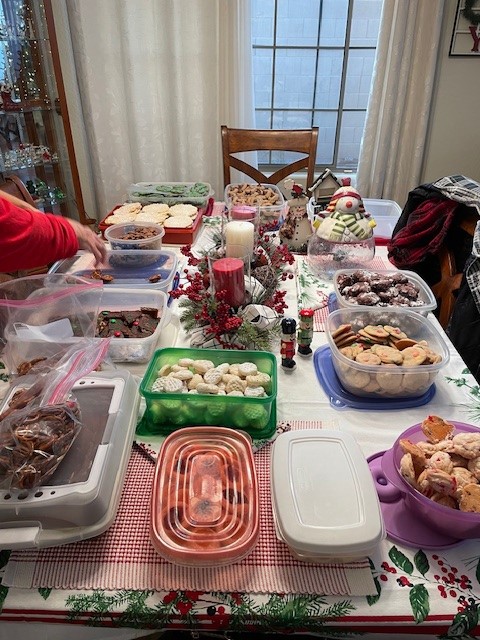
To this day, I enjoy baking; Christmas cookie baking is a big ordeal- 15-18 different kinds of cookies and a newly recruited team of nephews learning the ‘trade.’ While i don’t consider myself creative, I hardly ever bake the same thing twice.

Working at the the Old Fashioned Candy Store and spending time baking in my home kitchen, I feel a sense of relaxation and peace. Something about escaping into the indulgence of chocolate and bakery drives me to always sweeten things up.

Unconventional Lesson: A Moment That Defines My Approach to Education

If you had asked me years ago how I felt about school, my response would have been less than enthusiastic. School was not a place of excitement for me; in fact, it was a struggle to stay engaged unless something truly piqued my interest. I was academically ahead, yet the challenge of schoolwork failed to hold my attention. But one particular experience stands out—a moment that, while negative, has profoundly shaped how I approach teaching today.

As a child, I remember the routine of walking up to the board in math class, as we all did back then, to solve problems on the board in front of everyone. It was during these horrifying moments that my teacher would consistently and publicly point out that I was “doing it wrong.” My mistake? I wrote my numbers from right to left instead of the conventional left to right. This was never a conscious choice, just the way my brain processed numbers. And yet, rather than guiding me with understanding, my teacher reinforced that my way was incorrect, making me feel abnormal.

At the time, I didn’t see the issue—after all, my numbers still appeared in the correct order. But that persistent criticism instilled a deep-seated fear of numbers in me, one that lingers even today. I avoid writing long numbers on the board whenever possible, a habit born from years of internalized anxiety. Looking back, I now recognize that this teacher’s approach was not only unhelpful but also harmful. However, in an odd way, I am grateful for the experience because it has given me a profound awareness of how students feel when they don’t fit the mold.

This awareness has become the foundation of my teaching philosophy. In my classroom, kindness is a rule, not a suggestion. I emphasize the importance of embracing differences because it is often those who think differently who drive innovation and progress. I want my students to feel seen, heard, and respected—not for how they conform, but for what they uniquely bring to the table.

Education should not be about forcing students into a singular mode of thinking; it should be about fostering creativity, curiosity, and confidence. My journey has taught me that learning is not about getting everything “right” but about discovering new ways of understanding the world. So, if a student in my class approaches a problem in an unconventional way, I celebrate it. Because breaking the mold isn’t a flaw—it’s the spark of something extraordinary.

“It’s Complicated”

heart shaped images
Photo by freestocks on Unsplash

Like many educators, my initial reaction to AI was visceral rejection. When ChatGPT joined the scene in Nov. 2022, I felt shock and isolation. Would my assignments become obsolete? Would my role as an educator be reduced to managing prompts and outputs? Was my job going to turn into the philosophy I slip into in tough times–“shit in, shit out”? I’ll admit it—I had a minor panic attack about the future of my career as a composition teacher.
But I was curious. I started experimenting with AI tools like Claude, Poe, and Perplexity. I could see an appeal. I saw them assisting in tasks that would typically take a long time. I got a little excited about the possibilities. AI could free up time for more meaningful student interactions or help me with RSI. Maybe it could help level the playing field for learners who struggle with specific tasks. I became more enthusiastic and eager to share these tools with colleagues and students.
Then I got deeper into the AI ecosystem after reading numerous books; I started to see some complexities lurking beneath the surface. The environmental cost of training large language models is staggering—the water and energy consumption is similar to that of small cities. Then there’s the human cost: the invisible labor force in the Global South, working under challenging conditions to label data and moderate content. These AI systems, while impressive, are potentially widening the digital divide between those who have access to cutting-edge technology and those who don’t.
I am adopting a more nuanced stance now. I still use AI tools, but with greater intentionality. I am trying to balance their benefits with their drawbacks, and I’m trying to be thoughtful about how I present them to my students. Instead of positioning AI as either a threat or a salvation, I frame it as a complex technology that requires critical engagement.
My relationship with AI has evolved from rejection to enthusiasm to careful consideration. The relationship is not over, and I’m not sure where it will head next. I want to help my students understand the tools but also to think critically about their use. So my relationship status remains: “it’s complicated.”

A Magnetic Tradition

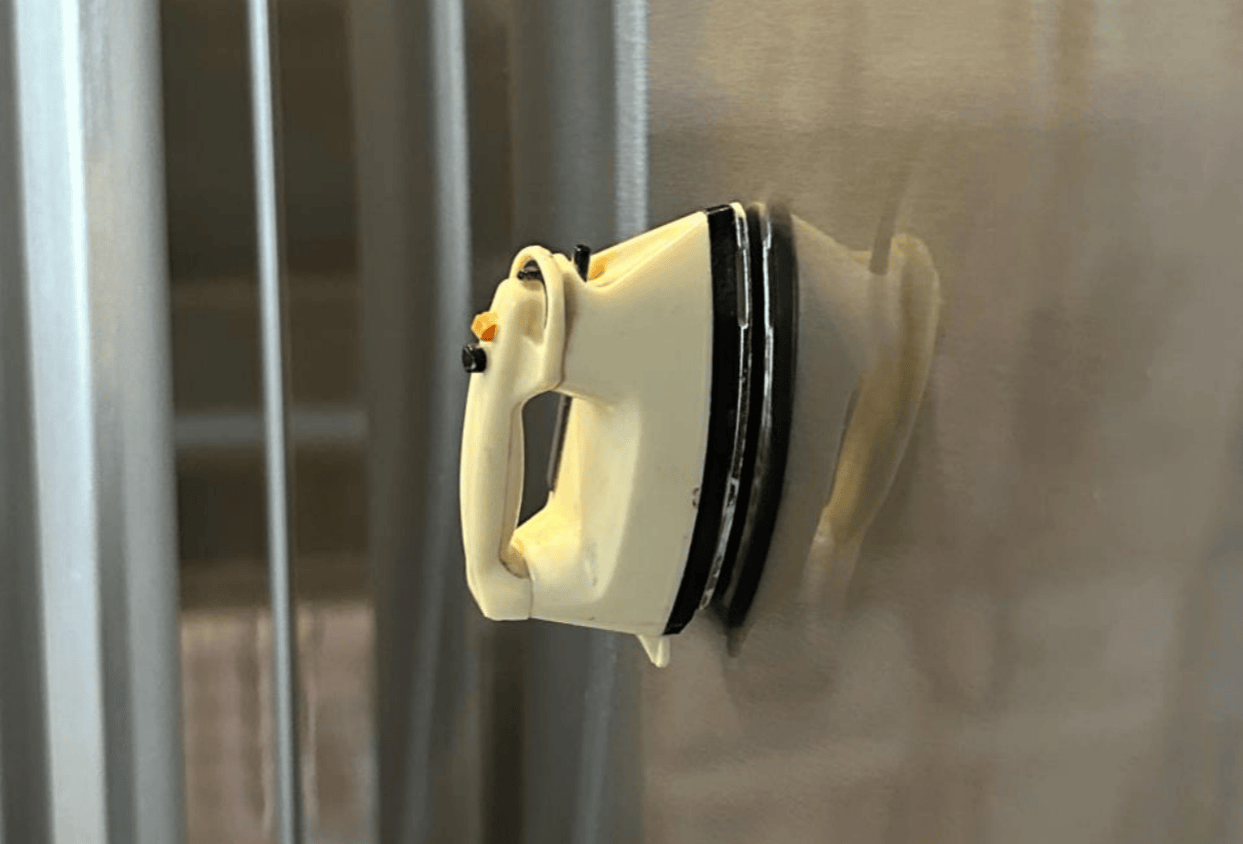
Forty (40!) years ago this fall, I received this refrigerator magnet as a gift:

Why would I still have this magnet, and why would I remember the year it was given to me? It dates back to the fall of 1985, when I was an elementary education major at ASU. One of the courses I took that semester was a social studies teaching methods course.

The course itself was not remarkable. I do remember a project where my group was assigned to teach a lesson to the rest of the class on how history is recorded. We broke the class up into smaller groups and placed them in surrounding classrooms. Our professor had a meltdown of historic proportions when she realized we left some of our “students” unsupervised. It was the first (and last) time a professor ever yelled at me. (I also had a TA throw a book at me that year, but that’s a story for another day.)

On the last day of the semester, though, this same professor gathered us all in a circle. She had each of us reach into a bag and take out a magnet. She then explained that, as teachers, we would receive many gifts from students in the future (and, by the way, a lot of them would be magnets!) She wanted to show her appreciation for our hard work by being the first one to present us with a “teacher gift.”

It was a moving moment, and one that stuck with me.

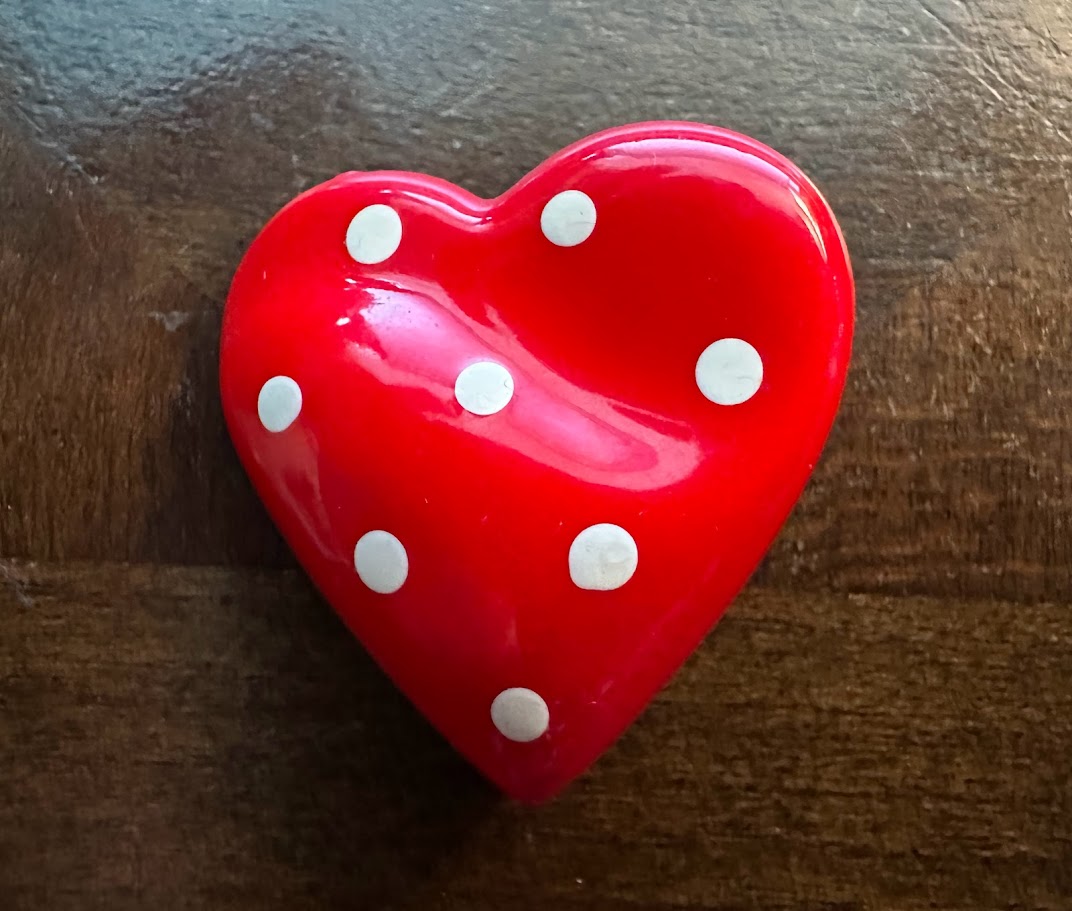
Years later, I found myself in a professional learning seminar about teaching with heart. At the end of the multi-day workshop, the presenter gave us all heart pins to remember the important insights we had gained together:

I’ve thrown away a lot of crap things in my life, but I’ve held on to this heart pin for the last 25 years.

In the book The Power of Moments, authors Chip and Dan Heath would describe both of these experiences as “defining moments” – meaningful experiences that stand out in our lives. The authors share four elements that can create a defining moment:

  • Elevation – moments that rise above the everyday and “break the script” of what’s usual
  • Insight – moments that rewire our understanding of the world
  • Pride – moments of achievement and/or courage
  • Connection – moments we share with others

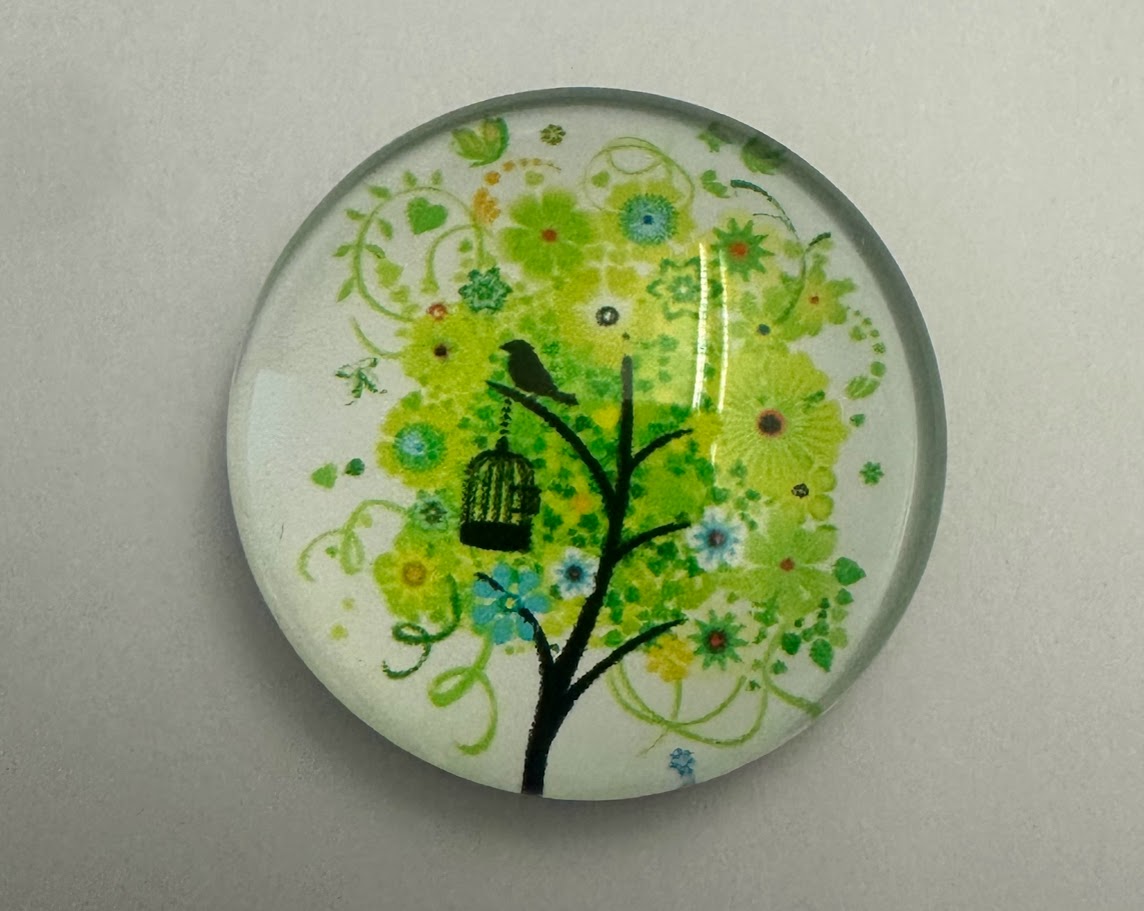
I believe the act of sharing a small token in a ceremony has the potential to include all the elements of a defining moment. As such, I’ve been inspired by these experiences to create a similar tradition in my courses. For example, I teach Educational Psychology, which is a first block course in GCC’s BAEE program. At the end of the course, I, too, give magnets to my students:

I offer the same sentiment to my students about wanting to give them their first teacher gift. The energy in the room is palpable as students take in the importance of the moment. There is, dare I say, a sacred feel to this tradition.

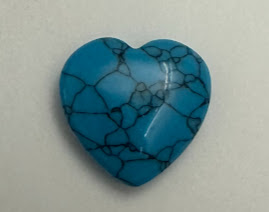
For my Positive Psychology students, we have a similar ceremony, but instead I share smooth heart-shaped rocks:

In every ceremony I’ve conducted, I’ve seen students’ faces soften and I’ve sensed hearts open as they experience a little elevation, insight, pride, and connection. And after the ceremony, I have significantly more students coming up to thank me for the semester.

And by the way, I feel nothing but affection for that professor from 40 years ago (not so much the book-throwing TA). After all, I never, ever left an elementary student unsupervised, and perhaps I have her to thank for that. But I am grateful that she modeled how to have a defining moment in a closing ceremony and that she gave that to me to share with my students.


For more information on using The Power of Moments in higher education see this Teaching Tip.

Show and Tell: It’s Not Just for Kindergartners

I’ve been teaching at GCC for 20 years and have tried a lot of best practices and trends in my teaching: gamification, flipped classrooms and project learning are just a few. However the best teaching trick I ever introduced to my class is my version of Show and Tell. 

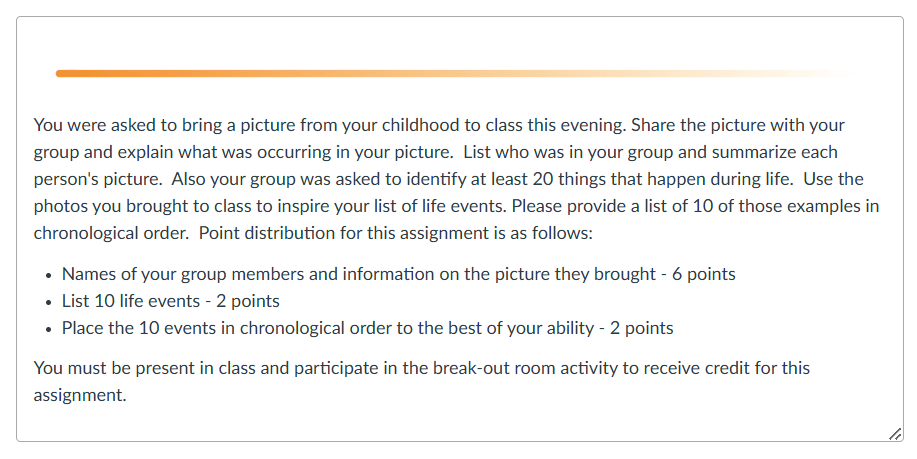
Every week students are asked to bring something from their home to share and discuss during class.  I select specific items each week for either a purpose or to relate the item to the content being covered for lecture. For example, on the first night of class, I ask students to wear their favorite shirt, hat, or piece of jewelry to encourage students to want to have their cameras on during our live online class. Week two they bring their favorite snack for the discussion on Sensation and Perception. For the week we cover Lifespan Development, students are asked to bring a picture of themselves during their childhood. For Memory week, they are asked to bring a family heirloom or something they want to pass down to future generations. Every week I put the students into breakout rooms where each student has a turn to share what they brought that week with some of their classmates. During break-out sessions, students share their item and the story behind the item. Students then submit an assignment where they list who was in their group and describe the item they brought. I refer to these break-out sessions as In-Class Activities, and here is an image of one of these assignments.  

Just because I think this is a great idea, doesn’t mean that it is. However here is what students had to say when asked about their favorite sharing activity.

  • My favorite thing overall about the class was sharing activities
  • My favorite sharing theme was the collections. Seeing people’s items was cool but hearing the stories behind them is why it was so memorable. I still remember my group mates concert shirts, butterfly themed items, and baking supplies.
  • I loved hearing about everyone’s achievements, and it was really uplifting to see all the amazing things my classmates have accomplished. Plus, hearing the teacher’s encouraging words at the end, made it even more special. 
  • My favorite theme is the most recent one talking about our collections and why they started. I enjoyed this one because it showed me more about my classmates and what they enjoy. I got to see some really cool legos and hear about books that are different from what I’m used to. 
  • I enjoyed every breakout session and sharing activities; talking with everyone and discussing various topics was delightful. 
  • My favorite sharing theme was the toy theme, I enjoyed seeing all the little tiny toys that my classmates have. It was my favorite theme because it made me relate to my classmates in that they also had little toys on hand with them.
  • My favorite theme was also our most recent when everyone brought something they’re proud of. I think knowing what someone is proud of tells you a lot about their life and personality, and it was fun learning that about people.
  • My favorite breakout session theme was when we all had to bring a favorite picture of ourselves and explain it. I loved learning about my classmates lives
  • I’m going to be honest, all the sharing activities were interesting and informative because they all related to the topic we were learning about for the week. It was also very interactive because the people I had in my breakout room not only participated, but I was able to get their opinion about the topic and could even ask for their input about certain concerns I would have and vice versa.
  • My favorite sharing subject from the weekly small group breakout sessions was “Memories from Childhood.” This subject promoted a feeling of understanding and connection among group members by enabling a sentimental journey into everyone’s history. Talking about our early years brought up a variety of feelings, from reflection to laughter, and gave us an insight into the early events that shaped the people we are now. This topic was the most enjoyable to me since it sparked meaningful stories and strengthened the group’s sense of friendship.

Show and Tell allows my students to connect with each other and build community in a virtual space. They are given a space where they can share personal stories and life dreams with their classmates. Although in-person class time is limited, I encourage everyone to create some time during the semester to give students that space to build friendships. If you are interested in ideas for Show and Tell themes, send me an email and we can surely come up with some fun ideas! 

Creating Community With STEM Connect

Article By: Cecily Davis, STEM Connect Analyst

At STEM Connect, we believe that community is the heart of the college experience. Whether it’s guiding students through the early days of their journey, celebrating milestones, or offering support when challenges arise, we’re here to ensure no one navigates it alone. Our seasonal programs create opportunities for students, faculty, and staff to connect, build lasting relationships, and grow together. In a space that can sometimes feel overwhelming, we strive to cultivate an environment where everyone feels welcome, supported, and celebrated. By coming together, we make the STEM experience not just about academics, but about fostering a sense of belonging and shared success.

The joy of Arizona Summer – bright, hot, and sticky! But there’s a cool way to enjoy it at STEM Connect: the Summer Bridge Program! The Summer Bridge program keeps students comfortable with ambient lighting, and our Advising Team ensures they stay sticky-free! With so much information out there, some of which may or may not be accurate, our team hosts a three-day Summer Bridge program to guide students in the right direction. Navigating the college experience can be overwhelming, but we ensure students leave with a stronger sense of community within STEM. And of course, no one goes hungry – there’s always food and refreshments at our events!

Let’s talk about our start-of-season and end-of-season events! As we transition between the Fall and Spring semesters, we love to celebrate! Welcoming students at the start of their semester journey shows that we care about their new beginnings – whether they’re starting a new program or continuing one. It also helps them feel excited about what’s ahead, knowing they have the support of their STEM community. At the end of the semester, we’ve learned that it’s just as important to celebrate course completion! Many students go through semester after semester without recognition, so we’ve made it a tradition to acknowledge their hard work, reward them, and come together. Success is not only determined by degree completion; it’s also about completing the semester goals students set for themselves. By celebrating, we invite students and faculty to join us at the STEM Connect center to connect over semester accomplishments. We play games, win prizes, take pictures, and offer freebies and raffles! Again, we have plenty of refreshments!

The last season of events – Spring! The lovely Spring Break: a time to recoup, rejuvenate, and reset. It’s also a time for midterms, spring cleaning, and all those to-dos. But what better way to bring back the excitement than with a day of Spring Fling events! STEM Connect coordinates a series of tables representing various STEM departments, clubs, and organizations, along with advisors, tutors, peer success coaches, university transfer reps, and STEM-related organizations such as the Military and the SciTech Institute. Whew! That was a long sentence!

We also started a brand-new tradition last year: hosting a reception for STEM students days before they walk across the stage at graduation. Yup, another party! The STEM Grad Reception is an opportunity for students and faculty to celebrate degree completion with food, fancy mocktails, pictures with loved ones or their support teams, and a Certificate of Achievement personally designed by STEM Connect. We hope you enjoyed our Scenic Route of STEM Connect, which embraces a sense of community and togetherness for STEM students, faculty, and staff!

ChatGPT and I are “Growing Together”

Curiosity led me to a ChatGPT prompt, ” What kind of relationship do we have?”

Apparently, ChatGPT believes, “…. we have a collaborative and supportive relationship! I’m here to help, provide information, and answer your questions, but also to learn from your preferences and adjust to your style. Think of it as a team dynamic where you’re guiding the direction, and I’m offering insights, ideas, and assistance along the way. If you need more detailed help or just want to chat, I’ve got your back.“

Reflecting, I am not sure what I think of my relationship with ChatGPT. It isn’t a love/hate relationship and we aren’t co-dependent either. I would agree that offering insights and ideas is something that ChatGPT brings to our relationship. In essence, we share experiences that shape who we are, yet we don’t necessarily influence each other’s paths directly, We are growing together. It is almost like a relationship developed out of convenience and opportunity.

I remain open-minded and optimist that ChatGPT and I will evolve into a mature and healthy partnership. Until then, we will take things slow and appreciate what each of us brings to the relationship.

Battling with AI and Community Building

I’m taking on both sides of the coin again this week, although I just have a couple of things to say about AI. First, AI has been a part of our lives a lot longer than we think or knew. Second, I’ve spent a good deal of time on voice-activated technology (think ’90s) and it should work a lot better than it does.

For example, I finally changed the female voice of Siri to a male voice because my female was taking on a bit of an attitude, if you know what I mean. Every once in a while you could tell she really thought that you should just do whatever it was you asked her to do – yourself. The male version of Siri has gotten to the point where he just simply doesn’t respond – a bit passive aggressive, it seems, especially when I ask for directions. So, AI, we’re listening, and we are silently grading your actions! (It’s kind of like silently correcting your grammar – but with more attitude)…

Now the other side of the coin is creating a community. I am happy to say that I learned from some excellent GCC instructors here to do this for my online classes. In my classroom classes I would just use my enthusiasm to help create the community, but this is all online and asynchronous – and you and the students have to build that community through the words you choose and how you say it.

My Community Building Exercise has to get going right from week 1, so it is a Discussion Assignment in Canvas, and I start with my own, relatively down-home introduction, with a photo of my family, or our puppy dog. I want them to feel comfortable and get them to want to share as well. But, between that Introduction – Tell Us a Little About Yourself, with a great selfie of a happy young woman we start off by talking about ourselves. For example, above, you see a photo from years ago of my son eating snow. When we went back to Minnesota for a wedding in December a few years ago, we had a magical snowfall, and my son got to eat snow again, one of his favorite things. It’s not something you would generally include in an introduction.

The idea of the more laid-back introduction is to open up and tell something about me (and I mostly talk about how I ended up back in Arizona, when I actually was born here — but never lived here). That’s complicated enough. This is important because we (I’m already using the “royal” we) want to welcome, encourage, and trust what we say to each other in our discussions. We are all in this together. This is what ‘we’ are working on this week…

The Introductions take us wherever it goes. I’ve already mentioned on a previous Canvas page that positive responses help to create a more positive environment – and that was one of those ideas I got from one of the GCC teachers I mentioned. I answer every student during that first week with their own public answer to their introduction, as well as answer, in the public forum, any question they ask of me.

I’ve had some fabulous students from all different study areas, coming from all over the world, and those who have never been outside of Phoenix, but the point is that we share. We share our lives, our experiences, and then we continue throughout the semester — so that it doesn’t stop right there. It’s exciting to meet all of these people! And the last thing I say to them is the last announcement of my module:

“There are no goodbyes for us.  Wherever you are, you will always be in my heart.” – Gandhi

And I include this: “This is where we leave the class.  Grades are in, scores are (mostly) high!  You did well – and you lasted the semester!  Please don’t feel that because a few years pass you cannot send me an email about this course.  I’ve had many students re-connect and say, “because of this course I did amazing things.”  Go out and be amazing!“

That’s how I end our community. The community is not over, if you want to contact me you can. And saying goodbye for me is the hardest part.

Estonian composer Arvo Pärt said to a group of us, “If you are walking down the street and you see me, don’t be afraid to say, “Hi.” I’ll appreciate the fact that you did.” Such an internationally famous composer to say something like that to us! And I’ve learned from many of my students that they changed their major because of my class, or it saved them from their difficult semester of STEM classes or I’ve been happy to run into some of my honors students and one said to me, “You were right about the university atmosphere.”

Doors? Who Needs Doors?!

There are multiple doors through which I cross before entering my current office space. My hope is that everyone who comes to my office feels welcomed as they make their way in, rather than excluded or deterred. I think about this quite a lot.

Recently, I watched a documentary about New York Times reporters covering the White House in 2017. It’s an interesting lens into that year. However, the thing that captured my attention wasn’t any particular news story, but how the Editor-in-Chief and Washington Bureau Chief each approached their workspaces. They both had offices but rarely seemed to be in them. Instead, they spent their time out on the news floor, borrowing open computers where they could find them, right in the middle of the action.

I really like this approach to offices (and the doors that lead to them) because it fosters collaboration and communication as well as inclusivity. It also begins the work of removing the hallmarks of hierarchy at a large institution like a college. As we work together in the same spaces, no single space becomes a privileged space, exclusive and reserved for only a few.

Perhaps the way to model inclusive education is to remove the doors entirely. What do you think?

Are You Feeling OK?

How are you feeling? Do you feel alone in that feeling? Do you think anyone else feels similarly to you? Would it help you to know that other people feel the same way? These are questions that motivated the tradition I started in my classes. I realized that the students were dealing with complex emotions and occasionally felt isolated by those emotions. Survey after survey has found that students are dealing with stress and loneliness, and these feelings that impact students’ mental well-being can contribute to issues with concentration, motivation, and keeping up with their coursework. So, to help students recognize, cope with, and even build connections from their emotional states, I asked them how they were feeling at the beginning of class.  

First, I started with the traditional “What’s filling your bucket, what’s draining your bucket?”.

Then, I tried a scale of pop culture icons. How are you feeling on a scale of Nicholas Cage?

Then, I moved to a scale of memes. How are you feeling on a scale of Sponge Bob memes?

And I ended up settling on a scale of animals. How are you feeling on a scale of llamas?; or dogs, cows, cats, birds, the list goes on. 

It was a small effort initially, but students began to recognize that they had a lot of shared emotions. Many students were tired, stressed, frustrated, or anxious, and they could see that other students felt the same way. At the end of the semester, I asked the students how they felt about the “emotion check,” they shared with me that they felt like they had a chance to express their feelings. Seeing other students feel similarly was comforting. They felt like it showed them that I cared about them as people. In many ways, the students expressed that they felt like the class was a community and that they felt like they were building connections with one another. 

One nice side effect of taking a survey of the students is that if I see a strong pattern, I can do a check in the class and see if I need to pivot to give them greater support. If most students choose the stressed llama, something is going on, and it might be a better use of my time to work with them on what is frustrating them. 

It doesn’t take much time. It is a fast “temperature check” that gives me a clear idea of how the students will respond in class. I find it helpful (and fun). Maybe you will, too.