Pushing Back on a College Myth

A story I have heard a lot is that college is a cold, strict place. For students, they hear “There is no late work accepted.” “You won’t get the benefit of the doubt.” “You better figure things out because you’re on your own.”  “You won’t be able to do x, y, or z in college.” The message? College is a scary place.

palm of hand pointed out

As if our first-gen students or anyone else coming to college does not already have a challenging time overcoming imposter syndrome or learning the ropes or having enough gas to get to campus or making sure they get to eat before class! This really is a myth that needs to stop. 


This myth doesn't just affect first-gen students, though they may feel its weight more than others. It affects returning students who left college once and are terrified of repeating the experience--we have many in our online classes. It affects students who grew up hearing adults talk about professors as unreachable figures. When students walk through our doors already bracing for rejection, they're less likely to ask for help, less likely to persist through a hard week, more likely to disappear quietly instead of asking for help. The myth costs us students before we even get a chance to show them who we actually are.


I talked with a student in office hours the other day who reiterated a version of this myth to me. She was truly worried about how she would be perceived for asking questions. I did my best to convince her that educators here at GCC would appreciate her asking questions; that is, after all, how students learn. People at GCC do care. They hold office hours hoping students will show up. They send emails checking in on students who've gone quiet. They build in flexibility for when a student is juggling two jobs and a sick parent at home.


How do we change the story? We can be intentional about telling a different story--starting on day one. The way we introduce ourselves, the tone of our syllabus, whether we smile when a student asks a question that's "already in the syllabus.” All of it sends a message. Counter stories don't spread on their own. We have to repeat them wherever we are able.


Grading Students or Grading Work?

My belief in rubric-based grading actually began long before I became a teacher. I was a TA in high school, and had been invited by my mentor teacher to “grade” assignments. The teacher gave me an answer key and a rubric for the assignments. I say “grade” loosely because I was really just identifying key pieces of information against a rubric.   The teacher gave the ultimate grade and score, and I never touched the gradebook. One of the memorable moments came from the reading of the short answers in the quiz on “Watership Down”. I had not read the book and could not discern whether the students met the requirements outlined by the rubric. So, I asked the instructor for a copy of the book, read it over the weekend, and then went back to “grading” the quizzes.  What I discovered was that the issue was less about my lack of knowledge and more about the rubric itself. Once I had the context I needed, I could see clearly that the rubric did not align with what the quiz question was actually asking. It was a valuable lesson, not just in content knowledge, but in how a poorly constructed rubric can undermine even a well-intentioned assessment. It was actually a very daring experience for me when I went to point out to the instructor the shortcomings of their rubric.  Luckily for me, the teacher was encouraging and received my feedback graciously, agreeing that the rubric needed revision.   

Since that time, I have been active in my approach to rubric use and invite the students to use a rubric on their own essays as a part of their peer review process.  I find that they become more capable of recognizing the requirements of an assignment and can give better feedback to their peers with a clear rubric. So, they first evaluate their own essays with a rubric and then have the opportunity to give feedback to their peers with the same rubric.  The students have consistently told me that they appreciate seeing where they might have gone in the wrong direction using the rubric.  

When I was a new teacher, I tried to be clear but fair and grade based on the students’ demonstrated skills as required by the university I worked for. I thought I was doing a pretty good job until I had a weekend grading rush. I discovered my own biases when I had a stack of papers to grade and no time to look up which paper was which. I graded fast, using my rubric and making comments on the papers, but so fast that I did not see the names on the papers until I was inputting them into the Blackboard system. That was when I realized that a student I had thought really had an understanding of the coursework was completely misunderstanding the content. The student had been so active in the class and involved in the class discussions, one of my most vocal and engaged students, that I had completely missed the fact that they didn’t really understand the content. Combined, these experiences have influenced my current grading philosophy, to grade blind and to have a clear rubric for the process. 

Shortly after my rushed grading weekend, I came across an article that discussed the “halo”  effect and the opposite of it, the “horns” effect. Teachers don’t intentionally start out having favorites, but there are always students who participate in class who may not have the strongest skills in their actual work.  The halo effect is caused when the grader allows their bias to subconsciously influence their grading based on the student’s perceived effort, participation, or behavioral compliance rather than their actual skills and knowledge. The horns effect is allowing the bias of a student’s perceived lack of effort, lack of participation, or misbehavior to influence grading subconsciously. I recognized my own epiphany reflected in the article. 

Looking back on those experiences, the rushed grading night that revealed my own bias and the weekend I spent reading a novel just to be a TA, it is clear they shaped my approach to grading. A good rubric is not just a grading tool, and blind grading is more than just a procedural safeguard. Blind grading with a good rubric is a commitment to fairness, and it protects both the student and the teacher from the very human tendency to let impressions get in the way of honest assessment.

Diversity. Equity. Inclusion. Silence

I’ve never loved a coward. I’m not specifically calling anyone a coward, but “what up doe?”

Credit: https://pixy.org/4285266/
Copyright: CC BY-NC-ND 4.0

“What up doe” (or “what up though”) is a classic Detroit greeting and colloquialism, primarily meaning “hello” or “what’s going on”. It serves as a, recognizing a person’s humanity and hustle, often used between friends, family, or as a familiar, affectionate greeting.

A court challenge to Trump’s education department directive aimed at threatening to penalize schools for practicing Diversity, Equity and Inclusion (DEI) has been successful. The Fourth Circuit court this month ruled that the directive was unlawful and put a stop to its enforcement, and low and behold, the Department of Education conceded. Talk about courage. Multiple groups of people, from educators, local governments, and civil rights groups, stood up and filed lawsuits to block these anti-DEI directives in education. And they won.

What’s that mean for MCCCD? Crickets. I smell fear. Dare I use the C word?

I wrote last year Erasing DEI at MCCCD is Erasing Us! to express how important I feel DEI is for us, our students, faculty and staff. People of color are tired of being erased, and our educational institutions were generally one place where we could be seen and heard and supported. No one should be attacked and threatened with vague directives to erase essential learning and support in our schools. No one should be allowed to stifle speech. We as educators know that these values are at the core of education in our country – a very diverse nation.

DEI is generally understood as fostering “a group culture of equitable and inclusive treatment.” District Court Judge Landya McCafferty

Let that quote sink in. DEI initiatives aim to create inclusive environments where students from all backgrounds, including different races, cultures, and LGBTQ+ identities, feel safe, supported, and capable of succeeding. How is that bad or discriminatory? or Radical? Maricopa does none of the DEI related discrimination accusations that fueled the initial EO on DEI, aside from “graduation ceremonies limited to specific racial or ethnic groups.” But I would argue that we don’t “limit” these spaces. We are all welcome to attend the LGBTQ+ graduation or join Equality Maricopa or any of our now defunct graduations or district groups.

Why didn’t we stand up to this nonsense? Will we see a return of all that we lost? And why is Maricopa still silent today on this? When will we show courage to stand up for ourselves? So, what up doe? and peace out.

The Path We’re Missing

I have been thinking about this for a while. I love GCC. The campus is beautiful: open, sprawling, and genuinely inviting. I’ve appreciated it since my own days as a student, back when rabbits ran through the grass, and peacocks made weekly appearances. I still take long walks here whenever I can; almost every evening. In fact, it took an unfortunate event to open my eyes to what I had been missing: a significant accessibility gap hiding in plain sight.

Our beautiful campus is also a maze. That realization hit home when a blind student tried to make their way from HT2 to the Math building. What should have been a short, straightforward walk became a gauntlet of planter designs, seating areas, bike racks, and discreetly marked buildings. The student had to be helped to their destination and eventually learned to take the long way around — not because of any limitation of their own, but because the campus design created an unintended barrier. This was someone who navigated the world independently every day. Our campus stopped them cold.

The classrooms and offices have braille markers at their doors, which is a meaningful accommodation. But getting to the right building in the first place is a different challenge entirely, and right now there’s no good system for navigating that first leg of the journey without sighted assistance.  

That’s what brought to mind something I noticed while living in Japan: tactile paving. Sometimes called “Braille for pavement,” tactile paving uses raised patterns and textures embedded in the sidewalk, usually in bright yellow, to guide pedestrians. In Tokyo, I used to encourage my kids to follow the corduroy-textured strips along our route as a game, letting the path lead us to the subway. What was a novelty for my children is, for blind pedestrians, an essential navigational tool.

I couldn’t help but wonder what a difference something like that could make here. Tactile paving is a Universal Design solution, which means it’s designed to work for everyone, not just those with disabilities. The bright yellow strips serve as a visual guide for people with low vision, a navigational tool for those who are fully blind, and a general wayfinding aid for anyone unfamiliar with the campus. Visitors, new students, and even new faculty could benefit from a clear, embedded path system that says: this way to the building entrance. Universal Design doesn’t create a separate experience for people with disabilities; it improves the experience for everyone.

The implementation doesn’t have to be huge. Tactile paving works best as a connective system,  strips that link key entry points to major buildings, mark decision points like intersections and stairs, and indicate the locations of building entrances. A well-designed network could guide someone from the main parking areas through the heart of campus, with textured indicators at every turn. It doesn’t require tearing up the campus or sacrificing the aesthetic that makes GCC so welcoming. In fact, countries like Japan have integrated tactile paving so seamlessly into their infrastructure that it reads as part of the design, not an afterthought.

The student who got lost between HT2 and Math shouldn’t have needed a human guide. The campus should have spoken to them the way it speaks to the rest of us: through visual cues, spatial logic, and clear markers. Tactile paving would be a meaningful step toward a campus that truly welcomes everyone who walks through it.

GCC prides itself on being a place where all students can succeed. Our physical environment should reflect that commitment just as clearly as our policies do.

*I used Claude AI to improve the clarity and readability of this post.

The Pool is my Third Space

This post represents a collaborative writing effort by two members of the GCC Employee Wellness Team, Louise So and Lori Walk. Louise is a member of the Fitness and Wellness faculty, and Lori teaches English and reading courses. Both share a passion for empowering others to be their healthiest selves. They support campus initiatives like Exercise is Medicine and the new aqua fitness opportunity at the GCC pool. Each of their posts will share personal experience and research in support of the Eight Dimensions of Wellness.

If you read the recent Wellness Wednesday email, you may be familiar with the concept of Third Space. It’s quite simple and refreshing! Third Spaces are places people spend outside of their home (first space) and their work (second space). “Third places often catch us at our best – we are there to engage in our hobbies, relax, spend time outdoors, or even practice self-care – we’re not overwhelmed by urgent tasks at work or the never-ending to-do list at home. Third places aren’t just for extroverts either. If you’re more introverted, these locations can offer safe spaces to be by ourselves to read or write, while still having someone remember our coffee order or compliment our haircut.”

One of our third spaces is the GCC Swimming Pool.

Louise shares “I have been swimming since I was 4 years old. I instantly loved being in water. It was the place where I could move freely, be with friends, play, and develop a natural skill. When I discovered I could swim fast, I embraced the competitive nature of swimming, building self confidence and independence that has helped me in all aspects of my life. Now that I am in my 50’s, I swim to wash away the cobwebs of a busy day. I crave the sunlight, blue skies and glistening ripples that can only be experienced in an outdoor pool.”

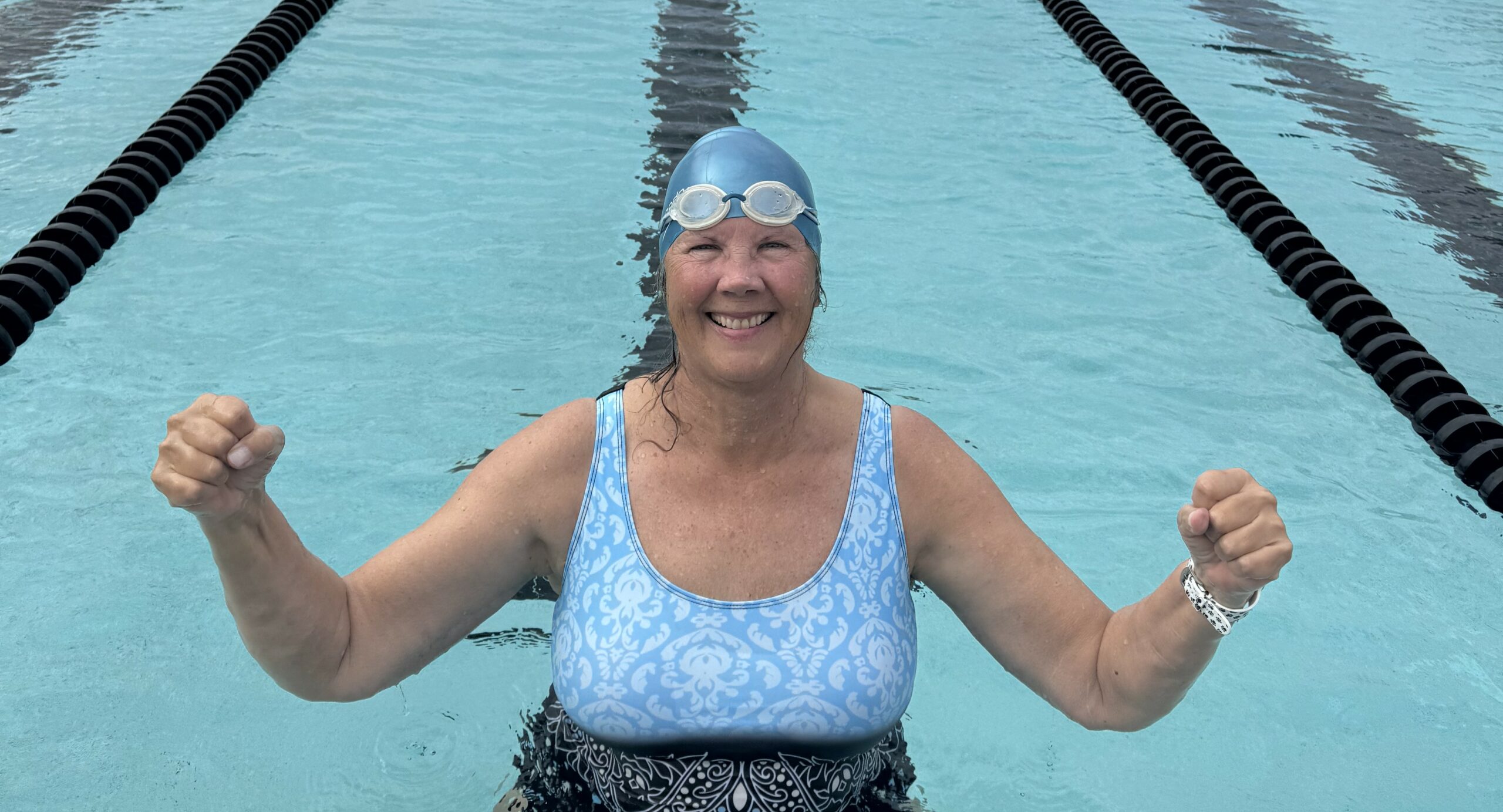
Lori adds “as a lifelong swimmer, I’ve always felt safe and strong in the water, whether in a pool, a lake, or the Atlantic and Pacific oceans. Through foot and knee and breast cancer surgeries, I’ve found the water to be a terrific place to resume my exercise program. It doesn’t matter if I have time to swim laps, do aqua fitness for a half hour, or water walk for ten minutes with a friend, I come out of the water feeling relaxed and refreshed. I have water buddies of all ages who inspire me to keep getting in the pool.”

Did you know . . .

  • GCC’s outdoor heated pool is one of only two Olympic-sized pools in the west valley.
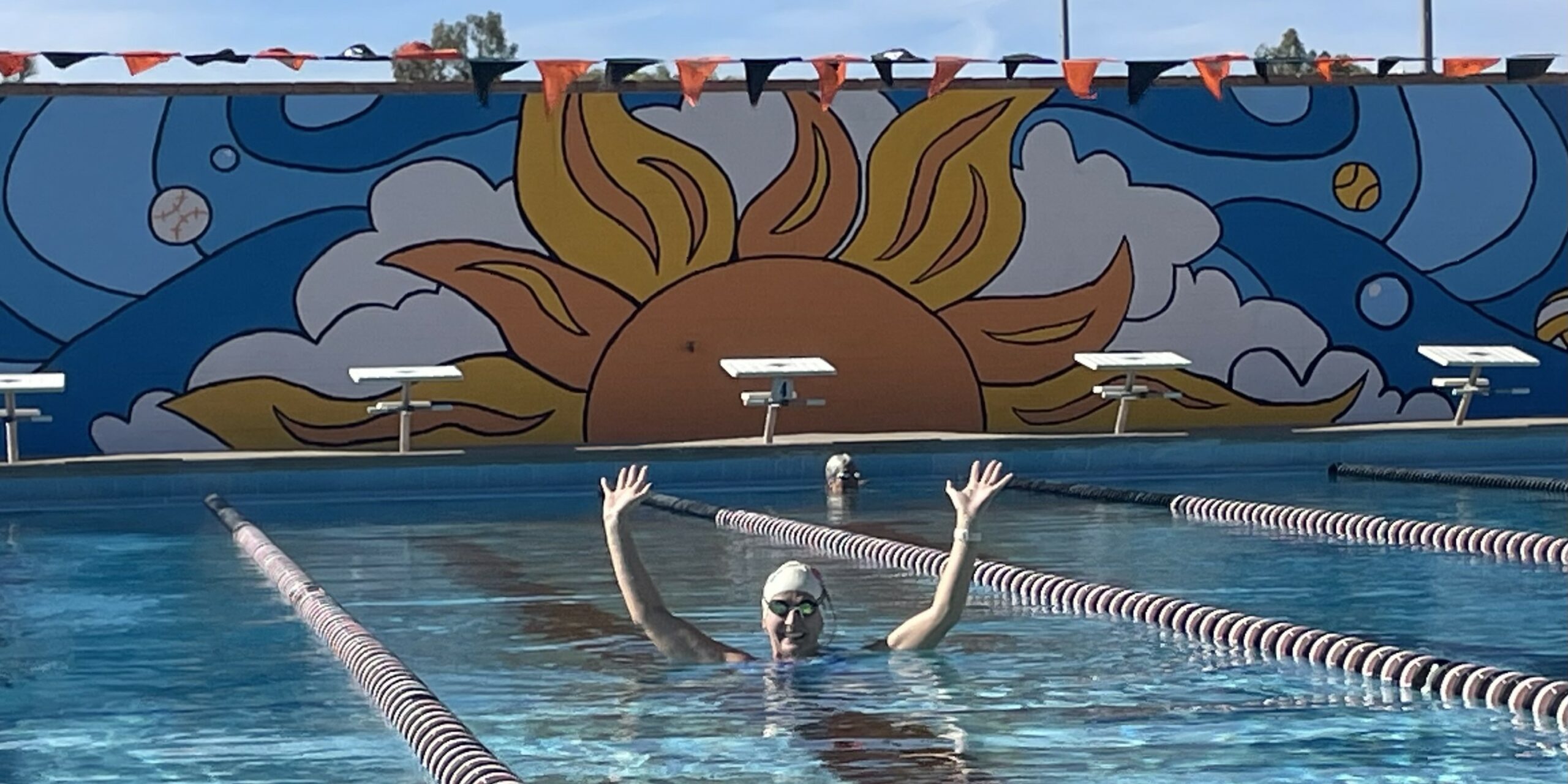
  • It boasts a beautiful mural on the west end, depicting a bold sunset, swimmers, scuba divers and a variety of sports. The mural was designed and painted by the GCC Art Department students and faculty in 2021.
  • It also has a dedication to Biology Faculty, Dr. Robert Reavis, who taught SCUBA diving and led the Green Efforts committee on campus.
  • You can swim or do aqua fitness on Mondays, Wednesdays and Fridays from 12- 3 p.m. Just stop by the pool with your swim suit, goggles and towel. Your first swim is free!
  • You can also sign up for PED101/103 SM Swimming or AQ Aquatic Fitness in the Spring and Fall Semesters. We have new sections starting right after Spring Break!
  • More information is available HERE

Contributors: Louise So and Lori Walk, members of the GCC Employee Wellness Committee

The Meeting of Accessibility and Generative Artificial Intelligence

Recently, I realized that I had been ignoring AI in favor of accessibility. I mean, a person only has so much brainspace, right? Then I started hearing a little buzzing about how others were starting to use AI to assist with their accessibility efforts, and I realized the two could be combined to save some time and make more challenging improvements related to accessibility. 

So here are a few ways I've been using my personal, paid Claude account to help me with the accessibility related to my courses:

  • HTML remediation for WCAG compliance. That's a mouthful to say that I pasted the HTML code from my Canvas pages into Claude with a prompt that asked it to correct the HTML code so that it was fully accessible. What Claude did was then to remove empty paragraphs, add screen reader text for links, fix heading structure and navigation elements, convert all caps text to proper case, and remove unnecessary inline styles and broken links. If I prompted carefully at the start of the chat, telling it I was going to give it page after page, it gave me HTML code back and wrote "Ready for the next page." It was easy to get into a groove of copy/paste/copy/paste. 
  • Transcript cleanup and video accessibility. Getting the video captions right with YouTube has never been so easy. Once the auto captions are complete, it's easy to copy the text of those, paste them into Claude, and ask that they be corrected for upper/lower case letters, punctuation, and spelling. Then it's simple to take the corrected version and paste it back in. There's no worry about VTT or SRT files. 
  • PDF to accessible format conversion. I do have a short story in one class. It's older and in the public domain, but I only have a scanned copy for students. I asked Claude to read the pdf and give it back to me in plain text. I then copied that into a Google Doc, used Grackle, and then created a link using "share" and "publish to the web." I then linked to that from my Canvas course. Students now have an accessible version of that story they can read. It also is a whole lot cleaner than that scanned version!
  • Writing a Pressbook. I had Claude create the first part of a Pressbook I'm working on. I asked for some styling and a particular font. I then asked it to create pages with that same styling for each section of content I give it. What I'm ending up with are parts of the book that all have the same styling regardless of where the content comes from. The book will look consistent. 
Right now, I'm really looking for ways that I can use AI as a tool to speed up what I have to do and to help me make all my course content fully accessible. AI doesn't always get it right, and I sometimes have to ask for a redo. The iteration is still faster than what I could do on my own, and Claude makes corrections to the HTML code, which I cannot do on my own without a lot of extra work. I am curious how others might be doing similar tasks. Let me know!


I’m not a Teacher, I’m a Storyteller | A Story

This may not be a radical idea… in fact, there are several fantastic articles on the topic I’ve linked below from others like me. But to a first-semester adjunct, this story I’m about to share was a groundbreaking moment of discovery, something we weren’t taught in “teacher school.”

This is a story about identity, development, and collaboration, and what it means to teach in collaboration with students.

I am not a teacher.

I was once asked in a marketing class to describe myself in one word, which is an impossible task for anyone who knows me. I’m an actress, a facilitator, a technology nerd, a stuntwoman, an entrepreneur, a caregiver, a DIYer, and a lifelong student with an endless list of interests. My degrees and certificates span culture, art, and technology, reflecting my refusal to decide what I want to be “when I grow up.”

But when I looked at all of those mismatched puzzle pieces, I realized they were all doing the same thing: telling or engaging with stories about people, ideas, systems, and experiences. So, I claimed the identity that fit all of them.

I am a storyteller.

No real big surprises there!

In my late teens, I was genuinely confused when a close friend asked if I’d ever considered teaching, after I’d given a laundry list of careers I was determined to have in my lifetime. Teachers, in my mind, were patient, gentle, steady, and meticulously organized. They were nurturers and experts. They were Ms. Frizzle, Gandalf, and Yoda made real. Don’t get me wrong, I was good at facilitating workshops; it was something that had sparked this recommended career path. However, a sixteen-week class felt apocalyptic for my hypothetical students, and for me. I was going to get attached, I was going to be a fixer of problems, I was going to hold them to too high standards, I was going to be a chaotic ball of energy with a little too much enthusiasm for the most mundane topics. I am a Storyteller, not a Teacher. I had some of those magical traits, but not enough to even consider the title, let alone the position.

Nearly seven years later, a coworker suggested I gain classroom experience if I wanted to become an instructional designer. I nodded politely while internally panicking. I loved the idea of giving back and sharing what I’d learned, but the same thought echoed in my head: I wasn’t a teacher. I could share my experience, I could show, listen, and explore with them. But was that enough?

Then, by a twist of fate, I was asked to fill an emergency opening to teach Photoshop. A program I’d been using for years, and one of my favorite classes I’d taken as a student. To be honest, I think I was already drafting an email asking for a course shell before the acceptance email fully left my inbox. I was excited about the opportunity to design a learning experience; the reality of “teaching” hadn’t quite hit me yet.

I started building something I’m passionate about. I can disappear for hours in a module, reworking, reorganizing, researching content, aligning, and anticipating. It was pure heaven as I built this world for my students to come play in with me. I started worldbuilding. The competencies became plot points. Each module became a chapter. I imagined my cast of characters (students) before I met them. I could see each of them: the non-creatives, the already-proficient, the ones relying on the Computer Commons to complete their work. I adjusted due dates. I planned support. I made sure my characters had what they needed to take this long journey with me and prepared myself for them to surprise me and help me revise my ideas as they grew.

On the first day, I walked in ready to play the role of “teacher.” I had taken classes on the art of teaching. I knew how to explain things. I had a color-coded “script” (lesson plan). I was so ready.

Nothing inherently traumatic occurred during that first class (despite every technical issue imaginable). We went over the syllabus, opened the program, and started exploring together. I asked questions and used my energy to draw the students out of their shells. It went (objectively) very well. I’d been told over and over again, “Facilitators aren’t Teachers”, and I internalized that meant I didn’t belong in this space. But that’s okay, I’m an actress, I’m used to playing in spaces that aren’t my own… but my identity as a Storyteller also informed my feelings over and over again… I wasn’t a Teacher. I walked out of that first class feeling like a facilitator who had just run a great workshop… but that wasn’t enough. The disconnect felt palpable, but I couldn’t put my finger on what was holding me back. It came back to identity. I’m not a teacher; that must be why this nagging feeling of “wrongness” was creeping in. Real teachers don’t feel like this!

I struggled for weeks with the tension between who I thought a teacher was supposed to be and who I was when I taught.

Then one week, exhausted and defeated, I “gave up” the fight to lean away from my facilitator roots. We were discussing typography, specifically kerning, when a student asked, “Is that why the Skyfall poster looks so weird?”

I could hear the angel chorus start to ring as I paused the lesson. We pulled the poster up, and sure enough, the letter spacing was dramatic. I dropped the poster into Photoshop and demonstrated how we would adjust the kerning in real time. The room changed instantly, and I’ll never forget the excitement as students dove for their keyboards to find more examples. This was the magic of improvisation I felt every time I presented a workshop, facilitated open conversation, and led with the story.

It was a frantic, somewhat chaotic moment as we found momentum in the uncharted territory, but it felt like settling into a familiar space.

Suddenly, we weren’t talking about fonts; we were examining how we, as humans, relate to shape, weight, color, and spacing, and using storytelling to do it.

I abandoned my carefully crafted PowerPoint. I scribbled the vocabulary and key points on the board. Students Googled their favorite posters, albums, advertisements, etc. We analyzed them together to see what worked, what didn’t, and what the design communicated about character and tone. How what we were learning popped up in the real world and (more importantly) how learning this tool would inform their future design work. They used the vocabulary. They debated the meaning. They connected design choices to narrative intent.

At the end of class, they sat outside in the commons, still talking about font pairings and correcting one another, using the language we’d just learned. Their work that week left a huge smile on my face. They didn’t just “get” the lesson; they internalized it. They were making creative connections and using examples from class and from their own research to do it.

The students connected to the story in a way they hadn’t to a more traditional style of curated, guided instruction. They were finding personal application and discovering motivation through the momentum of exploration.

The next week, they were still referencing those posters while discussing color theory. Their assignments showed more care, more intention, more thought.

That’s when it clicked.

I wasn’t failing at being a teacher by facilitating.

I was succeeding at being a storyteller.

I wasn’t delivering information; I was facilitating the journey toward discovering meaning. I was connecting lived experience and observation to new knowledge. The course wasn’t broken (and I wasn’t broken). I didn’t need to become someone else.

I didn’t have to become a teacher.

I just had to tell the story and invite the students to make the lesson a part of their own journey.

I’d built the world already. I knew who my students were and what they hoped to get out of the class. I just needed to guide them in the right direction and build momentum toward discovery.

Now in class, every session started with a rehearsed PowerPoint-based launching point to set our foundation… and then I turned the students loose on the topics with guiding questions: “So where have you seen this?” or “What does this remind you of?” or (their favorite) “Walk me through this concept/tool/idea.” Every class is an adventure (literally and figuratively). There were a few times we found ourselves on the edge of a rabbit hole, and I had to pull us back on topic, but the energy in the room was incredible. The collaboration and exploration were infectious… and I had so much fun witnessing it.

So, to me, a teacher is a little like the “Wise Guide” archetype, providing wisdom and experience for a hero and their journey. But this Guide doesn’t have to tell their Padawans all the answers or hit every bullet point on the lesson plan with perfect phrasing. They paint a picture, create a world, tell a story, and lead students through key concepts toward the big “aha!” moment at the end.

Teaching is storytelling.

There is no one type of teacher, just like there isn’t one genre of storytelling.

Every great teacher is a master at facilitating learning in their own way, showing students how to make meaning and breathe life into a concept by guiding them through the world (content) we love, helping them fight dragons (challenges), and watching as they become the heroes of the story (making independent meaning).

Deeper Reading (Storytelling as an Educational Tool)

The Educational Benefits of Storytelling
The Power of Storytelling to Facilitate Human Connection and Learning
The Value of Storytelling as a Learning Tool

You Are Beautiful | A Counterstory

During my master’s program, our professor Dr. Kris Ewing invited us to read This I Believe, a collection of short essays about core values that guide daily life, and then write one of our own. That assignment stayed with me. It reminded me that some of the most powerful stories we can tell are the ones shaped by lived experience.

As I thought about this week’s theme of counterstories, I kept coming back to that essay. In the spirit of challenging assumptions about who belongs in higher education, who carries wisdom, and what “success” looks like, I’m sharing both the video and written version of my original piece.

branches of a tree covered with snow

I believe in the little words.

I believe in the little words. The little words can be all it takes to make a difference in the life of a student. Programs, money, services, and material things can facilitate a change, but sometimes all it takes is the little words to validate a student in order for them to take the next step in the right direction. 

I trudged along high school unsure of myself. My place in this world, and not knowing what direction my life was going to take. I was in a pretty deep state of depression. My oldest sister no longer wanted me to hang around her. My brother and I were no longer close. My younger sisters could care less about me and I truly believed my mother hated me. I felt unloved and unwanted. I didn’t think highly of myself or that I was worth much. I pretended everything was alright. I’d smile, laugh, crack jokes, and create an image of being the perfect person, but when I got home I’d locked myself in my room let all the feelings fill my heart and soul and cry myself to sleep. I was not OK and was borderline suicidal. 

I was in my senior year and all of my classmates were talking about graduation, scholarships, and college applications. I still didn’t know what I was going to do after high school but in order to fit in with my friends, I wrote down scholarship names, downloaded college applications, and worked on a personal essay. One morning, the school counselor came over to me and said, “Mr. McClure wants to work with you on the Gates scholarship.” I had previously looked up the scholarship and knew that you needed an individual to be a nominator and recommender and I had already considered who I might ask to help me. Yet, here was the counselor giving me the name of the teacher who wanted to work with me although I had never had a class with him. 

I was skeptical about working with Mr. McClure. I had only seen him a few times in the halls and I heard he was a hard teacher and pretty unconventional. But in previous years he helped two students get the scholarship so I decided to give it a try. McClure turned out to be everything that everyone had said. He was a hard teacher and definitely unconventional. After school and at lunch, we would meet and discuss how we were going to work on the scholarship. The application consisted of me writing eight essays and him writing some essays as well. He would task me to write drafts, set deadlines, and then meet to discuss where I was at. Through our interactions he picked up on the fact that something was not right with me. He never directly asked me what was wrong but somehow just seemed to know. One afternoon, after talking about the scholarship he asked me, “Do you think you’re beautiful?” I’m naturally a pretty shy person and this question didn’t help my shyness. Meekly, darting my eyes and trying to avoid eye contact I said, “I don’t know…not really I guess.” He looked me straight in the eyes and said, “From today on, every morning and every night you go to bed or wake up. I want you to look in the mirror and say out loud, “I am beautiful.” I don’t care if it seems funny or others hear you. You need to say it every day, and I’m going to ask you about it because you are beautiful and you need to start believing it.

Mr. McClure never knew me personally. We had never met and I had never sat in his class. Yet he took the time to point me out and say, “I want to work with her.” He could’ve stopped there and just helped me fill out the scholarship application, but took it a step further and addressed the deep issues I was dealing with. He didn’t do this with things but by validating the person I was. He truly cared about me, my well-being, and my future. 

Today, I am a mother of a beautiful two year-old boy. A woman pursuing her masters degree, and a partner to a loving man. I am where I am today not because of a full ride scholarship but because someone showed me the power of the little words. The power of words like, “You are doing excellent work.” “I am glad you’re in my class.” “You’re intelligent,” or a reminder that I am beautiful. The little words that changed my outlook on my life.  

It Was Never Just About the Essay

I’m going to try not to make this political, but I make no promises. I teach freshman composition, African American literature and journalism. In the comp classes we don’t have interesting content to read and write about that is mandated by our curriculum. It’s just teach them to write, organize, use appropriate conventions. Actually it says more overgeneralized statements like “Write for specific rhetorical contexts, including circumstance, purpose, topic, audience, and writer, as well as the writing’s ethical, political, and cultural implications.” There’s so much to unpack here. You’d be surprised by how different professors are in the interpretation of what this means in our classrooms.

I mean just the first part alone is meaningful. “Write for specific rhetorical contexts” means adjusting your writing based on the purpose, audience, and situation in which the writing will be used. It recognizes that writing is not one-size-fits-all. Effective writers make intentional choices depending on who they are writing to, why they are writing, and where the writing will appear. In our students’ minds, I alone am the audience. They don’t often see the significance of writing for a specific rhetorical context, so we have to teach them what that means. So I give them the theme of “Truth in the US Elections and the Current Administrations Policies.” Now we have content to read and write about. I tell them if you’re mad or happy about immigration policies in this country, then who needs to hear your arguments? What is your purpose in writing? What is the context or situation? We discuss where and how the writing can be used.

The last part of that one course objective, “as well as the writing’s ethical, political, and cultural implications,” means students must think about the impact and responsibility of their writing, not just the technical aspects like audience or purpose. It asks them to consider how their words affect others and how their writing fits into larger social systems. I tell them their writing can be a form of protest or support for ideas, which makes writing more meaningful. I want them to know how writing connects to power, policies, public issues, or viewpoints. So yeah, it’s political, but it’s the real world. Writing can influence how people think about social issues, government actions, or public debates. I tell students, yes, your writing can do that, and I’m going to teach you how. That’s what this class is all about.

But what about the “cultural implications” in this course objective? Why is that in there? I want students to know that writing relates to people’s identities, backgrounds, values, and lived experiences. We’re all different. We come from different places metaphorically. As a writer, they should be aware of cultural differences and respect diverse perspectives. We don’t get to see that very often in society today, so it can be a challenge teaching this. Students often just want to repeat what they are constantly hearing in the media (news and social) instead of researching and finding the truth.

So Freshman Composition is so much more than teaching students to write. It is about helping them understand how writing actually works in the real world. It is about teaching them to think critically, to recognize audience and purpose, and to make intentional choices instead of just filling space on a page. It is where they begin to see that their words carry weight, that writing can inform, challenge, question, and create change. It is also where many of them, often for the first time, realize that their own experiences, perspectives, and voices belong in academic spaces. Freshman Composition is not just a writing class. It is a class about awareness, confidence, and learning how to participate in conversations that matter.

The Counter Story: Non-Verbal Communication

In a meeting filled with many familiar voices and confident phrases and statements, it’s easy to believe that what’s being said tells the whole story. But during a recent meeting, I noticed a colleague who speaks often but states they don’t always feel heard.. sitting straight up, almost perfect posture, eyes drifting to their hand written notes each time a comment was made by others that was framed as “already decided on.” Eye brows raised in a way that indicates they have more questions but don’t see the point in asking. While the conversation moved forward, their body language told a different story: hesitation, concern, and perhaps a sense that their perspective didn’t have value. Nothing in their silence suggested agreement; it suggested restraint. Paying attention to those non-verbal cues made it clear that an important viewpoint was present, just not being voiced. Sometimes when our co-workers say they don’t feel valued or heard, it isn’t because they weren’t invited into the conversation. It is a reflection that their communication style wasn’t understood by those around them; amidst us proceeding through the agenda, we sometimes leave people behind for the sake of “managing the meeting.” While fully unintentional, it represents a missed opportunity to show understanding and openness.

After the meeting, I followed up privately, naming what I had observed and inviting their thoughts. What emerged was an underheard perspective—one shaped by prior experiences and real constraints they didn’t feel safe raising in the group setting. By later amplifying that perspective in a follow-up conversation, and framing it as a necessary addition rather than a challenge, the group gained a fuller understanding of the issue at hand. Being attentive to non-verbal signals allowed the untold story to be acknowledged, respected, and shared. Listening in meetings is just as much about watching as it is about hearing.