One of the key rituals in my classroom is the use of line-ups. Inspired by Building Thinking Classrooms in Mathematics by Peter Liljedahl, I began incorporating this strategy at the start of class to form randomized groups. This approach aligns with the BTC model of randomized grouping while also giving students the chance to interact with everyone in the class.
Over time, this ritual has fostered a strong sense of classroom community and reinforced the value of truly random grouping. Students enjoy the variety of prompts I use and appreciate the opportunity to meet and collaborate with different peers each day. As a result, the classroom environment has become more positive and supportive, where students feel safe to take risks, make mistakes, and learn from one another.
Here are a few of the prompts that I use to line up my students:
In the 1980s, when I attended high school at Alhambra here on the west side of Phoenix, I had an amazing teacher for three of my classes: Mrs. Janet Moore. She taught sophomore and senior level English, and also the Humanities course I took in senior year. Though she passed away years ago, I can’t express how much she meant (and still means) to me.
One of Mrs. Moore’s gifts was to bring a sense of humanity and richness to our learning experiences. Whether it was encouraging us to explore alternative texts for our essays, or providing enrichment resources, she was always a gentle soul who made learning fun, and placed our lessons within the broader human context.
One day in Humanities class we were discussing the different attitudes toward discursive thought, as expressed in some Western and Eastern philosophies. Without “othering” Asian cultures, Mrs. Moore introduced and mediated discussions on the richness of views of meditation, koans, satori and kensho, and instruction through parables. She contrasted these with ideals of discursive thought and disputation, and placed them beside concepts of “Being” from Aristotle and Heidegger. In the context of this discussion, she recounted a Zen koan – which I later learned was told about the Zen master Hakuin – that went roughly like this:
One day, a warrior traveled far and climbed a tall mountain to speak to a venerable monk to learn the secrets of the afterlife. When he arrived, he approached the old man meditating in his garden, and asked him “Tell me, sage: where are the Gates to Heaven and Hell?”
At this, the monk opened his eyes to look at the warrior, and said “Who are you to ask about the Gates of Paradise? You look like a beggar!”
Angry with the insult to his pride, the warrior drew his sword and held it to the chest of the seated monk. “You will answer me, or I will kill you!” he shouted.
At this, the old monk said calmly “Here open the Gates to Hell.”
The warrior, taken aback by this, was silent for a moment. He then sheathed his sword as he calmed, recognizing the discipline of the sage.
The monk then smiled and said “Here open the Gates to Heaven.”
To this day, almost exactly forty years later, I still recall vividly the long, awed silence that persisted in class after Mrs. Moore spoke the final line of the koan. It has endured in my consciousness and resurfaced many, many times since then.
I mention this because the theme for today’s post is “Portals and Thresholds”. Mrs. Moore exemplifies the ideal educator for me, in the way she was constantly opening portals into new ways of thinking, and gently guiding us to those thresholds of learning and expanding our understanding. When I think of a model of the kind of educator I want to be, she is the epitome. And this koan beautifully illustrates the opportunity each of us has, in any given moment, to choose by our actions to open a portal that is constructive or destructive, and of meeting each student where they are, and differentiating our pedagogy to their respective needs so that each may walk through that portal without hindrance.
I try to apply Mrs. Moore’s modeling in my instructional area of Chemistry, a field which may not immediately strike many as synonymous with empathy and the human-centered dimensions of knowledge. Or at least, not in the way that, for example, the arts or humanities fields might. Our tendency in the STEM fields is sometimes to focus more on the precision, the exactitude, and the processes and the systems of our work – that is, the more cognitive components – and give less attention to the equally important affective, social, and behavioral components of learning (as well as practicing) in our fields. The arts do a much better job of this than we do in STEM, frankly.
It’s not to say we STEM instructors are unempathetic. My colleagues are some of the most empathetic people I know! Rather, I would argue that we have models of instruction that we have all learned which emphasize more strongly the cognitive components of learning, such that the affective, social and behavioral components sometimes have to be grafted on after the fact. And this grafting-on sometimes only happens once we engage in significant professional development and self-interrogation.
The way I teach Chemistry today is sometimes quite different from how I learned it from some of my Old School professors and teachers. In the 1980s, most of my college professors were in their late middle-age. Most of them had gone to college in the 1950s and were taught by professors who had themselves attended college in the 1920s. It showed, with some taking a “sink or swim” attitude with their students. (Worse, I also saw one tear up students’ papers in front of class, shout at their students, and throw erasers and chalk, upbraiding them in front of the class, and so forth. All abusive behaviors, but which were rather more acceptable “back in the day”.) Others were not abusive like this, but were merely distant and aloof. A pervasive attitude seemed to be that it was the professor’s responsibility to provide the structured content expertise, and the student’s responsibility to provide everything else, including the emotional engagement with the learning experience.
Don’t get me wrong: some of my professors were more engaged. A couple were even excellent! And students absolutely have to bring their own intrinsic motivation and executive function to the learning process. But effective instructors have a greater responsibility than just providing structured content expertise. We must also exercise appropriate affective engagement. Pedagogical soundness and excellence sometimes requires we be coaches, nurturers, facilitators, and gentle guides who – while championing academic rigor and integrity – also recognize that we do not work in a vacuum, and students bring their lives with them into our classroom. The notion that they should just “leave all that outside” is unrealistic.
This is particularly true when our students are experiencing so many challenges, one of the most pernicious of which is socioeconomic disadvantage. Having grown up as a first generation student in a poor household led, for much of my youth, by a single mom, this is particularly resonant for me. Unless someone has experienced this for themselves, it may be difficult to imagine how pervasive the impacts are for a student doing their best to manage home, work, and school under financial precarity. We hear about some students who may have been evicted from their homes, or who have a parent in prison, or who have to work two jobs while attending college, or who have difficulty affording child care, or transportation, or groceries, or medicine. But unless you have lived that life, it may be impossible to fully appreciate just how ground down this makes you feel, and how hard even the simplest things become. These challenges absolutely do not sit and wait at the threshold of the learning experience; rather, they are integral to the student’s experience of their world entire, and cannot be extricated from their learning.
So I am thankful that we, as a profession – and particularly in the community college context this is the case – have embraced a much more intentionally holistic approach to student engagement, which goes far beyond simply “providing expert content knowledge in a structured format”. Rather, we engage in helping lead students to the thresholds of learning, even when that means we need to differentiate our approach to meet their particular needs. When we find ourselves turning a blind eye to student needs or systemic disadvantage, even when it is in a well-intentioned effort to provide a “neutral” learning experience, we passively participate in an unjust system. There, I believe, open the Gates to Hell. But when we take it as part of our responsibility as educators to understand and work in appropriate ways to ameliorate the inequities that our students experience, there open the Gates to Heaven.
Well, I’m still searching for the Gates to Heaven as an educator. But every time I find myself empathizing with my students, respecting their individuality and trying to understand their perspectives and adapting to their needs – while maintaining the academic rigor of my teaching – I feel like I get a little glimpse of it. Every time I try to bring in the human dimensions of Chemistry, whether it is to reflect on climate impact, the geopolitical ramifications of sourcing raw materials, ideas in the philosophy of science, the intersectionality of race and gender in the historical practice of the sciences, or other relevant social dimensions, I feel like I present new thresholds for my students to gain deeper understanding of Chemistry in their lives and in the world beyond simply “can you solve this equation” or “can you name this compound”. And in so doing, I feel like I approach a little closer to the platonic ideal of what a chemistry course could be.
As I am now in the final decade of my career, I find that this is the area in which I am most excited to develop as an educator, and as a human being sharing this journey with you all.
And I wish I could talk about all this with Mrs. Moore today.
When I’m traveling — if I’m driving — I don’t choose the scenic route unless it’s a relatively quick trip (speaking metaphorically). Otherwise, it’s Interstate all the way, baby. As fast as I can go. No, we can’t stop and see that scenic spot even though we’ve driven by it 20 times and we’re ahead of schedule. I’m trying to get a lot done, and to be very honest, I’ve asked to do it. I’ve made promises and I’m looking forward to keeping them so I need the “Freeway” to get things done efficiently, so there will be times when the Interstate is the best access to accomplish my goals that week. So, when I write about transitions, pathways, and doors, as was suggested as an alternative, I realized, the rest of the time, when I’m not whizzing by, I do take the scenic route, because I think that leads to understanding the given subject.
I’m going to choose both options for this writing – the scenic route and the Interstate because I’m engaging students through our GCC Canvas website and I want it to be inviting, comfortable, and visually appealing – and yet have the access of going through a lot of important and relevant material. I want my students to feel that this course is where they would really would like to spend their time each week and just listen to music and, hopefully, think about what they’re listening to.
So many people think that by studying or learning about Bach and Mozart will make them smarter, especially as children. That’s not how it works. Music helps them learn how to use their brains in new ways — and can work in virtually any genre, especially if you show the influences of that genre.
I have had students who were heavily into STEM or specifically Math or Science, who told me at the end of class, “This course was the only thing that kept me sane because I had such a heavy workload. I looked forward to working on this class and learning about music. I didn’t know what it would be like, but it became so much more, and was just what I needed. Thank you for offering a place where learning could be comfortable and I could share my thoughts about what we were listening to, and learningabout.” Those kinds of comments are what I live for. To me, it’s what teaching is all about. Connecting and knowing that you have connected.
Moving on to doors, I have two specific images that I like to use that I think makes students think “it’s open, let’s go in.” I’m hoping that’s what they’re thinking. Before the semester begins, students are practically begging to get in, so I hope that these two visual elements help to welcome them. (When I taught in the classroom, I never had people try to “learn early,” but it seems to be something that they do in asynchronous classes, and I don’t blame them.) When I’m working asynchronously, I’m trying to get a jump on things as well, because I know how many deadlines I have coming down the pike, and how many decisions – artistic, educational, health wise, semester-wise are coming that I need to be on the job “working the problem.”
The idea is to invite students each week with more visual elements. I usually start with the photo above in week one. Somewhere later, I usually include this next one.
Regarding transitions, I just finished a book the other day by Mark Rashid, Horses Never Lie, (Simon and Schuster), and I thought how appropriate to come across this for my life and my teaching at this moment.
It was meant to show people how to be “soft” when riding a horse. You don’t need to jerk them around and try to be “the boss,” or to “dominate,” but you can gently guide them with light cues, allowing the horse to decide what to do. They have a wealth of information that they’ve often been taught and the author thought, as he was trying to get a particular horse to do something, “this horse knows what to do,” so subtlety will help better than a firm hand in order to let him figure it out.
And I thought, this is exactly what I’m trying to do with my students. I give them certain information, then we listen to exemplify that. I often ask them to share a piece with the rest of the class, and I ask them to discuss what and why they chose the music they included and what they thought of others choices as well. “Soft.” The metaphor may not be what they, as students, would use to describe what they’re doing, but I know they can do it – just like the horse usually knows what he/she is supposed to do. I ask them to keep their comments positive, and I think they appreciate that because they know they’ll be treated the same way with their choices. No judgement. Their opinion is honored.
We’ve already talked about the requirements for writing cues, so as the educator, I give them time to figure it out based on what I offer as prompts. And I’m willing to offer as many prompts as they need.
I had just finished reading this and I thought “I need to read more by this author because I think he’s on to something.” It allows students (and riders) to be more creative, to use their knowledge and what they’re learning about in the course, and all of the learning they’ve amassed up to this point. I used to tell my students (I don’t usually do this anymore) “you already know so much about music because you have so much music available to listen to.” I don’t say it anymore, because I think it’s obvious. Perhaps not.
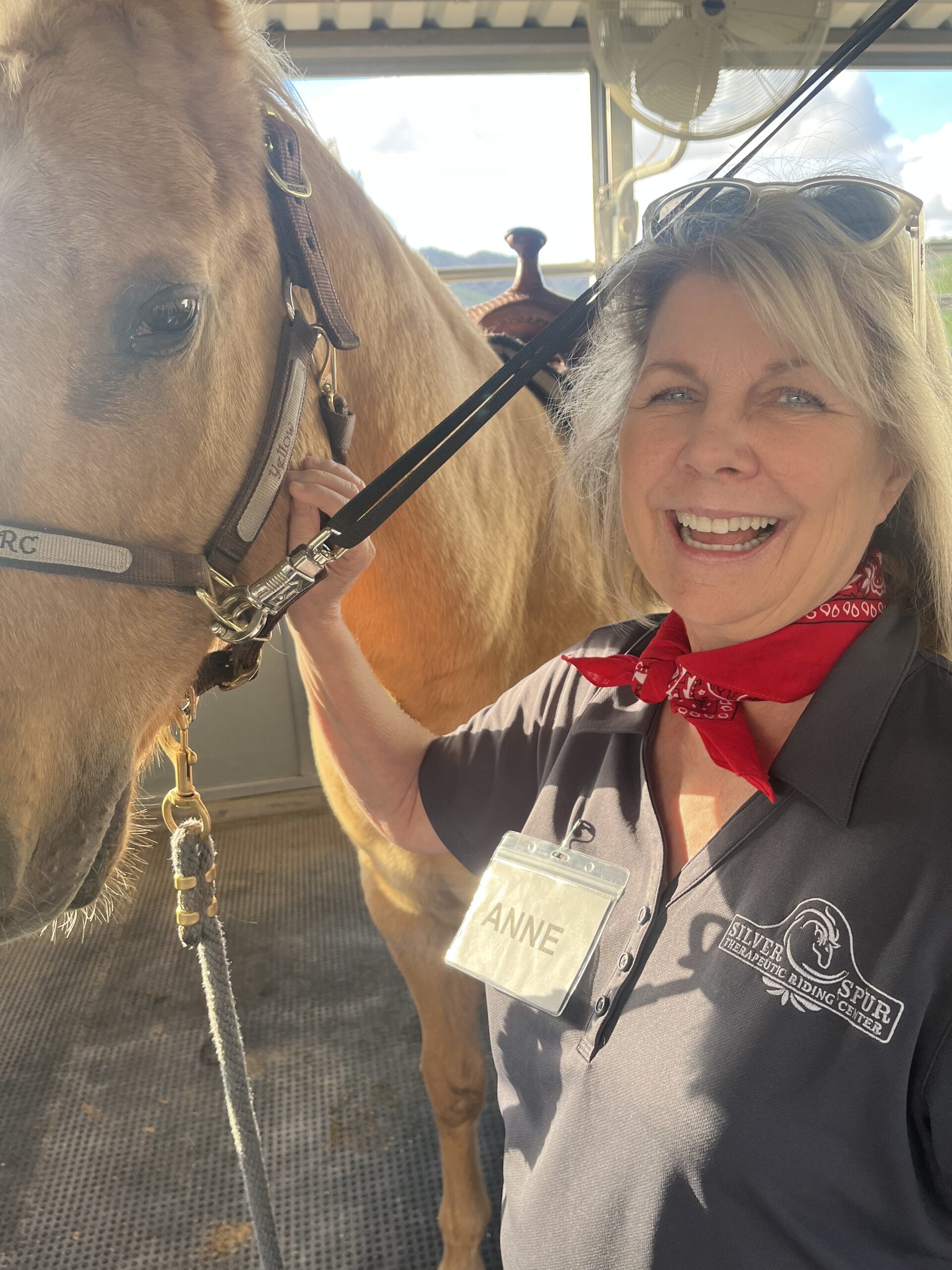
Here is Yellow Horse, a very wise 22-year old Palomino, who has cotton candy for his forelock. Over the years, he has taught me the meaning of being soft in my prompts and cues. I rarely have to do much of anything. He’s so attuned to everything and is such a joy. I hope that I can bring more of that to my students.