Category Archives: Write6x6

Finding My Place Between Bradbury and the Bots


In a blog post for Write 6x6 in February of 2024, I wrote, “As the future of AI in education breathes down my neck, I find myself wondering, do I want to be a Bradbury, digging in my heels in respect for my deeply-held principles about teaching, learning, and the craft of writing, knowing that my protest will do nothing to change what’s to come? Do I want to give in and say there's nothing I can do to stop what's coming, so let me grade this robot’s essay? Or might there be a space in between?”


Another Write 6x6 is upon us, and I see that my relationship to AI has clarified itself in the last two years. Yes, AI has changed education, and I have had no choice but to change with it. I worry less about AI heralding the end of original thought these days. (Note, I worry less, not none.) My colleagues and I teach students intellectual ethical strategies for using AI as a learning partner. My classes lean more heavily on questioning and dialoguing and journaling on paper where once I was handing out chromebooks and using online polling tools. At home, my husband and I chop veggies and stir pots as we prepare dinner all the while marveling at all the ways we used Claude.ai that day. Jeff uses Claude as a coding partner in his work, and I use Claude as a revision partner. (In fact, I used to joke that we were in a throuple with Claude until I realized this isn’t a joke for some people.)

I appreciate that I can take a real woofer of a writing piece, full of [place holders], unfinished paragraphs, and clunky sentences–something I would never allow a colleague to read–and get nonjudgemental advice from Claude. I don’t ask the tool to write for me, rather I ask questions like, “My sentences are clunky in paragraph 3. What advice do you have for me?” or “What are some ideas you can offer me for bringing this piece to a close,” or “Give me a list of places where my thinking is unclear as well as a list of punctuation and grammar errors.” I find it priceless to get advice at this messy stage of the writing process before I’ve belabored the piece and exhausted myself. Asking for advice rather than asking for revision also allows me to maintain my own voice, for better or worse.


Back in November, I began working with Claude as a writing and thinking partner to craft this year’s Write 6x6 challenge. I pay for Claude which allows me access to a few more features such as creating project spaces. (Paying for Claude also makes the “throuple” joke even more awful.) After I created the Write 6x6 Challenge project, I provided Claude with instructions explaining Write 6x6 and my goals for our work together. Next, I uploaded files listing the prompts from years past. I also created a very long document listing recent topics discussed on the podcast Teaching in Higher Ed and titles of workshops offered at this fall’s POD Conference. From this document, I asked Claude to do something he does very well, but that would take me much, much longer: synthesize. Claude identified trending topics of discourse in higher education today, and from that list, I crafted a collection of possible prompts. Claude helped me to refine the list, to create “dares” to accompany this year’s “truth” prompts, and helped me track down resources to accompany each week’s challenge. I continued to chat with Claude about the prompt list, the challenges, and the resources until just a few weeks ago. (A human colleague would have kindly asked me to shut up about it already long ago.)

I declare that I am pleased with this year’s prompts! I feel that the topics are timely and that the Truth or Dare challenge has a little something for everyone. I hope that you, too, will enjoy what Write 6x6 has in store for you this year!


If you hate the prompts, let’s just blame Claude.


Think Before You Prompt

When ChatGPT first appeared on the academic scene, I struggled with deciding which path I was going to choose in my own classes, turning to handwritten drafts as a stopgap, but operating with the knowledge that, in the long run, these students may actually need to know how to use AI in their future positions. I discussed detector software, outright bans, and fully embracing AI as possible positions. As I watched my students navigate this new landscape, I realized that prohibition wasn’t the answer. Students are already using AI. The question isn’t whether they’ll encounter it, but how they’ll think about it.

What I needed wasn’t a ban. I needed a path to knowledge and a way for students to make ethical choices.

This three-class lesson series across two weeks emerged from a simple premise: students can’t make ethical decisions about AI if they don’t understand their own thinking processes first. By combining critical readings, hands-on AI experimentation, and deep reflection on reading and writing itself, I’ve created an assignment sequence that transforms students from passive AI users into metacognitively aware writers who can articulate when, why, and how AI supports, or sabotages, their learning.

Here’s how it works.

Class One: The Dark Side First

In-Class Discussion: What’s Wrong With AI?

I begin where students least expect: with AI’s problems. We don’t soft-pedal this. Instead, we dive into:

  • Disinformation, propaganda, and the distortion of reality
  • The digital divide: How AI is only making it worse
  • Plagiarism and privacy issues: What happens to your data when you feed it to a chatbot? The impact on the art fields
  • Automated labor: The loss of human jobs
  • Climate Impacts: The carbon and water use
  • Stereotyping and bias: How does AI perpetuate harmful patterns? Tainted training data, averaging produces cliched results.
  • The replacement of thinking: What do we lose when we outsource cognition?

Only after we’ve thoroughly examined the risks do we shift to the possibility: When might AI ethically support learning?

This sequencing is deliberate. Students need to approach AI with critical eyes wide open, not naive optimism.

Homework: Real-World Consequences

Students complete two readings:

  1. “Your Brain on GPT” – An article grounding our concerns in neuroscience, showing how outsourcing thinking actually rewires our cognitive processes. This isn’t moral panic; it’s brain science.
  2. A current news article about someone caught using AI inappropriately in academic or professional contexts. Students must find their own source (from reliable news outlets) and answer: “What can you do in your own work to ensure that you use AI ethically and in accordance with academic integrity policies and professional standards?”

By having students research real cases themselves, they become investigators, not passive recipients of warnings. The consequences become concrete, not abstract.


Class Two: Why We Write (Before We Prompt)

Freewriting: Personal Writing Inventory

Before students can evaluate AI’s role in their writing, they need to understand their own. I begin class with a freewriting prompt:

“Why do you write? List all the reasons—for classes, for yourself, for others. How does writing help you? Where does it challenge you?”

This isn’t busywork. It’s groundwork. Students need to articulate their relationship with writing before they can recognize when AI disrupts or supports that relationship.

Homework: “Shitty First Drafts” by Anne Lamott

Students read Lamott’s essay about the messy, non-linear reality of writing. This reading does double duty: it normalizes struggle (writing is supposed to be hard at first), and it sets up our AI experiment perfectly.


Class Three: The AI Experiment

This is where metacognition meets practice.

Opening Discussion: Defining the Line

Before we touch ChatGPT, we discuss:

  • What makes AI use “cheating” vs. “learning support”?
  • How is asking AI different from asking a study group or tutor?
  • When does getting help become avoiding the work?

Students set their own ethical frameworks before experimenting. This primes them to evaluate their experience critically.

Activity Part 1: Comparing Human and AI Analysis

Students prepare by identifying from “Shitty First Drafts”:

  • 3 confusing passages
  • 2 main ideas
  • 1 personal reaction

Then, in pairs or small groups, they submit the Lamott essay to ChatGPT with two prompts:

  1. “Summarize this article.”
  2. “What are the main points?”

The comparison moment: Students match their own main ideas against ChatGPT’s. What did the AI catch? What did it miss? Whose interpretation feels more insightful?

Activity Part 2: Learning-Centered Prompts

Next, groups choose one of three more sophisticated prompts:

  • “I’m confused about [specific passage]. Can you explain what Lamott means here?”
  • “Lamott uses the metaphor of [X]. How does this connect to her larger point about writing?”
  • “I think the main argument is [your interpretation]. Does this align with the text, or am I missing something?”

These prompts model curiosity, not abdication. They’re asking for help understanding, not outsourcing comprehension.

Reflection Discussion

After experimenting, we debrief:

  • When did ChatGPT help you think more vs. think less?
  • Did any AI responses seem wrong or shallow? How did you catch that?
  • What’s the difference between “help me understand” and “do this for me”?

Students discover that the quality of the prompt determines the quality of thinking—and that AI can be a mirror, reflecting back the depth (or shallowness) of their inquiry.

Deep Reading Discussion

We transition to discussing Lamott’s essay more deeply:

  • What does Lamott mean by “the fantasy of the uninitiated” (paragraph 1)?
  • In paragraph 7, she “eventually let [herself] trust the process—sort of, more or less.” Why “more or less”? Is this wariness personal or universal to writers?
  • Is writing a first draft more about product or process? Do you agree for your own drafts?
  • How can writing serve as self-discovery? Have you experienced this?

These questions are discussed in class and require personal synthesis. That helps to integrate personal stories and prevent the quick AI fix.

The Final Reveal: AI vs. Student Voice

In groups of four, students give ChatGPT this prompt:

“Write a 500-word essay from a college student’s perspective on why you write. Reflect on personal motivations, whether for school, expression, or other reasons. Consider how writing helps you process thoughts, communicate ideas, or explore creativity. Discuss how writing has shaped your identity as a student or impacted your learning. Include specific examples.”

Groups post their AI essays to a discussion board, then compare them to:

  1. The other groups’ AI-generated essays
  2. Their own class 2 freewriting about why they write

The critical question: “Which key features suggest this was written by ChatGPT rather than a student?”

Students notice:

  • Generic “examples” that could apply to anyone
  • Lack of genuine vulnerability or specificity
  • Smooth, structurally perfect prose that sounds… hollow
  • Absence of authentic voice

The revelation: AI can mimic form, but it cannot replicate lived experience, genuine confusion, or original thought. And most importantly, students can tell the difference when they’re looking for it.


Why This Works

This sequence succeeds because it:

  1. Builds from critique to curiosity: Students approach AI skeptically but scientifically, not fearfully.
  2. Centers metacognition: Every activity asks students to observe their own thinking, not just produce content.
  3. Makes the abstract concrete: Students experience the difference between helpful AI prompts and thought-replacement prompts.
  4. Honors student intelligence: Rather than lecturing about academic integrity, I trust students to discover ethical boundaries through experimentation and reflection.
  5. Embraces messiness: By pairing Lamott’s celebration of “shitty first drafts” with AI’s too-perfect outputs, students see that struggle isn’t a bug; it’s the feature that makes learning possible.

What Students Take Away

By the end of three classes, students can:

  • Articulate when AI supports vs. replaces their thinking
  • Identify AI-generated text by its tell-tale smoothness and lack of genuine voice
  • Craft prompts that deepen rather than bypass learning
  • Defend their own writing choices with reference to academic integrity
  • Recognize that writing is thinking made visible, and that’s worth protecting

Most importantly, they’ve moved from “Is it okay to use AI?” to “Am I thinking, or is AI thinking for me?”

It is metacognition and digital literacy synthesized.

The most revealing moment? When students first realize we’re going to use ChatGPT in class. “Wait—we’re allowed to do this?” “This feels wrong.”

As we work through the activities, something shifts. By the end, students consistently tell me two things:

  1. “I can see how it can help with studying.” They recognize AI’s value as a thought partner—when used to deepen understanding, not replace it.
  2. “But I don’t want to use it to complete assignments.” Not because they fear punishment, but because they’ve experienced the hollowness of AI-generated work compared to their own authentic thinking.

This isn’t compliance, it’s wisdom. Students learn to ask themselves: Will this help me grow, or help me avoid growing? That question will serve them far beyond my classroom.


Resources Needed

  • “Your Brain on GPT” (or similar neuroscience article on AI and cognition). I like this one because the authors made it difficult for AI to summarize the article.
  • “Shitty First Drafts” by Anne Lamott
  • Access to ChatGPT or other AI (free tier works fine)
  • Discussion board for posting AI essays

Final Thoughts

Our students will use AI. That’s not a crisis; it’s a reality. Our job isn’t to prevent that use, but to ensure they approach it with clear eyes, ethical frameworks, and self-awareness.

This lesson series teaches students to think about their thinking, to value their own cognitive labor, and to recognize that the messiness of learning, the confusion, the struggle, the shitty first drafts, is where growth happens.

And that’s something no chatbot can generate for them.

*AI Disclosure: This blog post was conceived and written by a human, but refined and organized using Claude AI.

The Community College as a Library

Prompt: What metaphor describes your approach to teaching, learning, or your role at GCC?

I have been an enthusiastic library patron my entire life. My parents started bringing my sister and I to the library as toddlers and our house was always full of library books. When we got older, we were allowed to walk to the public library by ourselves. I vividly remember one summer of visits when I would make my way downstairs to the children’s section and over to the row of Nancy Drew books (far wall, lower left corner of the stack), load up my backpack with as many books as I was allowed to check out, and then haul them back home for an afternoon filled with mysteries. The school libraries across Flagstaff’s public schools loom large in my memory as well. Still today as a more mature library patron, I am amazed during each and every visit. I can fill up my bag with books that contain new ideas, experiences, information, and story upon story, and then take them home to enjoy, learn, and build empathy with people whose experiences are so different from my own. Or I can just hang out in the library to browse, or study, or sit and daydream in the company of people of all ages and backgrounds, a lovely reflection of the diversity of the community around each library. All are welcome in a library. All belong. Each time I leave the library, I feel the sheer joy of the place. I always think, “This is amazing! This is what our society is doing right.”

That’s the feeling I want all of our students and employees to feel here at GCC: That we are part of a larger community in which everyone is welcomed and celebrated. That we feel a sense of joy at being part of GCC. Community colleges, like libraries, are designed to be community spaces, inclusive, inspiring and supportive. We are the hub that connects students to schools and universities, careers and lifelong learning. We are a safe space to be, to rest and reflect, and an inspiring place to work and learn with one another. My hope is that every student, every employee leaves GCC every day thinking, “This place is amazing! This is what our society is doing right. I am glad I belong here.”

A Cake Made of Purpose

To celebrate our Write 6×6 Anniversary, let’s make a cake full of purpose, intentionality and full of flavor! As some may know, one of my hobbies is baking. In previous posts, I have also shared how this creates connections within my family and gives me a joy and happiness. If my work could be a recipe, the ingredients would be:

Flour – Our Purpose- Our Students
The foundation everything else is built on; without it, nothing holds together.

Eggs – Shared Governance and Collaboration/Partnerships
They bind the ingredients, creating cohesion and structure across our work.

Butter – Respect for People
Adds richness and depth; this is what makes the work we do blend together and not get dry or boring.

Sugar – Context and Community
Brings balance and care, ensuring the outcome is inviting and welcoming for everyone.

Baking powder – Pragmatic Problem-Solving
Helps ideas rise and turn plans into action.

Salt – Compliance and Integrity
Subtle but essential; without it, the result falls flat or fails entirely.

Milk – Role and Organizational Structure Clarity
Smooths the mix so processes work together instead of clumping.

Vanilla – Leadership
Noticed when it’s missing.

Lemon or Orange Zest (optional) – Data-informed judgment
Adds nuance and depth without overpowering the core flavor.

Write 6×6 and AI

I can’t believe it’s been 10 years since we started the blog challenge at GCC. Shout out to Todd Conaway, formerly of Yavapai College, for getting us started. Boy have things changed in these 10 years too. Lisa’s now in charge, and I love that. She gives us some interesting writing prompts that I usually ignore after I’ve spent a few hours thinking about it. I think this time I’ll write on her prompt: “TRUTH: It’s clear that AI tools are here to stay. What “AI hack” have you discovered that you would recommend to a colleague?”

This one is easy. I’m not going to over think this one. I could share how I taught ChatGPT to write like me, and after about a month, I thought it was the weirdest thing ever and stopped. Ha! That’s some scary shit. No doubt. Then I trained it to rewrite my feedback on assignments and add context and detail. For instance, I would write that a particular paragraph was weak, missing a transition, topic sentence doesn’t work and there are numerous run on sentences. I could just add that to the comments section in Canvas for the student to read, but it’s very vague. ChatGPT would take my comments, and knowing what the assignment asked for and the rubric for grading, and it would turn my 3-4 shorthand comments into a wealth of information for students; a full paragraph explaining the importance of using transition, strong topic sentences, and providing examples of run-on sentences. He (he’s a he to me) didn’t even read the student’s work, but was able to provide all that information just from my brief short hand. It was amazing, but that got old quick too. Sad to say I went back to my short hand and rubrics temporarily.

Create Course Content in NotebookLM

All that was dandy, but the AI discovery I want to share with you all today is something I shared with my department during week of accountability. The video below provides an overview of how to enhance online courses using Notebook LM, a tool that allows educators to compile and present course materials in an engaging way, including the creation of multimedia content like video overviews and quizzes for students.

Crossing Cultural Divides with “Adversarial Collaboration”

As we head into the future, there are many topics that cry out for consideration within the context of higher education.  One particular urgency is how our campuses will handle the increasing challenges of the political and ideological conflicts that continue to divide Americans.  Academics are not immune from this deepening division.  A recent article in Perspectives on Psychological Science articulates some of the damage done among academics in our culturally divisive moment but it also mentions a way forward.

Cory J. Clark is the lead researcher for “Taboos and Self-Censorship Among U.S. Psychology Professors.” 

This article details the results of a 2021 study of qualitative interviews of psychology professors regarding their beliefs and values.  These professors were asked to give their assessment to ten “taboo conclusions” by describing, “How confident are you in the truth or falsity of this statement?”  A small sample of the questions include:

  • “The tendency to engage in sexually coercive behavior likely evolved because it conferred some evolutionary advantages on men who engaged in such behavior.”
  • “Biological sex is binary for the vast majority of people.”
  • “Racial biases are not the most important drivers of higher crime rates among Black Americans relative to White Americans.”
  • “Transgender identity is sometimes the product of social influence.”

The participants were also asked:

  • “If the topic came up in a professional setting—for example, at a conference—how reluctant would you feel about sharing your beliefs on this topic openly?”
  • “Should scholars be discouraged from testing the veracity of this statement?”

The researchers documented that “for nearly all taboo conclusions, scholars who believed the statements were true self-censored more.”  This was due to the fear of consequences; professors were concerned about (1) being attacked on social media, (2) being ostracized by peers, and (3) being stigmatized or labeled pejorative terms.

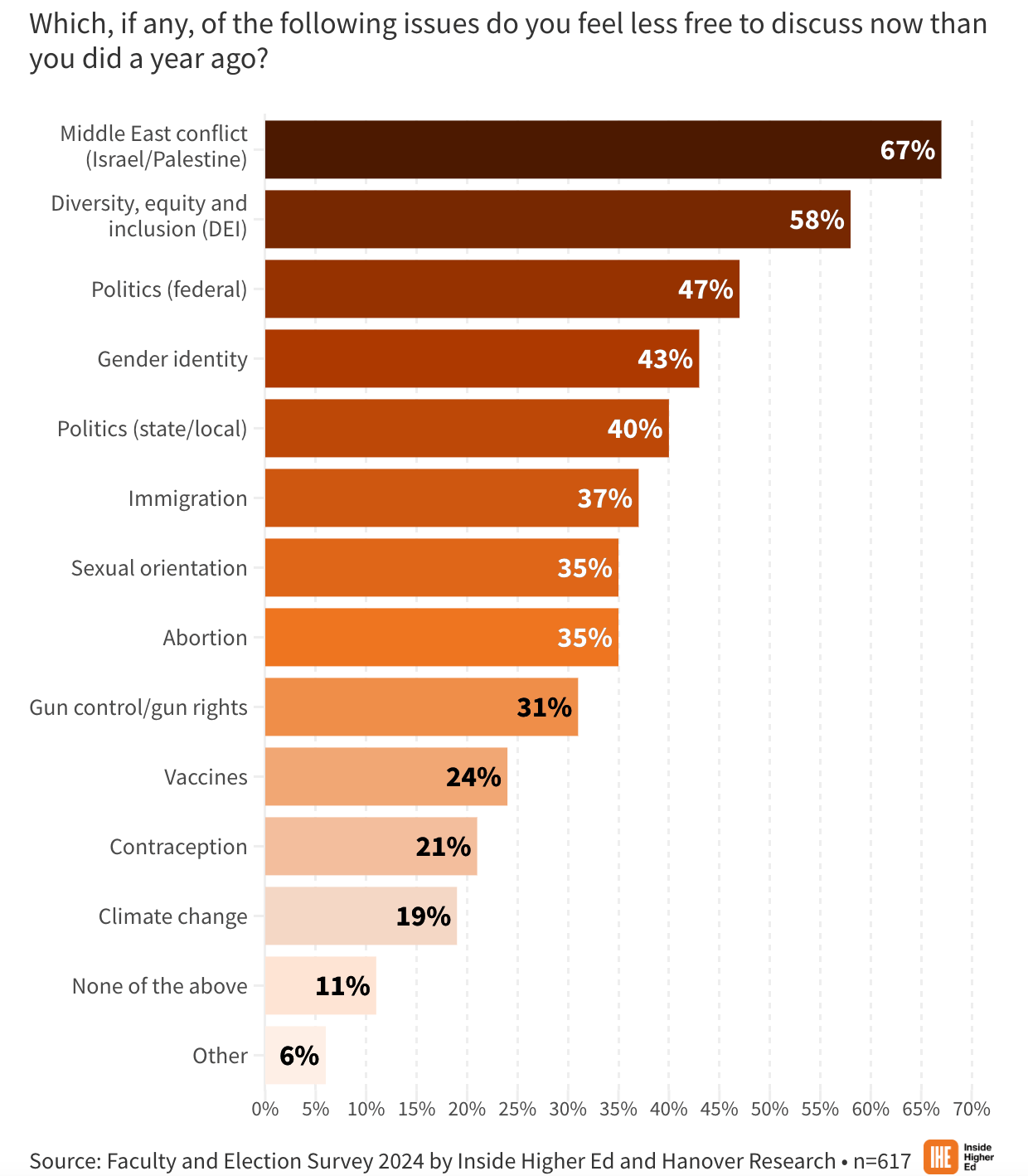
A recent Inside Higher Ed/ Hanover Research survey further documents this tendency.  The researchers state: “The feeling that it has become riskier to speak freely has led many faculty to censor themselves.  Nearly half of respondents somewhat or strongly agreed that they were refraining from extramural speech due to the situation on their own campus and/or the broader political environment. More than a third said they weren’t communicating with students in or out of class about things they previously might have.”

This tendency toward fearful self-censorship is not good for the academic environment.  It is here that Clark, et al. articulate one way forward using the concept of adversarial collaborations.  They write:

“Adversarial collaborations might reduce interpersonal conflict by turning adversaries into sparring partners who improve one another’s science.  Adversarial collaborations can also reduce the use of inflammatory modes of dispute resolution—such as straw-manning and ad hominem attacks—that contribute to a needlessly hostile scientific climate and may contribute to professors’ fears of social sanctions.”

Even on heavily contested social and cultural issues, those on divergent sides can work together and in the act of adversarial collaboration can overcome unhealthy biases. 

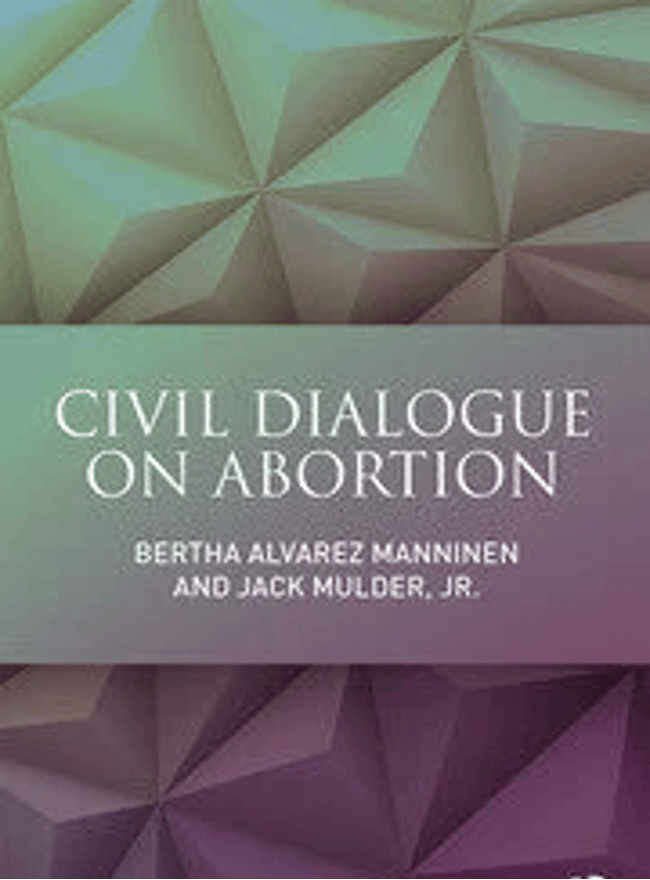
As we consider adversarial collaborations it is helpful to find models of this.  I was recently invited to present a talk at ASU on the topic of abortion and the personhood of the fetus.  I began my lecture with a reference to the book Civil Dialogue on Abortion by Bertha Alvarez Manninen and Jack Mulder, Jr. 

Manninen and Mulder are long-time friends who find themselves on opposite sides of one of the controversial conflicts today.  They manifest a high-level of argumentation with a simultaneous level of evident respect.  They outline four needed traits and dispositions needed for fruitful discussion:

  • Humility
  • Solidarity with our conversation partners
  • Avoiding dismissive words and phrases
  • Leading with what we are for instead of what we are against

They also list out some basic rules for dialogue when they write:

“Thus, we might say that civil discourse occurs when people of sincere conviction (a subjective condition) who are willing (also subjective) to submit their opinions to the (metaphorical) court of argument and rational discourse (this is at least more objective in the sense that we can agree on certain logical rules that can be articulated for any debate) are therefore invited to the table of conversation and not disinvited unless they refuse to make their case in such a fashion.”

Our students and the larger culture desperately need to this kind of dialogue on critical and controversial issues modeled for them.  The future of education—and our culture—depends on this!

_________________________________

A Love Letter to SEL

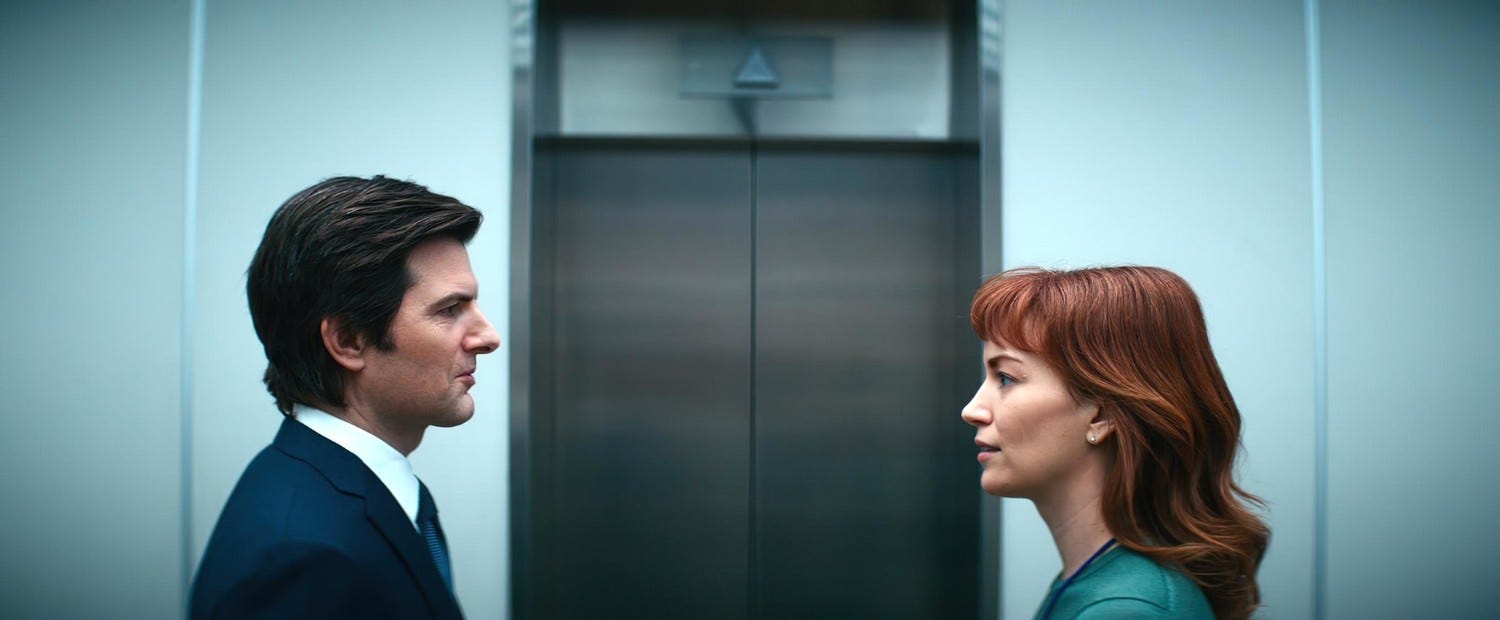
As Severance fans know, no talking in this elevator!

If we find ourselves in the elevator of the Life Sciences building, I will talk to you. This is not because I’m outgoing; my default setting tends to the shy side. But, after reading the study Mistakenly Seeking Solitude, I learned a thing or two.

  • Thing 1: We tend to underestimate the positive feelings that can come from conversing with a stranger.
  • Thing 2: We also underestimate the good feelings a stranger may experience through our bid for connection.

In this study, various train and bus commuters were asked to 1) connect with a stranger next to them, 2) remain disconnected, or 3) commute as they normally would. In short, people predicted more positive experiences in solitude, when in fact increased connection led to happier feelings about the commute. The rub? Unless we actually take the risk to reach out to a stranger, we persist in the notion that solitude is preferable and potentially miss out on a feel-good boost.

This is but one of the lessons on unexpected sources of happiness in my PSY 262: Positive Psychology course, and I share this research finding with my students on the first day of class. For one, it is an excellent example of scholarly research in positive psych. But also I use it as encouragement for them to connect with the “strangers” in their new class. A side effect I’ve noticed after the pandemic is less chit-chat between students before class. But in this class, my students definitely converse more freely with each other, and I attribute this in part to what they learned about positive emotions from this study.

In my PSY 372: Educational Psychology course, I demonstrate relaxation techniques for these teachers-in-training such as body scan meditations and box breathing. My purpose is, again, twofold: 1) to give them tools to use in the face of inevitable teaching stressors in their future classrooms, and 2) to help them center their bodies and attention before we begin our class. I visibly see their stress melt away when we use these techniques, and as a result they are more receptive to whatever I am teaching on that particular day.

Both of these teaching practices are examples of Social and Emotional Learning, or SEL. I believe being able to self-regulate emotions and behaviors is the ultimate 21st century skill for students, faculty and staff. Learning about unexpected paths to happiness and ways to manage stress are critical life skills. And in most cases, SEL can be integrated with academic content.

SEL defined

Not fútbol, as it turns out

I was inspired to write about SEL this week after reading Alisa Cooper’s moving post, Erasing DEI at MCCCD is Erasing Us! Alisa’s impassioned essay makes clear what Diversity, Equity, & Inclusion (DEI) actually is, and I am grateful for her efforts to clear up clearly mistaken notions about DEI. SEL is another political target that suffers also from mistaken identity. So what is SEL?

This week happens to be National SEL Week. The Collaborative for Academic, Social, and Emotional Learning (CASEL) is a leader in this area and defines SEL as “the process through which all young people and adults acquire and apply the knowledge, skills, and attitudes to develop healthy identities, manage emotions and achieve personal and collective goals, feel and show empathy for others, establish and maintain supportive relationships, and make responsible and caring decisions.”

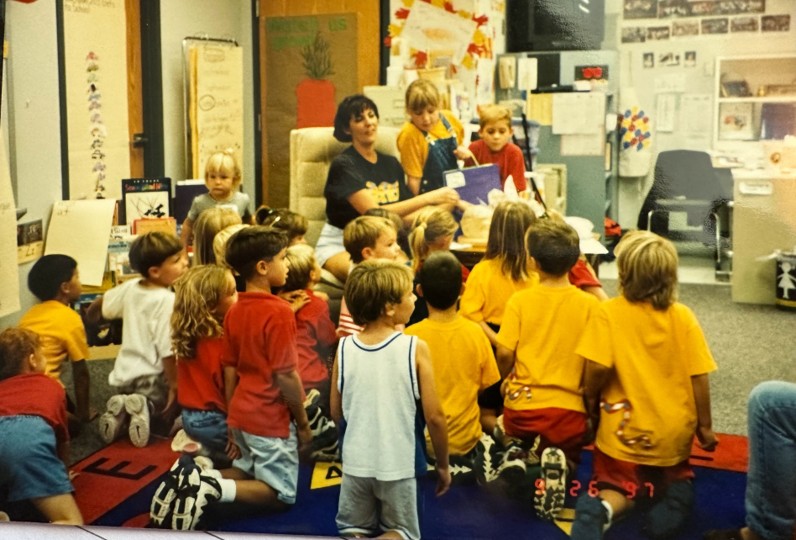
My K/1 students in an SEL lesson, circa 1998

I taught elementary school for many years, and SEL was a key component of my instruction. I was fortunate to teach in a school that implemented SEL schoolwide, and I witnessed SEL helping students both inside and outside of the classroom. For example, we spent the first two weeks of the school year steeped in SEL activities – icebreakers, social skills lessons, and other activities aimed at creating a safe learning environment. Where some might call this a waste of instructional time, we called this “frontloading,” and these practices are supported by the science of how the brain works and how children learn. As a result of our SEL efforts that continued throughout the year, our students’ headspace was more freed up to learn and we got so much more out of them as a result.

What is at stake?

Currently no state has established outright bans on SEL, but several bills have attempted to do so. The chatter around the demolition of SEL is definitely in the air. It is important at this time to share the heart of SEL in an attempt to clear up issues with its definition. If changes are to be made to the implementation of SEL in schools, my hope is that it would involve a careful, surgical approach that keeps the best interests of students at the center.

My husband, now a retired police chief, used to talk about “badge-on-the-table” situations. He told me that if he was ever in a situation that challenged his integrity, he would put his badge on the table and move on. Being told I couldn’t incorporate SEL would have been the equivalent to a badge-on-the-table situation for me as an elementary school teacher. Or, to paraphrase Charlton Heston’s words to the NRA, “I’ll give up SEL when you pry it from my cold, dead lesson plans!”

Erasing DEI at MCCCD is Erasing Us!

I am Black. I am female. I am gay. And I am deeply disturbed by the efforts to strip Diversity, Equity, and Inclusion (DEI) initiatives from Maricopa Community Colleges. The decision to remove DEI isn’t just about policies or politics. It’s about people. It’s about students who walk onto our campuses and wonder if they belong like I did when I went to college. It’s about faculty and staff who have fought to make education more inclusive, only to see those efforts dismissed as “unnecessary” or “divisive.” It’s about me.

Let’s be clear: the push to dismantle DEI is not neutral. It is not about fairness. It is about erasing the progress we’ve made in acknowledging and addressing systemic inequities in education. When institutions remove DEI programs, they are sending a message, one that says the success and well-being of marginalized students and employees are not priorities. They are telling Black, brown, LGBTQ+, disabled, first-generation, and other underrepresented students that their experiences don’t matter. That their barriers to success aren’t worth addressing. That their presence on these campuses should be tolerated but not supported.

Take Black history, for example. Every February, colleges, including MCCCD colleges, acknowledge African American History Month with events, guest speakers, and discussions that bring attention to the depth and complexity of Black contributions to this country. Black history is American history. But even that is being threatened. With DEI under attack, colleges are mandated to erase these programs, making Black history an afterthought rather than an essential part of education. And let’s be honest, most students in this country already learn very little about Black history. Ask the average person what they know, and they’ll give you the same names: Martin Luther King Jr., Rosa Parks, Harriet Tubman. Maybe Malcolm X if they had a teacher who strayed from the sanitized version of history found in textbooks. Beyond that? Silence.

They don’t learn about the countless Black scientists, inventors, and writers whose work shaped the world. They don’t learn about the thriving Black communities that were systematically destroyed, like Tulsa’s Black Wall Street, or the racist policies that shaped housing, education, and criminal justice in ways that still impact us today. They don’t hear about the long tradition of Black resistance, innovation, and excellence beyond the narrow lens of slavery and civil rights. DEI was one of the few institutional efforts pushing back against this erasure, ensuring that students, Black and otherwise, got a fuller, more honest education. Now, that effort is being ripped away. Are they coming after my African American literature class next?

We’ve heard the arguments against DEI. That it’s divisive. That it gives “special treatment.” That it lowers standards. These are convenient lies told by those who are uncomfortable with confronting the reality of inequity. DEI does not give unfair advantages; it ensures that opportunities and resources are accessible to everyone, not just those who have always had them. It does not lower standards; it recognizes that different students face different obstacles and works to remove those barriers. And if you think DEI is divisive, ask yourself: who actually benefits when it is removed?

The answer is simple. The removal of DEI benefits those who have never needed it. It benefits those who have always been represented in leadership, in curriculum, in hiring, in decision-making. It benefits institutions that don’t want to be held accountable for disparities in who gets hired, who gets promoted, and who gets to succeed. It benefits politicians and administrators who pander to anti-DEI rhetoric while ignoring the real harm they are causing.

So what happens now? Do we just accept that MCCCD is willing to silence and erase its marginalized students and faculty? Do we quietly watch as years of hard work and advocacy are undone? No. We speak up. We push back. We make it clear that the removal of DEI will not go unnoticed and that the people it is harming will not be ignored. They can erase DEI from our web pages, but they can’t erase us!

MCCCD should be a place where all students, regardless of race, gender, sexuality, or background, feel valued and supported. If the institution refuses to uphold that mission, then it is failing its students. And failure is not something we should accept.


Note: I started Write6x6 in 2015. I own this domain and champion all the diverse individuals who have shared their stories and experiences with our GCC community and beyond. So, MCCCD can’t erase us or this very diverse and inclusive blog.

The Interstate: GEN Z in the Workforce

Article By: Lauren Sundblom, STEM Connect Student Service Specialist

Recent discussions in the media suggest that many Gen Z workers struggle to meet employer expectations, with some experiencing difficulty retaining jobs in their early careers. While concerns about workplace preparedness are valid, they must be examined in the broader context of evolving workforce values and changing educational preferences.

Unlike previous generations, Gen Z places a high priority on work-life-balance, mental health, and job satisfaction. Rather than adhering to traditional career trajectories that emphasize long hours and gradual advancement, many young professionals seek immediate fulfillment and efficiency in their work. This shift challenges conventional workplace norms but also presents an opportunity for organizations to reassess how they attract, train, and retain the new age of employees.

This preference for efficiency extends to education. Many students today may be less inclined to pursue the standard four year bachelor’s degree and instead find value in certificates, boot camps, and accelerated programs that offer quicker entry into the workforce. Insights from experienced student advisors suggest that this trend reflects a growing demand for flexible, skills based learning pathways that align with industry needs. While this approach may shorten the time spent in formal education, it also requires students to develop key professional competencies such as communication, adaptability, and problem solving outside of traditional academic settings.

To better prepare students for the workforce, educational institutions must emphasize the development of transferable skills alongside technical knowledge. Experiential learning, internships, and mentorship opportunities can help bridge the gap between education and employment. Additionally, fostering resilience and a growth mindset will be crucial as students navigate a rapidly changing job market.

Rather than viewing Gen Z’s approach to work as a challenge, it can be seen as an opportunity to create more sustainable and engaging professional environments. By balancing the need for workplace adaptability with Gen Z’s values of flexibility and purpose driven work, both employers and educators can play a role in shaping a workforce that is both skilled and fulfilled.

A Wild West Garden Adventure

In the spirit of the upcoming Teaching in the Wild West CTLE Conference in April for my final Write6x6 post of 2025, I am hitching up my reflection horse and sharing a little of my trailblazing efforts. I hope you find something you can use on your own trails.

When my students got lost in the digital wilderness, I saddled up a semester-long trail ride through the Gaucho Urban Garden to lead them back to nature’s frontier. For several years, I have been working on an experiential learning experience that incorporates problem based learning for the students in my English Composition class. This year, I have expanded my approach in a way that I think is worth sharing. It all began in week one with the students tracking their digital technology use. Before heading to the garden, we had to face the truth about our digital habits—like recognizing when your trusty steed has become a stubborn mule. So, the students spent a week journaling about their technology use, using apps to track their time on their phones and paying attention to what they were doing with their time.

The week that followed was one of the more challenging ones. The students chose the most ornery of stallions to break, the technology they found was the most addictive. They broke up with that technology for seven days, journaling about their experience and about what they did instead of that habit. All the while, the students researched the mental and physical impacts of digital dependency. This part of the project culminated in an essay where they linked their research with their findings on their personal experiences. For many of the students, it was eye opening.

Next came the experiential learning component, the students began to work in the Gaucho Urban Garden. At the Gaucho Urban Garden, my students traded their digital spurs for garden gloves and learned that cultivating ideas requires getting your boots dirty. For one hour each week, the students would learn from a biology instructor about the care, maintenance, and upkeep of the garden. They planted seeds, harvested crops, learned about fertilizer and watering cycles, repaired sprinkler systems, and took ownership of an experience that most of them have never had before. All the while, they journaled about their experiences, what they were learning, and what foods they grew and ate. So many students ended up looping in their friends to the garden that we had more than just my students involved, and they kept coming back! This experience began as they were breaking up with their technology and continued through to the very end of the semester.

Then, the students began the research stage, where my students began to explore the possible solutions to digital dependency. My buckaroos rounded up solutions like skilled wranglers, corralling research into annotated bibliographies that would make any trail boss proud. They gathered sources, took notes, and explored solutions that would eventually be applied in their final essay. They got to know the skills they needed for the researching process and spent time in the library gaining new approaches from those friendly Gauchos, the librarians.

The next stage was a home based activity that also involved research and reflection. The home composting project. Their home composting adventures were like taming wild territory—turning kitchen scraps into gold just as surely as any prospector struck paydirt. The students researched what it takes to compost and began working on a small scale composting project that they digitally journaled about. The digital journals weren’t just campfire tales—they were carefully mapped trails showing others how to follow in their footsteps that led to the next stage of the course. Creating “how-to” TikTok style (or Youtube short) videos around composting or gardening, or in some way related to their suggested solution. Creating those ‘how-to’ TikToks was like learning to quickdraw—communicating their solutions faster than a gunslinger at high noon.

Once these stages were completed, it was time to bring together all the elements they’d gathered along the trail, like a skilled scout who knows how to read the landscape and find the clearest path forward. The students wrote an essay that brought together all of the ideas, the projects, and their experiences with the research. With a combination of metacognition, reflection, research, and rhetoric, the final essay hits every learning objective in the course. The students were able to demonstrate the skills they had learned in composition and apply those skills in a way that made it obvious why the skill was important.

Basically, in this wild west approach to teaching composition skills, these digital cowboys and cowgirls had learned to rope, ride and wrangle their way to a healthier balance between technology and nature. The students have told me that this has been an incredibly fun way to apply the things they need to know for future classes, and I have watched them grow as learners. As they ride off into the sunset, I know they are prepared for blazing their own trails.