Tag Archives: Faculty

It Takes a Village

Names have been changed.

I do not know that I, as an individual, make a difference; however, I do believe that WE, as a college, make a difference because we care, and we work hard to make one. “It takes a village […]” the African proverb teaches. The difference that we make is quantifiable in the success stories of our students. Through their success, the measurable difference becomes a bit more tangible. Here are a few of mine.

In my first semester as a faculty member at GCC, I had an 8:00 a.m. ENG102 class scheduled in LA107. In that class, I had Hercules, Heidi, Hunter, Jessica, Edgar, and 19 other students whom I would remember if I saw their faces. T used to sit in the back left corner of the room. Small in stature, she wore glasses and braces, but they did not mask her insecurity when it came to her writing skills, nor did they mask the fire that T possessed for achieving her goals. She was intelligent, persevering, and inquisitive.  What I admired about her was that she never let up with her questions until she received the answer she was looking for. She was always diligent in her work, reading, revising, proofreading, rewriting, until her final product was A worthy. As I grew to know T over the course of the semester, I also learned that T is a fighter and that she had been on her own in the United States as a young teenager, leaving family behind in Guatemala, without knowing any English. She came to the United States to have surgery to help correct a congenital bone malformation in her leg. After my class ended, I would see her on campus, mostly studying for Chemistry, but she continued to check in with me in her next semesters, and about her search for scholarships to continue her educational dreams. She was unsuccessful in obtaining the Dorrance scholarship, but I wrote her another recommendation for Barrett, the Honors College at ASU. This fall, I received this email from T:

Continue reading It Takes a Village →

IDP: Reflections on Student Evaluations

REFLECTION: 
 

In addition to the qualitative and quantitative department measures, two years ago I added a pre-post assignment dealing with students’ expectations for the class. I got this from one of the student success articles I read. Students respond to three prompts that tell me about what they look for in a good class, a good teacher, and how they view their role in the whole learning process. The rankings of x/10 indicate how well the reality at the end of the semester matched the expectation they set in their first assignment. They also add additional comments.

I find these pre/post assignments to be especially helpful when students do not rate me as satisfactory or higher in the course evaluations. For example, in the Fall 2015 EDU220 course evaluations, five or six students responded with less than satisfactory in several areas. The student evaluations are typically done with three weeks left in the semester. When I drill down into students’ comments at the end of the course, I’m pleased that overall I met their expectations (see attached pre/post First Assignment). In talking with my EDU students in particular, many of them need the entire set of course experiences to feel confident about their ability to serve English Language Learners.

Because most of my courses deal with students’ confidence in their own abilities, I continually focus on ways to help them relax, have fun, and see their own personal growth.  My daily challenge is to build relationships that are strong enough that they are willing to take risks and learn new things.

Write 6×6 Round Two Started Feb. 1st

write6x6I’m excited to be blogging again with my colleagues at GCC as part of the Write 6×6 Challenge. We had such success with our inaugural challenge last spring, so I was a bit nervous that no one would sign up for round 2 a year later. Luckily I will not be the only one blogging. We have 20 faculty, staff and administrators signed up! Yay! We even got the president blogging again.

In week one we are blogging about how we make a difference, although everyone is free to write about what ever. I’ve learned that most people just want to be told what to write about. Funny how faculty and others are just like our students in that regard. I tend to like to reflect on things in general and then write about what stands out the most. That’s a real challenge when you have a ton of stuff going on. Nothing tends to stand out, yet everything weighs heavy on my mind.

Sometimes I feel like I need a kick to help get me started on things, and that’s how I feel I’m making a difference at GCC. I’m providing the kick that others need to get started. We all have great ideas to either work on or share, and everyday in the CTLE we work to find ways to help faculty and staff hone those skills to develop their ideas or to just share them with others. We challenge them daily to learn new things, get involved, experiment and share where otherwise they would not feel challenged to do so or feel they don’t have the opportunity. If faculty and staff want to be challenged and want to be engaged, we’re here to make a difference.

When Making a Difference Means Failure

Making a difference makes us feel good. As educators and those who work in an educational environment, I honest believe it’s built into our DNA. The desire to make a difference is what makes our work meaningful.  The gratification that comes from helping someone, seeing a student finally “get” the concept, or watching a student grow and mature is relatively short-term. We see it in within the semester or so that we are working with specific individuals.

But what about the students who we couldn’t reach? We all have worked with them – the constantly absent, texting aficionado, excuse ridden, unengaged students. The ones who don’t do the homework, do not participate in class, or fail tests without caring often end up with grades that reflect that behavior. They do the bare minimum. They are also the ones, who at the end of the semester, are searching for extra credit or some way to blame you for their poor grade. They leave us thinking – is there something else I could have done? Does this student have extreme circumstances that I don’t know about? Is there just a personality conflict? Should I give them the benefit of the doubt, or should I let them fail? If they fail, will they come back and try again? These are tough decisions to make sometimes, especially given the conversations we have had this week about the Aspen Award.

How does this go back to making a difference? Maybe, by letting them fail we ARE making a difference – but with no gratification for us. Maybe the student who really didn’t earn a passing grade must learn the important lesson of setting priorities, time management, making choices, or even simply being present for the commitment he/she made. By passing them, are we simply delaying future, more consequential failures? Are we really doing them any favors by bumping up a borderline grade?

Unfortunately for us, we often don’t get to see the impact that has on a student in the future. Sometimes it is not until much later in life that they realize that failing that class set them on a new, more positive course. By then we don’t see the difference we made. And those differences often require more work and energy from us. I would like to argue that, in fact, a difference was made.

What the Kittens Teach Me

  I lost my long time, super sweet cat about six months ago, and I knew I would eventually get

The kittens: Lady Bug and Lila

another cat. When the Humane Society had their special “adopt a cat” deal, I thought,  This is a sign. So I went early one day, and I was happy to see a crowd there adopting cats and kittens.  Most of the cats were sleeping or huddled into the corners of their tiny metallic cages. These two?  They were playing, chasing their tails, chasing each other, and even playing in the litter box.  They seemed to have no idea the miserable situation they were in. Lesson One:  Play. No matter what life throws at you, play.  I am happy to say they are still playing. I’m trying to play more, too.
   Lady Bug and Lila think I’m their mom since I feed them, pet them, and talk sweetly to them.  So it’s no big deal to them to wake me in the middle of the night, crawl onto my chest, and begin purring.  They need some attention and affection (and probably want more food).  Lesson Two:  Patience.  It’s so hard to get mad at a purring kitten in the middle of the night.  
   

Papi and Lady Bug

The kittens are blending in to the family quite well.  They have a dog to contend with, Papi.  They seem to be co-existing splendidly; in fact, Lady Bug really likes Papi and will rub up against him, purring. She’ll even lie next to him.  Lesson Three: Be friendly to everyone.  Lesson Four: Cuddle.
   

Money Matters?

I can’t help thinking that lately, money has become the focus in academia. As the state cuts all state funding from community colleges in Maricopa County Arizona, how do we continue to deliver the best two year school education in the United States? What do we do? The answer seems simple to me, we continue to carry out the mission of the college.
Here is the Glendale Community College mission (taken from our website):

Glendale Community College prepares students for further higher education, employment and advancement, and successful participation in a global society.

Let’s focus on that mission. Everyone at a college plays an educational role for our students, from the college president to the clerk typist, to the faculty member in the classroom, to the maintenance and operations people, to the student affairs staff. Everyone at the institution should be aware of the college mission, and keep that as the focus of everything that we do.
If we all do that, we can continue to deliver the best to out students despite the financial woes. We can continue to do what we do best!

Life is Not a Multiple Choice Test

… well I suppose it can be, if you know what the choices are. In many cases, however, the available choices are not fed to you. There is no bubble sheet to fill in. It’s up to you to figure it out with no hints from a prompt.

Many of our younger students have been tested to death. One thing is for certain, they are comfortable with multiple choice options.

Last semester, I told my students that I was assigning a final project instead of a final exam. They begged me for a multiple choice test instead. To their credit, I had assigned a large number of projects throughout the semester, so I caved and wrote a final exam for them.

I do believe, however, that a degree means more than regurgitating facts. There are a number of other skills employers expect when they hire someone with a degree. I think these skills are learned through the college experience as a whole.

I came across this list of traits that we really cannot measure with tests today:

Whether or not we use multiple choice tests for factual knowledge, I believe the experience of going to college and completing practical application projects helps develop these characteristics.

Next time I work with a student who is frustrated, doesn’t like group projects, writing assignments,  or has roadblocks and other issues in the way – I will come back to this list, for no matter what a student’s major is, these skills come along with it. And we all get to contribute to that!


The Students…

After reading Louise’ s post  (who was and continues to be one of my mentors for PAR ), I was thinking about who drives me the most…my students! I have had the pleasure of having some students take me for several reading classes in a row. Not only do these students drive me to give them my best, but I also learn so much from their own struggles, goals, and ambitions!

Here are a few…

Sadan: I had this student for RDG 071, 081, and 091. I have observed  her grow each semester in her language and reading skills! I wrote a letter of recommendation for her to get her first job as a cashier at Ross. She was so excited! She had been interviewing for the past six months. I worked with her this past summer and several other students in an informal book club. She was very dedicated in developing her language skills…Her excitement drove me to spend my own time working with her and those other students.

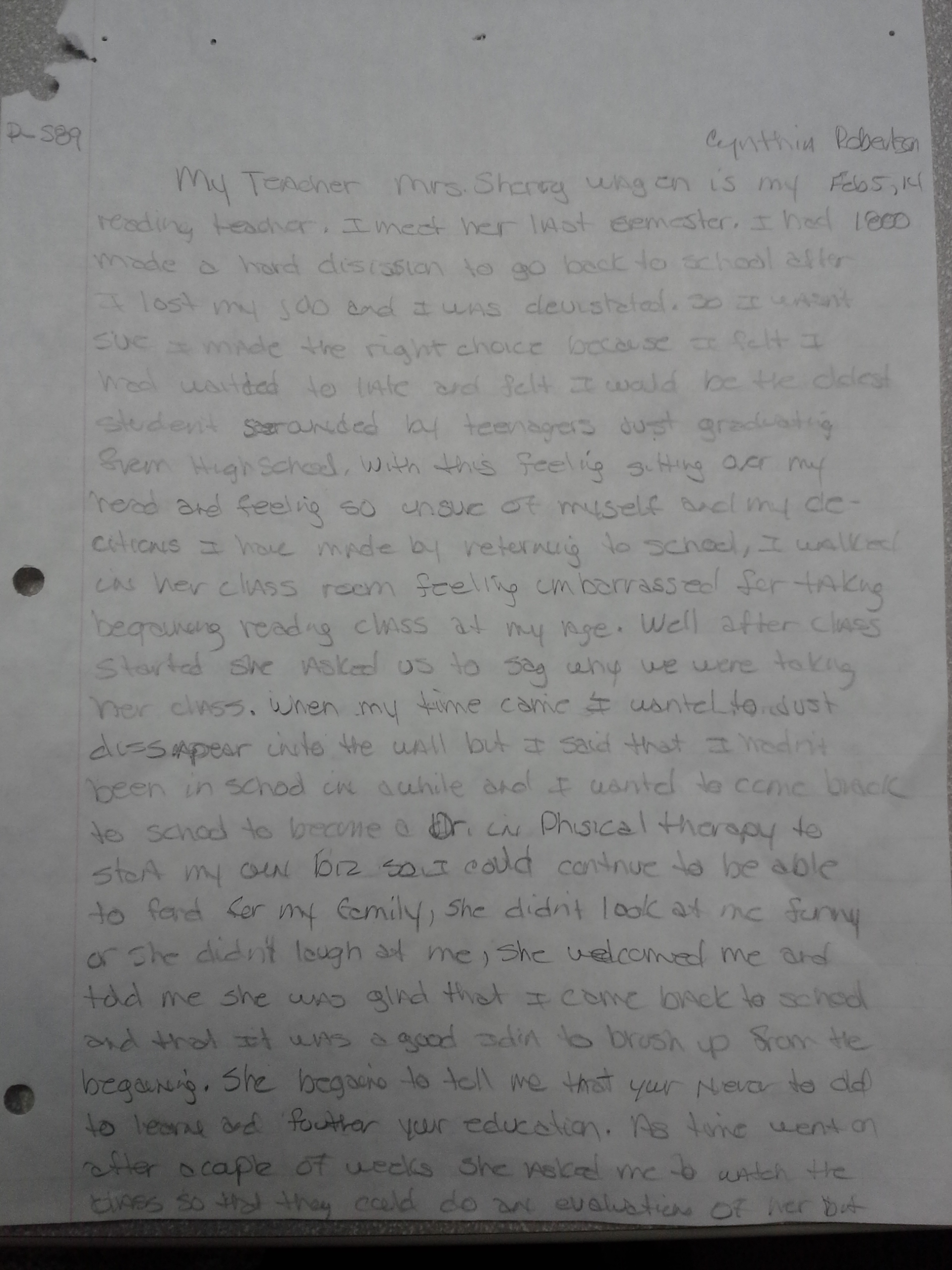
Cynthia: I had Cynthia my first semester as full time faculty in the Fall of 2013. At the time she was a 50 year old veteran and widow coming back to school.  For one of the assigned articles, the students had to write a response to someone who greatly impacted their life…she chose to write me a beautiful letter on how she was so nervous her first day, and felt too old and “dumb” to come back to school, but that I made her feel valued as a student by using  her life experiences as examples and connections. I keep this letter pinned up in my office as a reminder on the impact we have as instructors. I had Cynthia for RDG 081 and RDG 091. I watched her struggle with so many issues, that I was challenged to make each class period worth her time and effort for being here.

Cynthia

Hamad: This student started in the same class as Cynthia…I also had Hamad for RDG 071, 081 and 091. Hamad was a college professor in his own country. Having him in my classroom has been such a great experience! Yes, he started in such a low level of reading, but recognizing his competence and degree from his own country drove me to make sure my lessons reflected that ability… He recently just became a citizen of this country and was so proud the day he came into class. I now have his son in my RDG 091 class.

I am sure all of us have students like this that make it worth our while to get up every day and do what we do! These are just a few of mine:)


Every day brings something good!

So what is the “real main idea” here, Miss?

At the beginning of each unit, I present my mini-lectures on reading skills. It never fails that as I am talking I suddenly focus in on my students’ faces and think, “Really, Cindy? Do you think they really care about the main idea (etc.)?” Just this semester, I have a student whose 12 year old sister threatened to commit suicide, a student who was “working 2 jobs totaling more than 60 hours, taking care of her sick father, and taking 4 classes,” a student who “just wants to play baseball,” 2 students who told me they “are just here to play football, nothing more,” and a pregnant student who feels sick all the time. (I’m sure you have the same “stories” sitting in your classroom.) And I want to talk about main ideas! I feel Charlie Brown’s pain!

wahwahwah

So let’s talk about the “real main idea” here:

I just read a book called Mister Owit’as Guide to Gardening: How I learned the Unexpected Joy of a Green Thumb and an Open Heart; an unexpected gem because it happened to speak to me in my life right now. Through his work in her garden, Mr. Owita teaches Carol a thing or two about life. An unexpected friendship develops and the two help each other through personal crises and to reach a greater understanding of how to deal with what life deals us. Yep, sappy! Long story short, the book ends with this line: In every moment there exists a lifetime. Every day brings something good!

As I finished the book this morning (Tuesday, 3/9), I stepped out into our back yard and thought about my teaching day ahead. Aargh, 4 more days and then spring break! TG! Then, as I glanced down, I saw a rose bud on my brand new yellow rose bush called “Easy Living.”

YellowRose The main idea: In every moment there exists a lifetime. Every day brings something good! I can’t wait to answer my student’s question!

Naming Names

I am willing to name names, and I have two.

First of all, Laura Dodrill.

When I arrived at GCC in the fall of 2012 fresh from out-of-state, I had absolutely no prior experience teaching for a school in the Maricopa system. I was coming from a community college in New Mexico where I had tenure and seniority in my department. I was coming from a school where the number of full-time faculty in the English department (about 12) was about one-third the number it is here at GGC.  In short, I was coming from a place where I felt I made a difference in many ways beyond teaching.  While teaching here felt as fulfilling as it did there right from the start, I was now at a much bigger school in a much more complicated system.  Weeks and semesters were passing, and I was surprised at how long it was taking me to feel a part of GCC in any other way than teaching.  Sometimes, I simply felt adrift.  I would go to meetings in my own department and not recognize everyone I was sitting amongst.

But there was Laura.

Laura was assigned to be my FYRE mentor. FYRE is the First Year Residential Faculty Experience (or something really close to that). That meant that Laura had to mentor me for an entire academic year. She did so willingly and with aplomb. She answered (with incredible patience) my most basic questions, including how to use my office phone.  I would send her emails asking what acronyms meant (FEP, FYE, SOP, FPG…) .  She would answer cheerfully. She brought me a plant for my office.  She checked in on me from time to time popping by my office.  Right from the start, (to use current parlance) I knew she had my back. She still has my back. I can call her, write her, or go to her with any kind of concern. That kind of relationship–the kind where I know my mistakes will be forgiven and my concerns will be heard–is so precious to me that it has made me want to be a better teacher and colleague, and it made me want to find my place at GCC.

And then Laura introduced me to Celeste.

When it came time to plan the 2014 fall schedules (one year in advance in 2013) Laura suggested I join her and Celeste Walls in teaching an FYE (First Year Experience) learning community. Laura and Celeste had already done this together.  Laura would teach a Counseling and Personal Development class (CPD), and Celeste would teach an Introduction to  Communications class.  I would join them by teaching a Developmental Composition course (ENG 091). Because scheduling is planned so far in advance,  I had never met Celeste before the first time the three of us sat down in early August 2014 to align our plans for teaching the FYE that coming semester. We had emailed each other prior to that but had  never met as a threesome in person.

What transpired for me this past fall was far more than being one-third of a learning community. Because Laura, Celeste, and I met so regularly to debrief about our cohort, we formed a bond. And Celeste Walls became the second person at GCC (besides students) who inspired me to be a better person, teacher, and colleague. I wanted my class to match her class.  She has high standards for everyone — her students, her colleagues, and herself.  I wanted to meet her standards.  Furthermore, if I was having trouble drawing out a shy student in my class, I could ask for her and Laura’s advice.  If an assignment didn’t go well, I could debrief with them and figure out what went wrong.  I could present either one of them with challenges I was having in the classroom (and not just the FYE classroom, but in any one of my classes), and they’d respond thoughtfully and make suggestions. But what I love most about Celeste is that she’s really interested in what I say.  She leans forward to listen when I speak. She sets a high professional bar and simply through her actions, those around her are encouraged to reach it.

Laura and Celeste aren’t only outstanding teachers and colleagues.  They are the kind of people who reassure others by making a place for them in the community.  Largely because of them, I’ve been able to settle in. Who wouldn’t be inspired hanging around with people like that?