Category Archives: Write6x6

Money Matters?

I can’t help thinking that lately, money has become the focus in academia. As the state cuts all state funding from community colleges in Maricopa County Arizona, how do we continue to deliver the best two year school education in the United States? What do we do? The answer seems simple to me, we continue to carry out the mission of the college.
Here is the Glendale Community College mission (taken from our website):

Glendale Community College prepares students for further higher education, employment and advancement, and successful participation in a global society.

Let’s focus on that mission. Everyone at a college plays an educational role for our students, from the college president to the clerk typist, to the faculty member in the classroom, to the maintenance and operations people, to the student affairs staff. Everyone at the institution should be aware of the college mission, and keep that as the focus of everything that we do.
If we all do that, we can continue to deliver the best to out students despite the financial woes. We can continue to do what we do best!

Reflection isn’t such a bad word

I really enjoyed this 6×6 writing experience of sharing my thoughts with others. I never blogged before. It gave me a time to reflect about the students I have worked with over the years and to give life to my experiences.

I remember back in the early 1990’s, during my last semester of college prior to student teaching, everything we did in our education block had to be reflected upon. We had to write reflections on our lesson plans or what we gleaned from a particular writing or how a classmate conducted her lesson…. I began to really hate the word “reflection.” One day, my instructor told us to reflect on all our reflections. That did it! I rebelled and didn’t do it!

Now 25 years later, I think I enjoy reflecting. Thanks for the opportunity.

SPA Goes Green

By: Alka Arora Singh, Dean of Strategy, Planning & Accountability Have you ever seen a group of six employees pacing around campus? You know, the ones talking animatedly and oblivious to the world? If you get close enough to them you might hear head-spinning terminologies like analytics, forecasting, compliance, and planning. Hey, somebody’s got to work on all these super cool projects and GCC’s lucky team is from the Office of Strategy, Planning & Accountability (SPA): Sarah, Owan, Jay, Eddie, Phil, and Alka.

SPA works on several key functions and mission critical institutional projects. Some examples follow.

  • Institutional Research. The new paradigm for higher education is data informed decision making. Some recent examples for GCC include course load analysis, data for SSI and Developmental Education, and Market Analysis.
  • Accreditation from the Higher Learning Commission (HLC) and Compliance. Abiding by federal regulations is the ticket to Title IV federal financial aid for our students. Some current work in response to stakeholder needs pertains to Gainful Employment, Debt-Income Ratios, and Student Success.
  • Strategic Planning.  GCC has three planning tiers: Tier I (college plan); Tier II (divisional plans like Academic Affairs and Student Affairs); and Tier III (departmental or operational). These plans are integrated top-down (vertically) and also integrated (horizontally) with resources, assessment, and review for continuous quality improvement and student success.

Okay, so what is the outcome from all this crazy amount of work? How does SPA contribute to the institution, and help with student success? Glad you asked!

  • SPA worked closely with the instructional deans and department chairs to develop a more data-informed and efficient course schedule development process in 2014.  The process was instrumental in reducing GCC’s instructional budget deficient by approximately $2,000,000.
  • GCC proactively sought HLC approval for our three additional locations in 2013. Had this not been done in a timely fashion, Title IV federal funds used at those locations would need to be returned to the U.S. Department of Education.  While this amount can vary by enrollment, the amount could be $100,000 or more. When GCC had its routine review from the Office of Civil Rights (OCR) in 2013, one of the items on their agenda was handicap accessible seating in the Performing Arts Center (PAC).  The college worked with OCR on a solution that met the seating needs while at the same time saving renovation costs exceeding $1,000,000.
  • GCC received an award for Institutional Innovation and Integration in 2014 from the Society for College and University Planning (SCUP). Only one college in the nation receives the annual award, which recognizes innovative thinking, planning and implementation in strategic planning. The award acknowledges GCC for allocating resources successfully and effectively linking them to the institution’s vision, mission and academic priorities. GCC received publicity value worth $218,000 from this award.

Every one of the initiatives above helps students be successful: efficient course schedules, accreditation and financial aid, and planning.

The Office of SPA is committed to meeting local and federal mandates, and providing top quality customer service in keeping with industry best practices. The office takes pride in meeting your needs in an accurate, timely, and consistent fashion. And all this while helping the college save approximately 3.3 million dollars in less than two years (from a small sample of projects). Not too shabby for a bunch of geeks eh?

If the Green Efforts Committee is reading this post, SPA does work with various dimensions of green beyond dollar bills. We skip printing when possible, turn off our lights when out of the office, and recycle!

For more information on the Office of Strategy, Planning & Accountability, please visit http://www2.gccaz.edu/departments/administrative/spa

Reflection Based On “Simply The Best”

  • Week 6 (Mar. 9-13): Read the post. Louise asks some really great reflective questions: “Who or what drives you to be the best version of you? Would you be willing to name names?” “Who or what fires your passion for your field of interest and reminds you of your role at GCC?” It’s time to reflect. It’s the last one. Week 6.

Well, this Write 6×6 has pushed me out of my comfort zone. I’m a math/science guy and this writing thing is not my first, second or third choice of fun things to do with my time. That said, it hasn’t been as bad as I had envisioned it. We need to do Solve It 6×6 next 🙂

In response to Alisa Cooper’s challenge based on Louise So’s post “Simply The Best”, I write the following.

There are many people I respect that work here at GCC. I think that the key attribute that gains my respect and admiration is honest caring actions. Someone who genuinely cares about others and doing the best job that they can, where they give without thinking about the cost, always catches my attention. The list of names is to long to write. I’ve never been one who was good at answering the question “What’s your favorite _______?”. I have a lot of favorites. Trying to pick my top whatever people to salute would just be impossible. I hope that everyone I really respect knows it. Maybe that would be a good thing to do after this, write to affirm everyone that I think is doing a great job. Boy, what I’m I saying. That would be a whole lot of writing again 🙁

The question “What drives you to be the best version of you?”, has but one answer for me though, God. Ecclesiastes 12:13b states: “Fear God and keep his commandments, for this is the whole duty of man”. This, along with Ecclesiastes 5:18 “eat, drink, and enjoy yourself in all of your labor in which you toil under the sun during the few years of your life which God has given you.”, express my view of life. My take on this is, work hard, do your best, find enjoyment in all that comes your way, and do it all for God. I hope that if anyone sees me not living by the following two commands, Matthew 22:37-39 “Love the Lord with all your heart, soul, mind, and strength and love your neighbor as yourself.”, will point it out to me. Because this is what motivates me to be the best that I can be.

Disconnected???

This week is the first time in my academic career that I have officially felt I am having difficulty connecting with my students. I am in my 19th year as a college professor, having started at 27 years old.  I remember starting out, fresh out of graduate school. I was frequently mistaken for a student by faculty members who did not know me. I was able to easily connect with the students as I could relate to much of what they were going through. I longed to be respected by my peers, most of whom were older than I was. I sometimes wished I were older because I believed that if I were older, people would respect me and question me less.

Fast forward to this past week. In my 19 year career I have never been more challenged by students. The students in my classes today question me more than ever, and I don’t understand why. I saw them as disrespectful, as entitled, and as rude. I wondered why they felt the need to verbally share everything they know about a topic as though I am not going to cover the topic well enough if they don’t. I wondered why they act as though the are the authority on everything, as though I am not the person to cover the topics. I even wondered if I was in the right profession anymore. I started talking to my colleagues and found that many of them were feeling something similar, though maybe not as pronounced as I was. It was then that I realized that part of the problem was that I had spent a long time becoming a professor, and preparing myself for class every day, and maybe my feelings were hurt. I felt I was at a crossroads in my career, feeling disconnected from my students.

For the last few days I have been thinking about this, and I have come to the conclusion that I need to re-think my beliefs about my students and my role as their professor. The truth is, they do have the ability to find all the information I share with them on their own. With access to Google they can pretty much cover it all. What I need to do is make sure I am focused as a professor on giving them skills that Google can’t give them.  I can teach them to think like a scientist. I can teach them to be critical consumers of information (so I guess I should be happy they question me?), and I can teach them about integrity and professional responsibility.  Maybe teaching the content is becoming a smaller and smaller part of what I do.

The problem is not that the students are different, the problem is figuring out how to change what I do so that I can be fulfilled by my job and give them what they need. I am not one to engage in edutainment, I am pretty old school when it comes to teaching and I doubt that is going to change significantly. I need to connect what I can offer to what my students need.  If I can do that I can continue to do what I do at a high level and enjoy it. Something for us all to think about.

Simply the Best

Simply the Best – I’m Naming Names

Who drives you to be the best version of you?

Here is my current top-twelve list of coworkers who push me out of my comfort zone, fire my passion for my field of interest and remind me of my role at GCC. These people probably have no idea that simply by being themselves 100% of the time, they are setting an example and driving people like me to dig down deep and give all of myself all of the time.

In the past couple of weeks, each of these individuals has done something impactful that has helped me reflect on how I can be a better version of myself and ultimately help others to do the same.

Lisa Lewis – She boldly goes where others would falter. She does more work than anyone I know and has never complained once about it. Her work ethic makes me want to work harder. She brings out the best in her students, regardless of their excuses. She sets standards so people will reach higher.

Stephanie Sawyer – She goes and she goes and she goes, and nothing stops her. The ideas keep streaming and she pushes me to think of things in new and refreshing ways.

Alisa Cooper – She makes the most difficult and complicated matters seem simple and achievable. Her smile is contagious and her warmth makes her approachable.

Dr. Kovala – A true leader in a leadership role. I walk away from every encounter with a lesson that can be applied to my life. Just through Write 6×6, I am reminded of the joy of buying a drink for a student and how to be better prepared for a public speaking engagement.

Scott Schulz – A true supporter of dreams. He is approachable and knows when to acknowledge people’s efforts, encouraging self reflection and personal responsibility.

Eric Leshinskie – Willing to help, at the drop of a hat, in matters of grant writing, especially in moments lacking clarity and time.

Tressa Jumps – A real person with big dreams and guts. She is not afraid to laugh at herself. Another living example that it is possible to adapt your comfort zone in order to get the ship going in the right direction.

Mary Lea – The only person I know who can bring calmness and serenity to all circumstances. When life gets stressful, I invoke Mary Lea. She is like a genie in a bottle and always shows up when you need a dose of positivity.

Trisha Thurston – A spirited body who is not afraid of hard work. She brings out the best in people, especially when self doubt is slowing us up.

Nancy Burke – While standing in line at the cafeteria, I observed her as she offered to buy lunch for a member of the military, to thank him for his service. Sometimes we forget to look around and see the people standing in line with us. It’s fun to make someone’s day and take our mind off of our own worries.

Kristin Bennes – She sees a need and she finds a way to make life easier for everyone. She is compassionate and a true listener.

Lindra Fishleder – Game for anything that is going to make a positive difference. Another compassionate soul who builds confidence in others so that they may achieve their dreams without hesitation.

So, who drives you to be the best version of you? Would you be willing to name names?

Who shows bravery when others would throw in the towel?

Who keeps forging ahead despite a million excuses?

Who takes risks in order to help others?

Who sees past self doubt in others and pushes them to be their best?

Who sees a need that nobody else can see?

Who goes at everything with a positive attitude and a sense of humor?

Who sees your abilities and passion before your appearance?

Who finds a way when there is a road block?

Who sends a message of positivity in all of their interactions?

No man, or woman, is an island, and nobody is perfect. By supporting each other and bringing out the best in others, we can spend our days at work the way they are supposed to be spent…filled with passion, living our dream and improving the lives of others in the process.

Don’t see your name on this list? Keep working on the best version of you. You will find yourself on someone’s list!  ;o)

A VP, Dean, & Dept. Chair Walked Into a Bar…

By: Phil Arcuria, Research Director

A VP, Dean, & Dept. Chair walked Into a bar to discuss a new potential GCC initiative (where did you think I was going with this?). The initiative will require various types of resources and they want to make sure it “works”. They are discussing potential steps to take to evaluate the efficacy of the initiative. I happened to be sitting at the table next to them and, being a nosy neighbor, offered the following quick tips to help guide their efforts:
Tip 1: Write down the purpose of the initiative and the expected outcome(s). Verbally conveying it is not enough. Writing it down helps actualize it into something “real” that can more easily be refined and shared. One way to articulate the expected outcome is to complete the following sentence, “If the initiative is successful, ________ is expected to happen.” Or, a slight variant, “In order for this initiative to be deemed successful it must_______________.” Further refine the outcomes to capture the properties of SMART goals: Specific, Measurable, Achievable, Realistic, and Time-specific.
Tip 2: Substantiate in writing how you believe the initiative will result in the expected outcome(s). Be specific and detailed. Incorporate in prior research, best practices, how it has worked at other institutions, etc. If no prior research is available, lay out the logical argument on how the initiative will achieve the expected outcome. Pretend you are on an episode of ABC’s Shark Tank and you have two minutes to convince someone to invest the resources required for the initiative (e.g., employee time, funds, etc.). Craft your pitch and read over it. Does it provide a convincing argument of how the initiative will likely result in the expected outcome? If not, further refine it until can stand on its own. This step takes a lot of effort, but if we are not willing to put the effort into substantiating the value of the initiative, should we be asking anyone else to put effort into implementing it?
Tip 3a: Although Realistic is one of the characteristics of a SMART goal it tends to get glossed over. Most of us have a tendency to channel our inner Babe Ruth and swing for the grandiose aspirational outcomes. In higher education, this tends to take two forms. The first is in the unrealistic belief that most initiatives will have a direct effect on increasing persistence and graduation rates. Lots of factors go into whether or not a student persists and/or graduates, ranging from family and work obligations to their level of motivation and academic preparedness. Very few initiatives have the mass needed to directly move these metrics. Instead, focus on outcomes that you believe will be the direct result of the initiative. This also includes ensuring that the outcome and initiative are in alignment. One way to do this is visualize your outcome as a tree and your initiative as a saw. Is your saw proportionate to the size of the tree?  If you have a chainsaw to cut down a twig, your outcome is too meek given the initiative. If you have a handsaw to cut down a giant Sequoia, your outcome is too lofty given the initiative. Replace your inner Babe Ruth with your inner Zen and seek balance between the tree and the saw.
 Tip 3b: Unrealistic outcomes also come in the form of unachievable performance targets used to quantify them (e.g., [outcome] … will increase 5% over the next year). Take time to talk through what would need to happen for this to occur. For example, if the outcome and performance target is to increase enrollments in course X by Y% over two years, how many more students would need to enroll in course X? Based on the response to Tip 2, is it reasonable that the initiative will result in that? What factors might prevent this from happening (e.g., a drop in overall enrollment) and how likely are they to happen? One way to test how realistic the outcome is to ask yourself, “what percentage of my salary would I be willing to bet that the outcomes is achieved by the specified time frame?” If the percentage is low then you should consider revising the outcome to make it more realistic. It can also be very beneficial to set a range as the performance target rather than a single estimate to account for natural variability from year to year. Also, make sure you distinguish between a percent increase and an increase in percentage points. It may seem like a small nuance but increasing 20% by 10 percent points (20% –> 30%) is a lot different than increasing it by 10 percent (20% –> 22%).
 Tip 4: Write down any potential secondary or indirect outcomes of the initiative. There are outcomes that you do not expect the initiative to directly influence but might indirectly influence. In short, success on the initiative will not be determined by these things happening, but they are a nice additional potential outcome. Persistence an graduation rates tend to fall in this category. Do this by expanding the sentence in Tip 1 to, “If the initiative is successful, [direct outcome] is expected to happen, which in turn may lead to [indirect outcome] happening.” Indirect outcomes are like donuts on Friday. They are not essential to measuring the successfulness of the day, but are still worth vigorously pursuing.
 Tip 5: Make sure the metric selected to quantify the outcomes directly relates to the outcomes. Sounds straightforward, but it is easy to select the wrong metric given the outcome. My professional leaning is toward quantitative methods. There is something elegant about numbers and their utility. However, it is important to acknowledge that not all things should be evaluated in quantitative terms. Antoine de Saint-Exupéry eloquently reminds us of this in the below excerpt from his classic tale of The Little Prince:
“Grown-ups love figures. When you tell them that you have made a new friend, they never ask you any questions about essential matters. They never say to you, ‘What does his voice sound like? What games does he love best? Does he collect butterflies?’ Instead, they demand: ‘How old is he? How many brothers has he? How much does he weigh? How much money does his father make?’ Only from these figures do they think they have learned anything about him.”
 Figures are immensely beneficial and in many cases are the best method for evaluating an expected outcome. But do not let the method drive the need. Go with the approach that best fits the nature of the initiative under evaluation – but do not be deceived into thinking that pursing qualitative outcomes is an easier short cut to evaluating the success of an initiative. In many cases it is a much more difficult path. Ideally, most things should be evaluated from both perspectives.
 After enthusiastically conveying these tips, the VP, Dean, and Dept. Chair looked at me with puzzled faces and said, “So is this how research directors spend their Friday nights?”  I sheepishly slinked back to my table as I muttered to the group, “the next round is on me.”
For more information, please email us at spa@gccaz.edu.

What I Do When I Have “A Week”: The Human Connection

It’s been a week. Not to over-share, but this week I put $3000 into repairs for my car. This did not even fix the A/C blower that still works inconsistently. Luckily, I can get the blower to work if I open the driver’s door while the car is running and then slam it shut really hard. I thank my eleven year-old for helping me figure out that tip.

Also, this week, my father was diagnosed with Alzheimer’s Disease, and though my family has known for a while that something is terribly wrong with my dad and we weren’t surprised at the diagnosis, I’ve still felt a lot of sadness this week.

In addition, my eleven year-old had a orthodontic installation on Tuesday afternoon, which has now given him a speech impediment. (He thayth hith Th’th funny now.) and a sore mouth. This has made him cranky. He also can’t eat well and has had his fill of pudding, apple sauce, and soup this week.

There are also other stressors on our family plate, like are on all family’s plates, but I’ll spare you those.

So why do I share all of this personal information with people I don’t really know that well? It’s something about that human connection. And that’s the same reason why I teach: for the human connection.

What keeps me afloat in a week like this one? My work. My students. Every day is an opportunity to make a difference in some small way. You have to love a job like that. And I think when I can make a difference, even in a small way, I can step out of my own personal difficulties, even for a little while.  While I’m helping a student edit his essay that’s due that evening, I’m wholly invested in our work in that moment together. Then, I don’t have to worry about my dad or my son or the car.

Furthermore, working daily with my students means that I am reminded daily that everyone has challenges. We just all do. I’m no different than any other person who’s sitting in a chair in my class, except that I have my degree, and I get to use it in a meaningful way. Now, I can help others work toward their goals, despite their personal challenges.  Keeping in mind that we all have difficulties while attempting to achieve our goals means that I can work with students more mindfully.  Like me, like everyone else, they are managing a lot.

Earlier this week, one of my twenty-something year-old students just had surgery to remove thyroid cancer from her body. She emailed me last night to say that the surgery went well but that she is in a lot of pain. I wrote her back and told her to sleep and rest as much as she could. Next week, if she’s able, she can take up her writing again for our course. And then she can use Spring Break to catch up.

Obviously, this student’s  cancer surgery  this week completely pales  my own worries or challenges. In January, she knew this surgery was looming and asked at the beginning of the semester if I would work with her when the time arrived. I said I would. I figure if she wants to continue her education while fighting cancer, she should. In fact, I find her approach to be incredibly brave. It would be easy to give up one’s educational goals in the face of cancer, even if only for the semester.

So I as I teach my students daily, they teach me. And these lessons sustain me–especially through the rough weeks.  And I’m sharing all of this with you, just in case maybe just one of you has had a challenging week, too. 🙂

Ch-ch-ch-changes

Ch-ch-ch-changes!

The fitness industry is booming these days. What changed, you may ask?

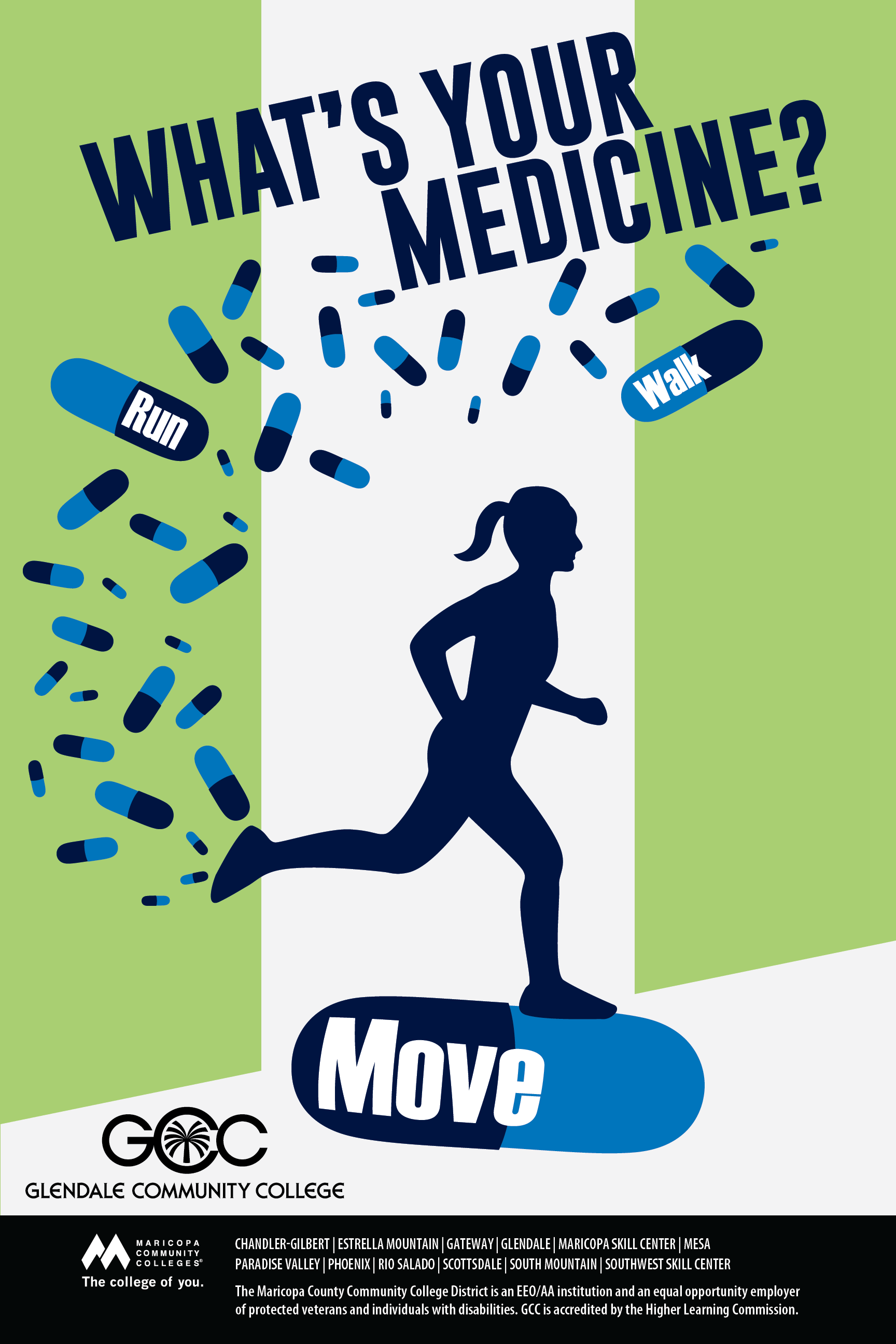
For years, the medical community has been focused on fighting communicable diseases. Vaccines took care of most of these problems. Today we are faced with a more challenging problem…hypokinetic disease…or the disease of inactivity.

The act of sitting too much has made us sick. It is a risk factor for heart disease, stroke, cancer, back pain, obesity, high blood pressure, type 2 diabetes, osteoporosis, osteoarthritis, and many diseases and disorders related to mental health.

Trillions of dollars are spent on this “sickness” industry each year. I cannot fathom “trillions.”

whatsyourmed_forweb-01

Positive change is afoot.

In 2007, the American Medical Association joined forces with the American College of Sports Medicine to ignite an initiative called Exercise is Medicine. (You have probably heard about it because we are embracing it at GCC!) They are simply asking that exercise be recognized as a medical vital sign. If patients are not getting enough exercise (150 minutes per week), they should be referred to an exercise professional.

A long time ago…before times changed…the exercise professional was the person who liked sports and spent a lot of time in the gym. If you had muscle definition, you were considered an expert.

The fitness professional has evolved, thank goodness. We now have reputable organizations that certify and demand excellence through continuing education. Today’s fitness experts have a solid understanding of the skeletal and neuromuscular systems, they understand the inner workings of the heart and lungs, and they know how to fuel the body with optimum nutrition. They can design individualized exercise programs for a variety of populations, they know how to motivate and lead, and they understand their scope of practice within the allied health continuum.

The other thing that changed that has led to a booming fitness industry is the number of baby boomers hitting retirement. Sedentary baby boomers…

This is great news for graduates of the GCC Exercise Science and Personal Training programs who are looking for immediate entry into the workforce. Back in 1985 GCC was one of the first colleges in the country to offer a personal trainer certification. We were innovators on the cusp of a health revolution.

This health revolution is preventative medicine. It is very simple and it does not require any pills. It simply requires that we move more.

What does this change mean to the faculty, staff, students and GCC community? It’s time to “move” in the right direction and stop sitting so much!

Out With the Old, In With the New Part III

Death by PowerPoint vs. Getting My Act Together With Power Point

Many years ago I attended a workshop presented at Phoenix College by Liz O’Brien, Communications professor. It was called “Death by Power Point;” the purpose of the workshop was to demonstrate how “power points” kill active learning and engagement in the classroom. She modeled how to use power point presentations to guide your lectures and structure the class time. She listed all the “Do Nots,” including too many words, regurgitation of lecture, etc. In the few cases I have used power point, I think I have usually followed her guidelines closely. The most difficult piece for me, of course, is to limit my words. I also find attending power point led presentations boring and monotonous. As a result, I rarely use them in my teaching.

After observing my mentees and their dedicated use of power point, I had an epiphany: Maybe I was being close-minded! :0

I am at the opposite end of “minimalist” on the neatness spectrum. Basically, it’s how I work! After grading a set of papers, you will find mini-lists of points to review when I return them, sticky notes with notes to students, more sticky notes with reminders to myself, and more sticky notes marking places to remember to review or emphasize to students (and that may include a sticky note with an example or two.)

photo (6)

Yes, I overwhelm myself!

SO…I gathered an entire folder of sticky notes and other notes and created a power point presentation! I now have a chapter-by-chapter review of American Wasteland to share with students when I return their RRRLogs (reflections.) Most of the comments, reminders, clarifications, and points to emphasize are the same semester-to-semester so I will not have to rewrite them. I can add/remove as is necessary, it is all in one place, and students can “see” what I am talking about. I do not think I will “put every thing on a power point” but I like the way this little project played out! One more lesson for the mentor from the mentees! Thanks Sherry and Sara!