Simple Fun

Sometimes, the simple things are more fun and meaningful than all the banquets in the world,” E.A. Bucchianeri.

Confession – I am not one who practices work/life balance very well. I am a home grown Midwest Girl with a strong work ethic. A work ethic that causes me to be the first one in to work and the last one out of work. I love to work, and I love the feeling that comes from putting forth a full day’s effort and investing into the lives of those I serve on a daily basis.

As I enter this middle-age phase of life and become more aware of my limitations, aka stamina, it is apparent to me how important having FUN helps me to replenish my empty cup (soul).

Fun comes packaged in many different ways for me. It can be a walk with my daughter; a hike with my husband; watching a movie with my son; talking on the phone with my Midwest peeps; watching the sunset; sitting by the pool; cooking a favorite meal; ordering take out; grabbing a cup of coffee while running an errand; or daydreaming about a trip.

The older I get the more I realize FUN for me = CONNECTION. It means sharing a special smile at the grocery store with a young mom who is dealing with a teary toddler; or an elderly person who needs help wrestling a grocery cart free from the string of other carts.

These simple connections also apply to our office atmosphere and our day-in-day-out activities assisting our Veteran students with their class selections or calling and speaking with a VA Representative in good ole Oklahoma. No matter what we are presented with, we can make a connection through a friendly smile or friendly banter. This too is fun.

Simple fun in our work place and interactions with others elevates morale and productivity. When we keep things simple, we are not allowing the confusion of words; thoughts; assumptions or attitudes to get mixed in.

Introducing fun in higher education feeds the fire that burns deep within our students. We can ignite the flame that is almost burned out by fanning the flame using a gentle answer (signifying a gentle breeze). This approach allows the fire to grow.

Ahhhh, yes, this simple act reminds me of a good bonfire in the darkest of nights. Nothing spells fun like a messy SMORE;-))

Thank you for stopping by and reading ~ Jody (aka Midwest – that’s what my office peeps call me).

Think You (or Your Students) Need Willpower?  Think Again!

“How do I change my behavior?” That’s the question one of my students asked after a GCC Money Talks session. It was the Fall of 2019 and Money Talks had just launched and this student was one of the first to participate. It was a great question, unfortunately, I didn’t have a great answer. I did find a blog post with 5 Ways of Changing Your Financial Behavior but I knew that I needed a better answer.  Fortunately, I found that I already had a great resource on my bookshelf. The book, Change Anything is exactly that – a great answer and set of strategies

Free Speech & Difficult Ideas: The Way Forward

Over the past few years in writing for the 6 x 6 writing project I have often written on the themes of free speech and the need for critical, civil, and constructive dialogue—see “Celebrating the Value of Free Speech” and “The Other DEI… Diversity in Examining Ideas.”  This focus has been reinforced recently by the Faculty Senate’s adoption of a GCC-version of the “Chicago Principles.”  Here are some relevant sections of the GCC statement:

Of course, the ideas of different members of the GCC community will often and quite naturally conflict. But it is not the proper role of GCC to attempt to shield individuals from ideas and opinions they find unwelcome, disagreeable, or even deeply offensive. Although GCC greatly values civility, and although all members of the GCC community share in the responsibility for maintaining a climate of mutual respect, concerns about civility and mutual respect can never be used as a justification for closing off discussion of ideas, however offensive or disagreeable those ideas may be to some members of our community.

In a word, GCC’s fundamental commitment is to the principle that debate or deliberation may not be suppressed because the ideas put forth are thought by some or even by most members of the GCC community to be offensive, unwise, immoral, or wrong-headed. It is for the individual members of the GCC community, not for GCC as an institution, to make those judgments for themselves, and to act on those judgments not by seeking to suppress speech, but by openly and vigorously contesting the ideas that they oppose. Indeed, fostering the ability of members of the GCC community to engage in such debate and deliberation in an effective and responsible manner is an essential part of GCC’s educational mission.

The GCC Philosophy and Religious Studies Department continues to manifest this commitment to the free expression of ideas in a rational and civil manner.  By its sponsorship of its annual panel discussions—“God & Truth” and “Critical Dialogues”—our campus and community have the opportunity to witness and participate in the ongoing interaction of ideas.

Free Speech on the Campus

Last October our “Critical Dialogues” panel discussion was devoted to one of the most enduring and controversial topics in our culture—Abortion.  And, again, we witnessed a rational, civil interchange which should be envy of any institution of higher learning.  We chose the title, “Abortion: Beyond the Slogans, Beyond the Rage,” which communicated our desire for a deeper analysis of the debate in a context devoid of acrimony—you can watch the event and see if we accomplished our goals!

In the Classroom…

n my introduction to philosophy classes, I wanted to bring this quest for rational and civil dialogue to my students.  Early in the semester we go over logic and logical fallacies.  Then every week we review a particular logical fallacy.  This served as a good foundation from which to work as we approached the topic of abortion after the Critical Dialogues panel discussion.  So often the debate on this topic is dominated by slogans and fallacious reasons and helping students see through the irrational slogans would serve them well in their logical development.  Over the past fifty years the philosophical literature is replete with sophisticated defenses of both the pro-choice and pro-life perspectives.  I had my students read a classic pro-choice piece—Judith Jarvis Thomson’s “A Defense of Abortion” and the pro-life philosopher, Francis Beckwith’s response, “Personal Bodily Rights, Abortion, and Unplugging the Violinist.”  Then, in class, I went over the philosophical terrain of the arguments and where the key philosophical issues came to expression.  I utilized Dr. Angela Knobel’s outline of the various arguments and this allowed for a rich discussion on the topic.  Later, in their philosophy journals, several students mentioned that, although they had not necessarily changed their minds on the topic of abortion, they did have a greater appreciation for the other side of the debate.  Serious interaction on a controversial cultural topic with a renewed appreciation for other points of view—that’s educational success!

The Science of Belonging

In my research regarding neurodivergent students, current studies indicate student success is tied to supportive, understanding instructors. Negative faculty attitudes and lack of awareness are the major barriers to success for students with disabilities (Dowrick et al., 2005 as cited in Sniatecki et al., 2015, p. 260). To succeed, students with ASD, for example, will require support from understanding faculty members who are responsive to the unique academic and social needs of students with ASD (Austin & Peña, 2017, p. 18). Another factor in pursuit of equity and inclusion amongst student populations is the sense of belonging.

In his book Belonging: The Science of Creating Connections and Bridging Divides, Cohen (2022) discusses his research about how to establish connection in all areas of life. Recently, I attended a webinar, sponsored by Norton Publishing, where Cohen discussed his book and strategies to bridge barriers. One effective strategy he discussed was the concept of wise feedback, based upon his and others’ research. According to Yeager et al. (2014), “Wise feedback increased students’ likelihood of submitting a revision of an essay (Study 1) and improved the quality of their final drafts (Study 2). Effects were generally stronger among African American students than among White students, and particularly strong among African Americans who felt more mistrusting of school.” In the study, in addition to commenting on the students’ essays with suggestions for improvement and typical words of encouragement, wise feedback consisted of the statement: “I’m giving you these comments because I have very high expectations and I know that you can reach them” (Yeager et al., 2014). The result? The simple intervention “closed the racial achievement gap in this sample by nearly 40%” (Yeager et al., 2014). In addition to wise feedback to foster belonging, Cohen also indicated students need to feel a sense of three things in our classrooms: “You are not alone. You have potential. We are going to do this together.”

Now, I’ve started to include wise feedback in all of my comments on student essays. Additionally, I have included the three statements about belonging at the top of each of my Canvas course home pages in hope of fostering belonging and supporting success for all students.


References

Austin, K. S., & Peña, E. V. (2017). Exceptional faculty members who responsively teach students with autism spectrum disorders [Abstract from ERIC]. Journal of Postsecondary Education and Disability, 30(1), 17-32.
Cohen, G. L. (2022). Belonging: The Science of Creating Connection and Bridging Divides. New York, NY: W. W. Norton & Company, Inc.
Sniatecki, J. L., Perry, H. B., & Snell, L. H. (2015). Faculty attitudes and knowledge regarding college students with disabilities. Journal of Postsecondary Education and Disability, 28(3), 259-275.
Yaeger, D. S. et al., (2014). Breaking the cycle of mistrust: Wise interventions to provide critical feedback across the racial divide. Journal of Experimental Psychology: General. 143, 804–824.

Podcast Power: Happiness

Recently, I have started listening to podcasts by Dr. Laurie Santos titled The Happiness Lab. I have enjoyed learning how our brains are wired to remember negative experiences over positive ones and how we can find happiness in the smallest things. This podcast has not necessarily had a profound impact on my class instruction rather on myself and the kindness I have toward the human condition. 

The Happiness Lab with Dr. Laurie Santos

The Happiness Lab speaks to the stress we put on ourselves and how that stress affects our bodies and minds. I have taught future elementary educators for the past 5 years. They are some of the most dedicated learners I have ever taught. However, they are also some of the most overwhelmed and self-critical students I have encountered. 

By listening to The Happiness Lab I have learned how to create healthier habits within myself and I am sharing what I have learned with my students. My students exhibit the effects of stress and I have found myself suggesting and sharing information from the podcast. Through listening to The Happiness Lab, my desire to help my students has increased to areas outside of the course content.

Summer Stars

Songs to represent musical growth in teaching, performing, and composing

Starlight

Stars have represented decades of growth for me as a composer, a writer, and as an educator. I’ve written operas, string quartets, choral pieces, all including stars, but, of course, I couldn’t have done it without the poets who wrote about them first.

What Do You Listen To and How Will That Help You Grow?

Learning to choose notes, write music, is something I teach by example, just as I was taught. And to bring that full circle as educators, we grow when we listen. I’ve taught ear training; taken ear training; but I really began listening when I was very, very small — and paid attention to what composers were doing to connect to listeners. To be perfectly honest, I’m falling in love again. I love lots of styles of music, and teach all about them, but in this week’s work, I chose the more difficult road, talking about my music. It would have been a lot easier to just talk a bit about a song and its history…

A composer, at least the kind I am, representationally, has to know how to make words fit the voice because singers may change vowels to create a better sound. … Acoustical physics at its finest. So, taking into consideration the difficulties vocalists face, how the words will have to be sung in order to hit that very high note, and still bring out the beauty, success will be measured.

In that blink of an eye, and with pieces I haven’t heard in years, because of this first week’s prompt, I’m opening my soul to much of my past and listening to compositions that worked, that didn’t work, that really worked, and, well, some that needed to go back to the drawing board. It’s challenging and emotionally-charged. Why didn’t it work or what did work? Sometimes it’s the composer, the performer, or the recording – or, during a live recording, an audience member who coughed loudly throughout the entire piece. I got a little taller that day.

The songs that make a listener fall in love with each word are the truest test of success. After all, the words are the most important elements. And, it’s not the applause that shows whether you truly connected with others’ ears, it’s the silence.

I chose to include a short piece, still about stars, from Songs of the Night Wind, with the Stockholm String Quartet and Olle Persson, baritone.

Summer Stars, Olle Persson, baritone, Stockholm String Quartet, text by Carl Sandburg
Summer Stars

Bend low again, night of summer stars,

So near you are, sky of summer stars,

So near, a long-arm man can pick off stars,

Pick off what he wants in the sky bowl,

So near you are, summer stars,

So near, strumming, strumming

           So lazy and hum-strumming.

                                                                                                              Carl Sandburg

What’s on Your Bookshelf?

by Mary Anne Duggan

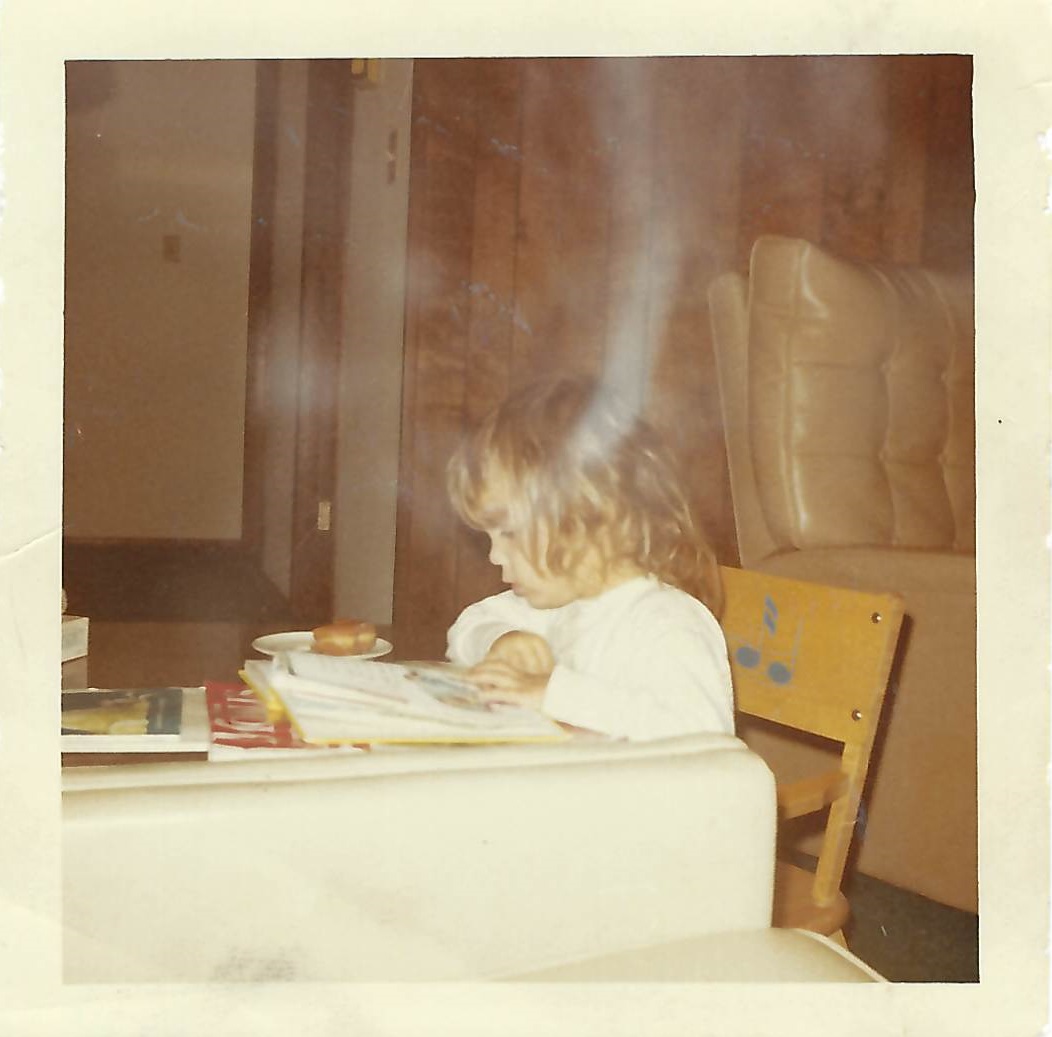
I’ve loved books (and donuts) for a long time!

A long-distance lover might whisper over the phone line, “What are you wearing?” But I find the question, “What are you reading?” so much more intriguing. Thus, this week’s Write 6X6 prompt about our current literary delights really “lit” me up.

Someone once said, “I like to carry a book with me at all times in case nothing happens.” I feel the same way, and that is why I always have a book (or several) well within reach.

Lately I have three types of books going at any one time: 1) An audiobook for long car rides to GCC, 2) A non-fiction book to read in stolen moments throughout the day, and 3) A good, juicy novel. Here is what I’m reading now in each category:

Audiobook – Sapiens: A Brief History of Humankind by Yuval Noah Harari

When I visit my daughter who lives on the Upper West Side in New York City, I always stop by the Strand independent bookstore on Columbus Avenue. It was there that I stumbled upon Sapiens last month, and I thought it might enrich my learning of evolutionary psychology. It turns out what I don’t know about the history of our species is a lot, and I am so grateful to have found this book.

(Speaking of New York bookstores, I highly recommend the documentary The Booksellers available on Amazon Prime.)

Nonfiction – When Memory Comes by Saul Friedländer

Very soon I will be embarking on an educational delegation to Poland and Israel to study the history of the Holocaust and prospects for global peace in the future. A dear colleague loaned me several books to help me prepare for the trip, and When Memory Comes is one of them. Friedländer’s memoir that spans from being hid as a child from the Nazis in World War II to living in the newly-created state of Israel as an adult is gripping throughout.

Fiction – The Tattooist of Auschwitz by Heather Morris

I always have one glorious novel on my bedside. When I spoke with my doctor just this week about having difficulty sleeping, he said that old saw, “Mary, the bed is only for two things.” Well, if I have to choose only two things for the bed . . .

Seriously, I’m not giving up reading in bed (or the other two things). The book I am reading now is a “Shannon Pick.” My niece Shannon has impeccable taste in books, TV, and movies, so when she makes a recommendation, I take note. The Tattooist of Auschwitz is a fiction book based on interviews with a real Holocaust survivor. I don’t count it as a full-on historical record, but it is a well-written and enlightening story. It is at once dreamy and heartbreakingly tragic.

I’m off now to snuggle up with a good book (and not sleep)!

Is That It?

Audible, book, audible, book. That’s how I roll. Audible for walks and car, books for bedtime.

Ploughing through the pages of “Is That It?” written by Sir Bob Geldof, I am brought back to the eighties when Adam Ant, Duran Duran, Culture Club and The Police roamed the earth. These British bands who were the highlight of my teenage years were also the bands who got together to help Sir Bob on his mission to save Ethiopia from the ravages of famine.

Geldof takes us back in time to his sorrowful Dublin upbringing. The places and people bring me back to my Irish childhood, singing the songs of his band, The Boomtown Rats. You may have heard of “I Don’t Like Mondays,” “Banana Republic,” and “Rat Trap.” His distaste for his childhood and his disappointment for his homeland is quite evident in his lyrics. Disliked by many, his unique personality allowed him to pull together some of the most amazing music events of all time – Band Aid and Live Aid.

You are probably wondering how this autobiography has anything to do with my work here at GCC. Why am I not talking about books on fitness or wellness, like Spark or Atomic Habits? As it turns out, you can actually gain quite a bit of creativity and insight into your deepest thoughts when you stop reading about the “continuing ed” style material and completely deviate from your norm. Elizabeth Gilbert talks about this in Big Magic…I think…maybe it’s time to read that book again.

I digress. What I am gaining from this book is courage. I am reading about a man who was beaten down by his father, his school, and his employers for a good chunk of his life. He beat himself down. But he had courage and he was not afraid of hard work once he had a vision. He was not afraid to speak his mind, even when he knew it was the least popular thing to say, and he spoke up to authority when something was clearly not right.

As I roll into the final two weeks before the not-so-annual (thanks COVID!) health fair, and go into my usual panic mode about what needs to be done and what cannot possibly be done at this point, I have to stop and think about the amount of planning, effort and coordination that Geldof did in a short amount of time to unite the world for Live Aid. He was driven by a crazy vision and he had the courage to bring it to fruition despite the odds.

I am grateful for the team of people who have supported this annual venture over the years. My vision is to see people embrace good health and to find support in the process. Everyone knows what they should be doing…walk more, eat better, meditate, sleep…and they know all the bad things that happen when they don’t…heart attack, stroke, diabetes, hypertension…but sometimes we need simple reminders and a little push from the experts…Fitness & Wellness, Nutrition, Nursing, EMT, Behavioral Health, Counseling, Psychology…

Please, please, please come to the Health & Wellness Fair on 3.23.23, 1-4 p.m., and bring five friends. I promise you will be rewarded in heaven!

Health Fair Flier

The Long and Winding Road

by Mary Anne Duggan

When the first prompt of this season’s Write 6X6 challenge was announced, my brain buzzed with potential songs that represent my career in education. The first thing I did was to search for chart-toppers from my first year in teaching – 1986. A quick trip down musical memory lane promptly reminded me of why I don’t love 80’s music.

But another song from the past kept floating in my consciousness – The Long and Winding Road. So, I decided to take lyrics from this 1970 Beatles song for a spin around the record player to see if it spoke sang to me.

The long and winding road
That leads to your door
Will never disappear
I’ve seen that road before
It always leads me here
Leads me to your door

I didn’t set out to become a teacher. Instead, I started out as a dance major in college. I struggled in the first two years of my dance program. The professors didn’t like how much time I was spending with my boyfriend. They didn’t like that I actually ate food. And on the first day of my junior year, I got sideways of my ballet teacher.

On that day, the teacher was disgusted by her students’ lack of preparation. At the end of class, she went around and demanded the names of some of us to report to the department chair. When she approached me, my face was flushed and heart racing. “What is your name?” she barked. The toes in my ballet slippers were tingling, and I packed up all that adrenaline and ran to the registrar’s office, where I proclaimed, “I want to change my major!”

You could do that back in 1984. Computers weren’t used for registration when I was in college, so you just told someone if you wanted out. “Well, what do you want to study?” asked the 25-year old registration manager.

I took a split second to think about the last time I was happy in a college class. “I love psychology because I’m totally into how people learn!” Enter the first bend of the winding road: I thought that meant I should be an elementary school teacher.

The winding road went from elementary school teacher to preschool owner back to elementary school teacher through a master’s degree in counselor education to staff developer to peer evaluator to a PhD in educational psychology to clinical assistant professor of education to research program director to assistant research professor in family/human development and – finally — to teacher of psychology. You know, that thing I told the registration manager I wanted 39 years ago.

But all along the road, there is one thread in my career of four decades: A fierce desire to honor the individuality of my students, to provide a visceral sense of safety for them, and to encourage a sense of belonging for all. To make my classroom a place students feel they have value and something to contribute. It should be no surprise that what I have been working on through the whole of my career is what I so desperately needed in that dance studio, on that fateful August day so very long ago.

“The Greatest Love of All”

“The Greatest Love of All” by Whitney Houston, The Voice, represents my career in education. As a kid, my favorite musical artists were tied to the music my parents listened to: Michael Jackson, Paul Simon, Tina Turner, Willie Nelson, Jim Croce, Elton John, Dolly Parton, Julio Iglesias, Carly Simon, Bob Seger, Whitney Houston, and anything from Andrew Lloyd Weber, among others. My mom, a teacher, used to play “The Greatest Love of All” all the time, mostly while cleaning house and belting along. She used to say, “See, Roxanna, always love yourself, depend on yourself, and never walk in anyone’s shadows.” It goes without saying that my mom is my hero. As a child, I wanted to be just like her (as an adult, I can only hope to be just like her).

In our house, like many, school and education were paramount. In fact, I had a kid table set up in the kitchen with four chairs where I used to sit my dolls, Hermosa (my beloved first Cabbage Patch Kid purchased at Smitty’s on Baseline and McClintock) and Lupé (a life size child mannequin my great grandmother from Mexico gifted me), in the front row while I would “teach” them and play school. I always imagined being a teacher like my mom and following in her footsteps, especially when Whitney croons:

I believe the children are our future
Teach them well and let them lead the way
Show them all the beauty they possess inside
Give them a sense of pride to make it easier
Let the children’s laughter remind us how we used to be.

For my sixth grade most famous person project, I even wrote Whitney a letter to let her know of these important matters and my plans to teach the children well. My memory does not serve me, but I’m fairly certain she sent me a signed glossy 8X10?

Today, I believe this song is subconsciously woven into the forefront of why I pursued a career in education. That, and I failed out of pre-med my freshman year… but, that story is definitely for another time.

Get Your Kicks on Write 6×6