Tech Tip: Use Time-Blocking – Please!

This might be a personal request of all faculty I have the pleasure of working with. With all of us working from home a lot more and possibly only being on campus two days a week, it’s challenging trying to find time to meet with people. It’s so nice when I can just pull up a calendar invite, add the people I want to meet with, and choose “Find a Time." It magically presents everyone's calendar revealing all the common free time. This, people, is how most organizations work. However, we don’t even come close. Most of the time there is nothing listed on faculty calendars. Oh, so you’re free on Wednesday at 2 pm. That’s perfect. Well, that’s usually not the case. My tiny tech tip is to leverage your digital calendar tools to implement time-blocking strategies. In addition to simply listing your class, office hours, and meeting times, allocate specific blocks of time for different tasks, such as grading, research, and class preparation. This helps in creating a structured schedule and enhances focus on specific activities during dedicated time slots. It also allows for better visualization of your day and ensures that important tasks are given the attention they deserve. But most importantly to me, your colleague, is now I know when I can request a meeting with you. If you’re still available for meeting requests but you’ve blocked off time to grade, you can indicate that you are still free on the calendar event. It’s quite simple. So what do say? Can we please use our calendars?

Effortless Perfection

My Audible “read” of the week is Susan Cain’s “Bittersweet.” One of the topics she discusses is about “effortless perfection.” She explains it as this unrealistic state we attempt to achieve in order to fool others into thinking we have everything under control and life is cool. Underneath, we are all “train wrecks!” Okay, I speak for myself…

Yup, I do that! I didn’t realize that it was a thing and I didn’t realize that I did it! But it made me laugh. I started to conjure up images of people that appear to be effortlessly perfect! In the swimming world, Michael Phelps comes to mind, effortlessly swimming the impossible butterfly stroke at superhuman speed. Then I think of the years of grueling training to which he has subjected his mind and body. His world fame came at huge price to his sanity. But he is an icon of this era.

Michale Phelps Swimming

I think of famous musicians who sing their hearts out on stage in front of audiences all over the world. Yet, I just have to tell my phone to play their song and it effortlessly plays across the airwaves, And I think to myself, how many times have they sung that song over and over and over? How many times do you think Mick Jagger has sung “Satisfaction?” How hard that must be to tour the world and be away from home for so long. How many hours spent rehearsing and perfecting?

I look around at my coworkers who show up with a smile each day, knowing that they are making a difference, while carrying a mountain of endless stress brought on by an attempt to keep home life and work life in balance. The resilience they display is mind blowing. And they come back the next day and do it again and again and again. They seem to do it with ease.

Why do we strive for effortless perfection? Go on, admit it! You do it too!


Ode to the Yellow Legal Pad

My workspace in higher education has changed many, many times over the past 15 years. Just during my time as faculty, I moved offices seven times in eight years, if memory serves. I’m a fan of change, so each move presented an opportunity to learn about a new location on campus, meet new colleagues, connect with students in a different space, or get a new plant (spoiler alert: they all died… my condolences, plant world).  

One constant throughout all of this change, manifesting my love of putting pen to actual paper, is the Yellow Legal Pad. A note-taker’s dream come true! It’s a beautiful canvas, page upon page, awaiting all manner of thoughts, ideas, and big plans. Outlines, books to read, research topics to explore, quotes that resonated. Not to mention doodles (not every meeting can be riveting), grocery lists, and an occasional note to myself not to forget that thing I keep forgetting. I can work just about anywhere as long as I have my trusted YLP and pen by my side.  

The Yellow Legal Pad accompanied me through law school (I know, so predictable), my Ph.D. program, eight years of full-time teaching, and now many years of administration…ing. It’s my essential learning, thinking, and writing tool. I mourn for all of the never-to-be loved-by-Gen-Z Yellow Legal Pads. Maybe I’ll start a Gretchen Wieners-esque “make YLP happen!” movement.

In my current office, I have many new-to-me things, all lovely and deeply appreciated. I have a handful of ink pens at the ready. But none are more precious to me than the stacks of Yellow Legal Pads, both new and those already filled with notes to be revisited and reflected upon. 

I invite you to join me in admiration of the YLP. We can meet for coffee or lunch and share our joy in opening up a new pack, tearing off a sheet to roll into a ball and throw at the nearest trash can, or simply stacking them neatly as a reminder of the work accomplished and exciting work ahead. Here’s to you, YLP! And with that, I’m off to do that thing I would have forgotten but for you.

Office Space as Reflective Space: Who Am I?

When setting up my office space I wrestled with what to put on the walls–what do I want people to see when they come in my office? I meet with numerous students and I wanted the space to be a warm and inviting space that would provide a sense of who I am for those meeting me for the first time. The pictures and items on my walls reveal the diverse sides of who I am.

First, there is a picture of my family taken at my son’s wedding a few years ago. I love my family and this is a reminder that the most important things in life are not found in my office but in the relationships outside of it.

The next set of pictures revolve around Francis Schaeffer–a philosophical thinker. (I am in the Philosophy & Religious Studies Department, after all!)

Schaeffer was a philosopher and public intellectual whose writings I read in high school. He was the motivating factor for me to pursue philosophy and the life of the mind. I keep this quotation from him right above my desk as an inspirational reminder to me….

Next, people will see an art project my daughter and I worked on a few years ago. It’s based on the famous Shroud of Turin and we sought to recreate the image in a unique manner.

I read an article by literature professor, Nathan Wilson, about how he created a replication of the image by painting on a piece of glass and letting the sun bleach out the negative space. In other words, the dark parts of the image are not a result of being put on a light cloth but, rather, the result of a dark cloth being bleached out except for the areas of the image. My daughter and I tried it in our backyard and it worked!

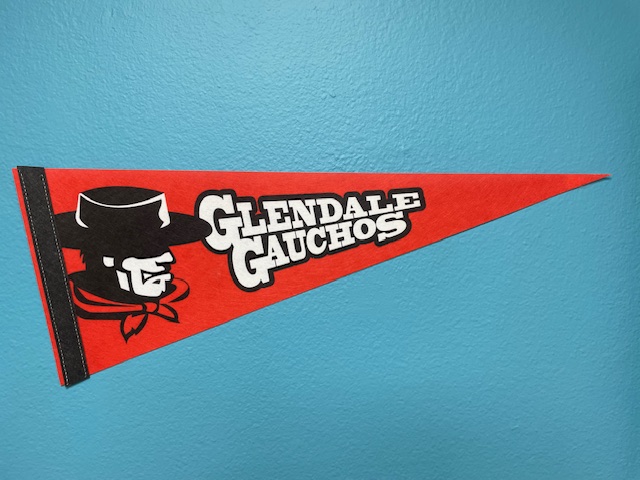
No GCC office would be complete without a Gauchos flag!

The next two pictures reflect a bit of the fun side of who I am. These are also some of the first items students see when they come into my office. The first is a quotation from the movie “Nacho Libre”–a truly great movie!

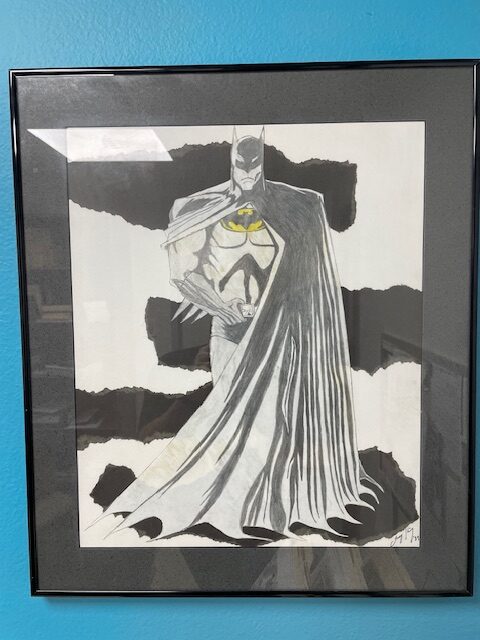
And, finally, for the superhero enthusiast there is Batman. My friend drew this for me back in 1989. Michael Keaton’s Batman had recently come out and I was a fanatic. I saw the movie twice on the opening day–one time was at 3 am!

Yes, there are the miscellaneous philosophy books and scattered files that accompany any office in our department but the pictures give a picture of who I am in my diversity of personality. They remind me of who I am and I hope give a glimpse of my manifold character to the students who enter.

Note to Self

by Mary Anne Duggan

If I were to write a letter to myself as a beginning teacher some 36 years ago, what would I say? How could I light a path forward for the old me? How could I keep the letter from being 50-plus pages long? I have a lot of questions about this week’s Write 6X6 prompt. But one thing I have learned over the years is to just jump in – knowing all the answers is not required (and most often not even possible!)

Dear Mary Anne,
     I see you over there. You are at a high school football game in September where you are watching your new fiancé’s brother play football. But you’re not watching the game; you’re grading a stack of papers. On a Friday night. And, oh yeah, you teach fourth grade
. . .

Flash forward to you leaving your classroom at the end of another long day in January, towing a luggage cart carrying five or six textbooks and a blank lesson plan for Wednesday. It’s Tuesday. A veteran teacher passes by and quips, “Ah, working more and enjoying it less, right?”

Now it’s the last day of the school year in May, and you are furiously assembling books the students created to take home for the summer. You’re using the new-fangled book binding machine the school just purchased. It’s your lunch hour, and you are sweating like a — well — a teacher who waited until the last minute to provide a special experience for her students in a room with a swamp cooler.

Dear, dear Mary Anne, the school year is not a nine-month slog with respite only allowed in June. You can’t hurl yourself against the wall year after year trying to attain teaching perfection. No such thing exists, and your health will suffer in the process.

You have ambitious plans for providing a wonderful school experience for your students. You have all these grand ideas of what makes a “good” teacher. But a “good enough” teacher who lives a healthy and balanced life will surely be enough by anyone else’s standards. Let go, at least a bit, and you’ll see that the world keeps spinning and your students keep on learning. And you will have many years in this profession you love.

The older me,
Mary Anne

As I look back on this letter, I am left with further questions: Would I have listened to this advice way back when? Is it desirable to have all pitfalls flagged ahead of time? Or are some missteps just part of the process of growth as a teacher and, perhaps more importantly, as a person?

You Belong Every Place

While age and enrollment status are key, the other demographics here also speak loudly: over half of our students are female and first generation with no or limited prior college experience, our occupational awards are equal to our transfer degrees, and, as an HSI, Hispanics make up more of our student population than any other ethnicity. Furthermore, we know our classrooms are also serving neurodivergent populations and those impacted by the current and severe mental health crisis. This is our community, and as a community college, our purpose is to serve the community in making all decisions with the following foresight: “How does this support our students?” A sense of belonging on campus is a paramount part of the puzzle, and as faculty, staff, and administration, we play the most essential role in fostering it. It starts with us. According to Sparks (2021), “A Review of Educational Research analysis of 46 studies found that strong teacher-student relationships were associated . . . with improvements on practically every measure schools care about: higher student academic engagement, attendance, grades, fewer disruptive behaviors. . . .” Furthermore, Maslow (1943) asserts belonging is one of the five basic needs associated with human motivation. We know our students are more likely to feel motivated and will be more likely to succeed and fulfill self-efficacy when they feel belongingness. A very wise special needs parent advocate once told me, “The child will always determine the place.” Meaning, if the student feels belongingness, then they will only thrive in the right place. Angelou believed in belonging to herself: “You only are free when you realize you belong no place — you belong every place — no place at all. The price is high. The reward is great…” (Goodreads, 2023). So, what does it mean to belong, and more importantly, how do we foster it on our campus?

To me, belonging means fitting in through: feeling a part of something greater, being respected and valued for my contributions, being recognized for my strengths and allowed weaknesses, and trusting my identity is also recognized and accepted. It isn’t new, and it is more than a buzzword. Thus, belonging is something I actively think about and plan for in my work as faculty at GCC. I’m not great with small talk, and I’d much prefer to simply get to work, but I try to make an effort to talk to my students when they come to class, know their preferred names and pronunciations, meet them where they are, offer referrals to other campus resources, welcome each one when they enter, offer them snacks, craft assignments which connect them to the content and their communities, constantly post campus events and happenings in Canvas Announcements, craft warmer-toned emails, use messaging in Canvas if they have fallen off of the radar, offer diverse readings, demonstrate gratitude and empathy when they share their circumstance with me, use music and humor, offer flexibility, maintain high standards and clear expectations, recruit for ENH112: Chicano Literature in hopes that it makes again (pero sin éxito), be real and do my best to be vulnerable and human if I make a mistake (post-COVID brain fog is real) or share a learning from my own experience. I have also been using Pear Deck to do emotional temperature “Check-ins.”

I’m not alone in these things. They are happening all over campus every day, all day. I know my colleagues and their commitment to the shared responsibility. I’m thinking to foster belonging on campus even more, possibly bolstering the concept of students belonging every place, it would take a team-approach where all of the current efforts are centralized, and we really seek a shared understanding and visibly address the invisible barriers for our students we may not be aware of.

References
Goodreads. (2023). A quote from conversations with Maya Angelou (literary conversations. Goodreads. Retrieved April 12, 2023, from https://www.goodreads.com/quotes/904289-you-only-are-free-when-you-realize-you-belong-no

Maslow, A. H. (1943). A theory of human motivation. Psychological Review, 50 (4), 370-96.

Sparks, S. D. (2021, September 17). Why teacher-student relationships matter. Education Week. Retrieved April 12, 2023, from https://www.edweek.org/teaching-learning/why-teacher-student-relationships-matter/2019/03#:~:text=A%20Review%20of%20Educational%20Research,fewer%20disruptive%20behaviors%20and%20suspensions%2C

Be Kind, Rewind

Dawn Gibbs hit me with that saying today while I was in the 05 English Office this afternoon. I was reading a sign on Dr. Jennifer Lane’s door that said something about being kind. We laughed about how old we are to remember that saying from the Blockbuster VHS tapes we used to rent. She actually had to remind me of the saying even though I’m older than her, but it got me thinking about my students and how young they are. It’s easy to forget they generally have no idea what the heck we are talking about when we make references to things. I can’t even remember what I was talking about, but one student spoke up after I made a comment about something and said, “Does anyone in this room look old enough to be alive in the 80s?” I did the math in my head and looked around the room. I guess he had a point. They were all traditional college students: 18-23, born between 2000-2005.

We had a good laugh at my expense, but it was all good. It gave us an opportunity to chit-chat a bit before we started the lesson. I’ve been teaching so long, that I don’t really think about how I build community in my classes anymore. I’m a competitive person by nature and I love to challenge students, but I usually make them do it in groups. Our classrooms are set up in 4 computer station pods, so technically I already have groups before we do anything. I’ll point at a pod (group) and say if all four people in this group can give me an answer, you can be top dog this week. No one even knows what top dog means, but they’re into it. “Name four NFL teams on the western side of the US.” “Name animals that walk on two legs.” I just make up stuff on the fly which is usually silly, and we debate the prompts before we settle on a good. It’s classic wasting class time. But is it really?

Of course not. We’re building community and building a sense of belonging in the class. I build in 15 minutes for questions and chit-chat at the beginning of each class where I ask them questions and practice their names. And at the end of the class in their digital exit ticket, I ask them three things. List one thing you learned today, one question you still have, and any random fact about anything. I’m always amused by what they write on these exit tickets. They like to joke and give me a hard time about asking dumb questions or how I still can’t pronoun their name, but thanks for trying. I try to keep it light, so students feel comfortable asking for help if they need it. It’s not really anything that’s planned (aside from the time). It’s just my natural way of teaching.

ChatGPT vs. The Creative Hunt

As I was pondering the topic of ChatGPT for this post, I thought back to when I took ENG101 in the early nineties; most of us were still still submitting handwritten essays on paper. (In ENG102 the following semester, I upgraded to typing my essays at the computer lab and printing them out for submission. I just had to be careful not to lose the floppy disk!)

For nostalgic purposes, I began to write out the first draft of this post on line-ruled paper. When I got to the fourth full page, I was reminded of how time consuming it is to write by hand how my wrist and fingers quickly get sore. So I took a break…

Early hand-written drafts of this post

It was during this writing “downtime” that thoughts about my post continued to swirl in my head, and then I came to realize what makes the often tedious writing process worth it: the hunt. The hunt for stimulating words, the hunt for vivid imagery, the hunt for creative ways of expression – all in the deep jungle of ideas and concepts.

Then I thought: Imagine if hunters were given the option of bypassing all the tedious work of getting a hunting license, getting hunting gear, improving their aim with target shooting, then going out to the wilderness and sitting, waiting, pursuing and eventually killing (for lack of a better word) their game… How many of them would want to instead feed some info into a supercomputer and have their prize deer, ducks, and elk tagged and bagged, ready for their selfie?

I would imagine not many. I’m not a hunter of animals, but I do consider myself a hunter of creative ideas. And just like hunting, sometimes you’ve just got to stay quiet and still, and the game will come to you, often when you least expect it.

Self-portrait of me hunting for creative ideas (drawn on good old-fashioned notebook paper)

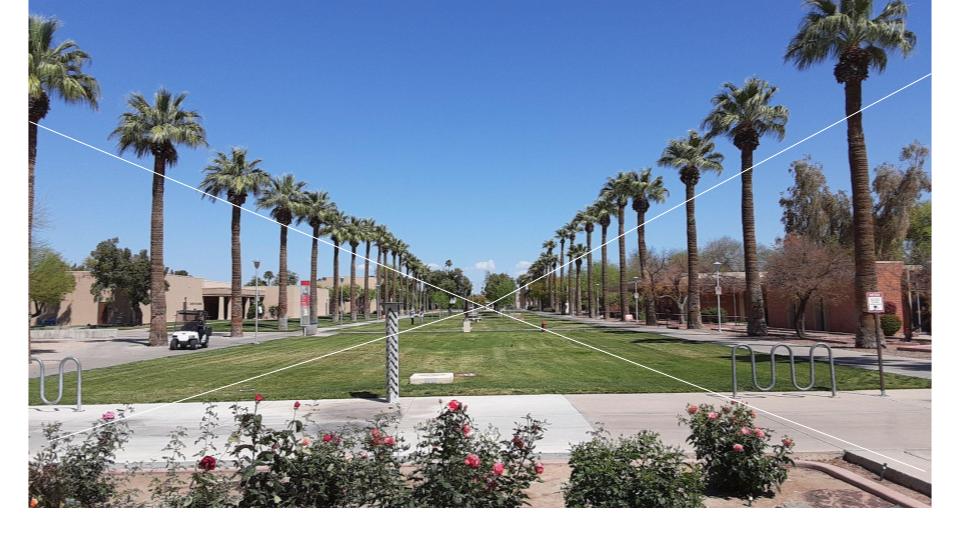
So I think it’s important to convey to students that most worthwhile writing  doesn’t start when we put pen to paper, or start tapping the keyboard, or feed data into ChatGPT – it starts waaay before, along the one-point perspective line of our lives and to that vanishing point in our past – you know, that time we’re nostalgic for.

One-point perspective (roughly) at GCC

Why Online?

by Mary Anne Duggan

According to Maricopa Fast Facts, in fall 2022 69% of GCC students attended school part-time. In addition, ever since the onset of COVID, students are opting for online courses in greater numbers. The masks may be down and freedom to roam the school halls restored, but the online, part-time student population only seems to be growing in droves.

We are a community college because we serve the community. But, we also build community in our classrooms, student organizations, sports teams, and special events. Community building becomes decidedly more difficult when our students only have one toe dipped into school life.

I have been thinking a lot about why my online courses fill up much faster than my in-person courses. As part of an anonymous mid-term survey I gave to my statistics students this semester, I asked students to “Briefly explain why you decided to take PSY 230/231 fully online as opposed to in-person.”

Two major qualitative themes emerged to the question of why online: 1) scheduling/logistical and 2) preference for online learning. Scheduling/logistical reasons dominated (71% of all responses) and had the following sub-themes:

  • Convenience
  • Flexibility
  • Work demands
  • Avoid commute
  • Scheduling needs
  • Participation in sports
  • Parenting/homelife responsibilities

Preference for online learning had the following sub-themes:

  • Do well in online classes
  • Like online better
  • Anxiety/avoidance of being in-person
  • Ability to go at own pace
  • Perceive in-person courses as harder

What was interesting (but not at all surprising) is that, when broken down by age (18-21 vs. 22+ or “traditional” vs. “non-traditional” ages), scheduling/logistical was mentioned by the 22+ set more often (81% of their responses) than in the 18–21-year-olds (62% of their responses). Of course, this survey of my classroom students is not generalizable to all college students or even students at GCC. But, it helps me to know a little more about what motivated my students to choose an online class, especially a class that is typically perceived as highly rigorous.

The reasons my students gave for selecting online courses over those taught in-person indicate the strong pull of this learning platform that isn’t going away any time soon (or ever). The continuing challenge for educators is to find new ways to foster a sense of belonging for part-time and online students.

And yet, there is another “community” to which our students belong – their immediate and extended families. Yes, my student who is a father in his 30’s might not attend a basketball game on campus, but he shares his online work with his 10-year-old son who wants to know about “all those funny numbers on the screen.” Or there’s the mom of a two-year-old who laughs as her child climbs all over her while we video conference. There’s the dad who I just know is sitting off camera as his son participates in a Zoom class, poised to offer tutoring after sign-off. College simply looks different for some of our students, but the motivating factor of community can be present in many forms.

ChatGPT? Good Grief!

by Mary Anne Duggan

It’s hard to put into words how I feel about the sudden explosion of AI (and ChatGPT in particular). My son happens to work in AI, and our conversations usually leave me with a blank look on my face. I nod politely as not to let on how little I understand about this thing that will supposedly upend how we all live and work.

Sometimes I feel like technological roadkill. The advancements are rushing by at 100mph, and I’m left stunned by the side of the road. As I think about it more, the feeling I have might be one of grief.

So, I asked my new, best worst friend ChatGPT to tell me a little more about grief so I can figure out if this feeling fits. In less than 30 seconds, this is what my “friend” delivered:

“The stages of grief, as identified by psychiatrist Elisabeth Kübler-Ross, are:

  • Denial: This stage involves disbelief or denial of the reality of the loss.
  • Anger: This stage involves feelings of anger, resentment, or frustration about the loss.
  • Bargaining: This stage involves a desire to make a deal or bargain with a higher power or with fate to change the outcome.
  • Depression: This stage involves feelings of sadness, loneliness, and despair about the loss.
  • Acceptance: This stage involves accepting the reality of the loss and moving forward with life.

It is important to note that not everyone experiences all of these stages, and they may not necessarily occur in a linear or predictable order. Grief is a highly individualized and personal experience, and people may experience a range of emotions and reactions that are unique to their situation.”

Hmm, this might be what I’m going through. But my new friend left out all the nuances of Kübler-Ross’s research on grief (which was actually conducted with critically-ill patients and not the grieving public in general). No mention is made of the problems of stage theories in general or the liberal application of Kübler-Ross’s stages to any kind of loss one might have. In short, ChatGPT is not ready to replace me as a professor just yet.

But, if my career is on life-support from the attack of AI, perhaps the stages of grief apply to me as the not-quite-dead-yet patient:

Denial – I teach statistics. Surely ChatGPT can’t solve the multi-step hypothesis testing items I assign to my students.

Anger – ChatGPT can solve the multi-step hypothesis testing items I assign to my students! Gaaahhh! It also can correctly answer multiple choice items pated from Canvas. *sound of punching pillows*

Bargaining – If I just demand that my online students come to the testing center four times a semester it will all be okay. If I just show my students why learning statistics is important it will be okay . . .  If I just . . . If I just . . . If I just . . .

Depression – Instead of finding solutions, I’ll rewatch season 2 of Ted Lasso for the third time (and “Believe!”)

Acceptance – ChatGPT isn’t going anywhere. Since I am not going anywhere either, acceptance is the only option.

Acceptance, however, doesn’t mean resignation. I can accept this new way of finding information and turn it to my, and my students’, advantage. Not quite sure how I’ll do that yet, maybe I’ll ask my new friend.

Get Your Kicks on Write 6×6