Why is it I find myself humming the theme song from the 1980s sitcom “Cheers?”
Sometimes you want to go
Where everybody knows your name
And they’re always glad you came
You want to be where you can see
Our troubles are all the same
You want to be where everybody knows your name
Ah… the hunger and quest for community. To be known by name by those who are glad you came—finding such a place is a great human good!
Here at GCC, there are two communities that I am a part of that have allowed me to participate in this “great human good.” The one is relatively new, and the other is a longer-term community that is producing deep and lasting relational effects.
The first, and newer, community is a Christian Professors Group. As the name would imply, this group is a community of like-minded individuals that gather regularly for discussion on how our mutual faith-commitment can stimulate us in our role as educators. This is a shared comradery that seeks to inculcate and sustain serious reflection on how the Christian knowledge tradition can influence us as participants in our various disciplines as well as move us to “love our neighbor” inside and outside the classroom. It is exciting to be challenged to think about the intellectual virtues needed in the academic context and how these might be modeled in our GCC context. One such intellectual virtue is that of being “fair-minded.” In his book The Outrageous Idea of the Missional Professor, Paul Gould helpful notes:
“The virtue of intellectual fair-mindedness requires that we willingly listen in an even-handed way to those with whom we disagree. It is to strive to understand another’s position and to resist erecting simplistic straw man arguments against our opponents which in turn are quickly (and often smugly) refuted. Perhaps the worry is that being open to another’s viewpoint in a fair-minded way leads to relativism. Alternatively, perhaps the worry is that such fair-mindedness is not possible given our psychological biases. Neither worry is legitimate. Being fair-minded is consistent with the belief that there is an objective truth to be found. Further, one can be psychologically biased and maintain rational objectivity. Our biases don’t stand as an insurmountable wall between our minds and the objective world. Being fair-minded is one application of the golden rule: we would want others to treat us and the views we hold with fairness and charity, and we should do likewise in return.”
Engaging with fellow travelers in the Way as we seek to bring truth, value, and charity to our students and institution has been rewarding.
The second community is one which I have had a longer tenure with—six years—and in which I have found on-going friendship as well as intellectual challenge. I’m speaking of the GCC Philosophy Club. The wonderful community provided by this group of individuals is due, in large part, to the pioneering efforts and ongoing activity of the head of the Philosophy and Religious Studies Department, Peter Lupu. He is the community-builder behind the community we enjoy.
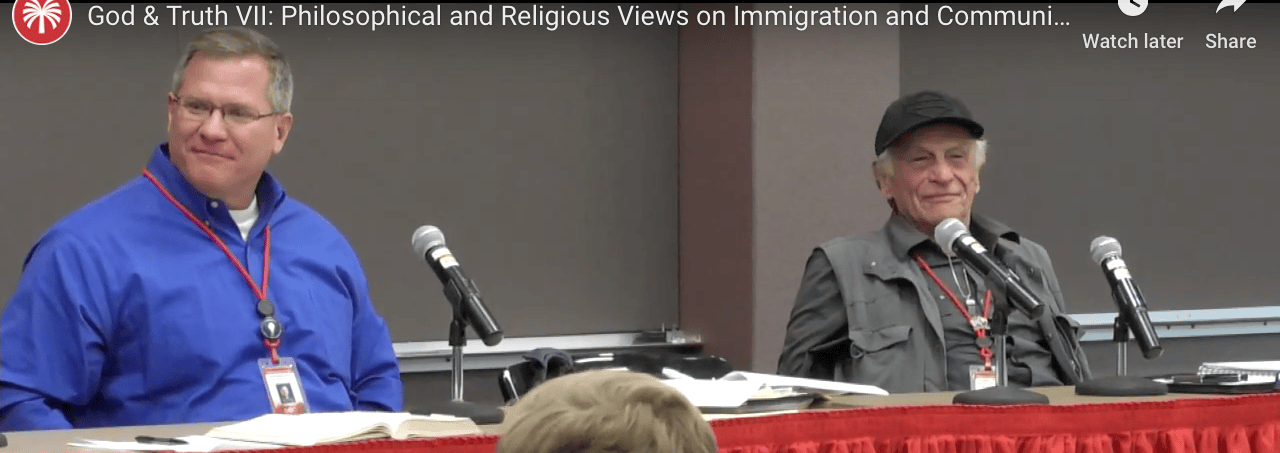
Peter and I on a panel discussion in 2019
Over the years the GCC Philosophy Club has had many students participate in its activities. Every Friday at 1 pm we can be found outside the LA building under the “Tree of Knowledge” discussing, debating, laughing, and, just in general, having a good time. We even have doughnuts occasionally. There is an exciting energy in having 6-12 students and faculty engaged in topics of keen importance (and some which are frivolous but fun). Our end of the semester meals at a local restaurant are memorable. There’s nothing like experiencing a student committed to communism have to courageously defend his views over a plate of gyros and fries!
One measure of the power of this community is how many students who have graduated from GCC continue to come back and join our discussions. During the peak time of Covid when we were meeting virtually, we sometimes had more former students joining us for our Zoom calls than current students. Personally, I have made friendships with students that have continued beyond their time at GCC. I know students pursuing degrees in philosophy who are now at ASU and U of A, and we continue to stay in contact, trading articles back-and-forth and catching a lunch together when we can. In fact, last summer I met with a group of former GCC students every Friday for lunch at our favorite pizza place—well, it was my favorite. We would discuss philosophy articles and current events. And, of course, all of this was punctuated by tons of laughter, Pepsi and pizza.
Community… the word speaks of the safety and the goodness of friendship. To find it is to find something precious. I’m thankful of the places where everybody knows my name (and I theirs) and they are glad to include me in their number.
[Note: I’m going to be making some broad generalizations here, but I’m not unaware there is a wide range of differences within the groups as well as outright exceptions.]
From mid-2018 until a few months ago, I was almost completely disconnected from what had been my essential online education & open teaching and learning & educational technology community for more than a decade. What started as a positive, intentional break when I left my job in Alaska became a slog through deep depression, my mother’s death by suicide, prolonged ECT treatment, the pandemic, and continuous family issues that ultimately precluded even making personal connections with those I was closest to.
Most of those issues remain in some way, but I’ve managed to re-establish some connections and make a tentative re-entry into that world behind the scenes and—beginning with posts like this—out in the open too.
It’s not the same. Some voices of my personal community remain as active and strong as ever, if not even better. But a significant majority have retreated, become more withdrawn, or left the public arena (if not the profession) completely.
What happened? Whence my unease? Is it an inevitable fact of aging, both my own and the community generally? Is it just me? Why does it, in this particular area, just feel both different and, in a way I can’t quite pin down, wrong?
I’ve been considering these questions through the lens of Gardner Campbell’s famous (in my circles anyway) “Bags of Gold” analogy, where he—and I! Way back in 2009!—felt that the explosive growth of technologies and platforms paired with experimental pedagogical approaches created the conditions of a possibly amazing educational future. We knew there were those who couldn’t care less, even outright skeptics—that was what made the analogy funny and powerful—but my assumption, as cynical as I could be, was that the obvious availability of riches would overwhelm most educator’s doubts.
But here I am, looking around at veritable mountains of gold that not only remain undisturbed, but for many seem to have disappeared beyond the broad horizons bounding a flatland of ephemerality characterized by relentless consumerism, individual rootlessness, and a weird kind of collective amnesia…all yoked firmly to what Langdon Winner called “technological somnambulism.”
Educational technology has changed, with the LMS becoming even more entrenched and totalizing—mimicking the same dynamics in the larger connected worlds of social and consumer platforms—but I’d argue that’s more effect than cause.
And students’ use and expectations of technology, like almost everyone’s, have followed the same contours of big tech and the web in general, reifying in technological spaces—particularly the loops of social software and the whorls of short-form media—a gossamer of weak ties, discussions that are more serial than exchanges, and debates consisting mostly of successive tribal screams.
Still, that doesn’t explain my malaise—angst, disquiet, lassitude, whatever it is—or that of others I know are similarly troubled (and sometimes tormented). After all, the wealth of possibilities available to teachers and learning designers has never stopped growing, even as individual apps and services have come and gone. Micro-communities are flourishing like never before. And my job, intentionally chosen (and fortuitously given subsequent events in my personal life), provides plenty of freedom to dig deep.
Like I said, I can’t quite put my finger on it.
Or maybe all of this has been so much prattle (apologies if you’ve made it this far; you are a warrior) and an explanation can be assembled from simpler, more personal stuff: I’m older, wearier, still haunted by depression, and saddled with a brain that—in addition to normal decline—doesn’t work the way it used to after so much electricity has been shot through it.
Finally, I face a challenge I know others are squaring off with: convincing teachers that any of this is worth their time and effort to authentically consider, much less explore with their students (and the constant, low-level resentment that I have to spend my time enticing them to become better teachers rather than facing an overwhelming rush of those who want it for themselves). That will be the topic of my next 6×6 post, which I promise will be more positive than this one!
Giving up the life of the road (or the airplane) is partly how I ended up at GCC. I’ve been a long-time traveler. Although I was born in Arizona where my father finished his structural engineering degree at the University of Arizona, my parents and I moved within eight months to Minnesota. A few years later we moved to Colorado. I lived in so many different places in Colorado, depending on the university I was attending or the degree I was seeking in Denver and Boulder, that my mother finally started using pencil to update my address in her address book. My roots are scattered because of this constant moving.
Two years before we moved to Arizona, my husband, son, and I went to Estonia for a year while I taught as a Senior Fulbright Scholar at the Academy of Music and Theater in Tallinn. Everyone told us it was not the “going on” a Fulbright that would be hard, but “returning from” our year away. They were right. We had changed and the only way to live with that change was to change our surroundings. We moved.
My husband, son, and I had been living in Arizona for about a year, and I’d spent most of that year working and traveling as a Composer or Producer-in-Residence back and forth to Minnesota, as well as to Rome, Beijing, Toronto, Milwaukee, Pittsburgh, Atlanta – well you get the idea. My long travels ended when I came home and was greeted by my nine-year-old son, who was just waking up, when he said, “Mommy, are you really here or am I just dreaming?” Ach! It was a knife in my heart! He had never mentioned that he missed me and certainly not this much! I decided if I did travel it would only be for short trips and only occasionally from then on.
Before you ask, “What kind of a mother are you?” you need to know that my son is autistic and has always been very accepting of me going away; with a kind of “bye, see ya” sort of attitude. He loves to be alone, and it’s difficult, sometimes, to accept that. To give you an example, my husband and I went on a business trip back in 2018 (yes, he’s a musician, too), and left our son at home with the dog (by this time he had graduated from high school with honors and was capable of being alone – but it was an experiment because we would be further away – so we had support people at the ready if he needed someone). When we returned my husband kept coming back in from the garage before he left for work to make sure our son was okay with him leaving, and asked him so, and our son, who has a great sense of humor, said, “Less talking, more leaving!” From that response, although ten years later, we knew he didn’t miss us that much while we’d been gone.
Jumping back ten years, I applied to teach at GCC. The first word I think of when I remember my first days at GCC is “friendly.” I found everyone friendly and helpful. The two communities that first welcomed me were the Music Department (aka Performing Arts) and CTLE.
Before this, I’d been teaching for twelve years, after my doctorate, at two private institutions (three, if you count my alma mater – which is public) in Minnesota, so I knew my way around lots of subjects, but I knew there was a program called Blackboard, among others, but no one would teach me about it. Over the years, I had also been offered five full-time positions in Minnesota, strictly a phone call – “we’d love to have you come work for us,” but my health was not good when I was offered a few of them, and the other, which I would have loved to take, was offered just as I was receiving my Fulbright. I couldn’t take the job knowing I wouldn’t be there that next year. Also, and you’ve heard this from others if you haven’t said it yourself, the winters were about eight months long and I just couldn’t take that kind of cold anymore. I was looking to take my roots somewhere warmer although I had not planned it to be this warm.
The Music Faculty shared their syllabi, what needed to be in a syllabi technically, how to find my courses, and helped me get up to speed within a few days! I hardly knew what had hit me, but I really enjoyed the people I met. They have become friends and some of the best people I’ve worked with. I’ve missed seeing them during the pandemic at meetings and performances. We recently met in person for the first time in two years and my heart sang for hours afterwards, having been able to see so many friends again. It is truly an anomaly to have this many good people together in one department – and that includes the whole Performing Arts Department as well.
I discovered the other GCC community shortly after I started when I signed up to learn how to teach online. No one had asked me to learn this, but I saw this as a possible future — need I say more? That introduced me to Karen Russo and CTLE. For several years I took everything that CTLE offered, free seminars on teaching and best practices, free offerings on other online programs for use in online courses, district workshops, designing courses for E-readers, and master classes on being a better educator. I’ve gotten to know almost everyone in the department, and I’ve met other equally friendly and helpful educators as the department expanded.
I now have been teaching exclusively online for a little more than 10 years, and love it. I still take a workshop here or there, although mostly on Zoom or Google lately. CTLE has patiently answered questions and solved problems for me. I have learned more from them about successful teaching than I had ever known and I am thankful for it. I applaud CTLE for what they have offered through the years so I could become a better teacher of music. The Music Department and CTLE has allowed me to put down some strong roots in this community.
The Great Wall of China with the International Alliance for Women in Music 2008
It has been nearly thirty-five years since I took my first philosophy class here at GCC! I was fresh out of high school (go Deer Valley Sky Hawks!) and was excited to pursue a path studying philosophy with the hopes of eventually teaching in the discipline. (As an aside, my very first philosophy class was with longtime GCC professor Bob Hubbard who recently passed away.) Now, being able to teach our students in the Introduction to Philosophy class (PHI 101) that I took so many years ago is amazing! I find there are some direct continuities between the concepts I learned over three decades ago and the ones I teach today in my classes.
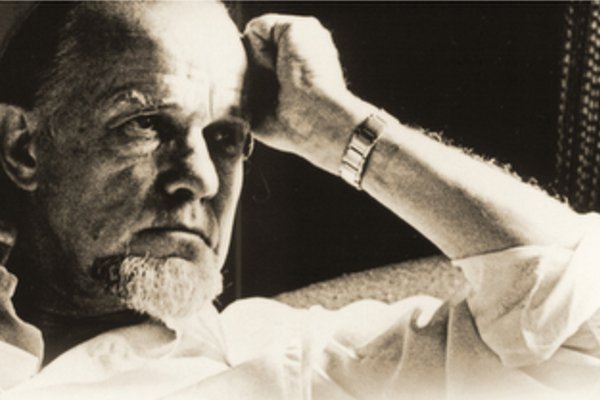
In my last year of high school, I was exposed to the thought of Francis Schaeffer. As a thinker he taught me to consider the concept of an integrated worldview. A picture of Schaeffer hangs in my office as a tribute to his role as a doorman to the larger world of ideas.
Around this time, I also read James Sire’s book The Universe Next Door: A Basic Worldview Catalog which further encouraged my approach to philosophy in terms of comparing and contrasting various worldviews. It is this worldview approach that has set the trajectory for my thinking and teaching. I recently participated in the GCC library’s “suggest-a-book” promotion, and I suggested Sire’s The Universe Next Door (now in the sixth edition).
During the first week of class, I explain the concept of a worldview using a worldview triangle where each point is marked by the one of the key worldview elements: Metaphysics, Epistemology, and Ethics. I also have them consider the eight worldview questions utilized by Sire:
i. What is prime reality—the really real?
ii. What is the nature of external reality, that is, the world around us?
iii. What is a human being?
iv. What happens to a person at death?
v. Why is it possible to know anything at all?
vi. How do we know what is right and wrong?
vii. What is the meaning of human history?
viii. What personal, life-orienting core commitments are consistent with this worldview?
I want students to come away from my philosophy class seeing not only the depth and breadth of great thinkers and their ideas but also the very real practicality of how a worldview functions in their lives and our culture. In order to reinforce this, I write two things on the board every class period. One is the worldview triangle, and the other is the statement, “Ideas have consequences, some bad ideas have victims!” This is to remind the students that the study of philosophy is not about the arcane or irrelevant (okay… some of it is!) but, rather, about ideas that move cultures and societies. In order to show how this is the case I use the essay by Ashley Fernandes “Why Did So Many Doctors Become Nazis?”
Fernandes notes how doctors and nurses joined the Nazi party in Germany in greater numbers than other professions. She writes:
“It is worthy of emphasis that although many professions (including law) were “taken in” by Nazi philosophy, doctors and nurses had a peculiarly strong attraction to it. Robert N. Proctor (1988) notes that physicians joined the Nazi party in droves (nearly 50% by 1945), much higher than any other profession. Physicians were seven times more likely to join the SS than other employed German males. Nurses were also major collaborators. The Holocaust should be studied by every health care professional as a reminder of how sacred the substance of our craft is, and what the consequences may be if we forget the dignity of persons again.”
Fernandes shows how good people in a discipline committed to healthcare could become attracted to bad ideas and subsequently lend their hand to evil atrocities. I read large sections of this essay to the students in my classes to show the very real-world effects that bad ideas can have when they take root in a culture.
Throughout the semester I continue to stress this dynamic of philosophical ideas and how they come to expression in our own culture. At times the students can think that studying Plato and Aristotle can seem out of touch with their lives. One way I attempt to show the ongoing relevance is that these ancient thinkers’ ideas continue to pulsate through our culture—either as ideas to follow or to overthrow. I try to demonstrate that beneath all the culture war battles that take place in our time there are underlying philosophical ideas at play. Many times, we simply stay on the surface of cantankerous disagreement that often degenerates in shouting matches. But beneath all these cultural hot spots there is first a philosophical disagreement. Understanding the philosophical categories may help them navigate these cultural debates in a more reasoned manner.
I love philosophy and teaching philosophy. The ideas that ignited in me a passion to think and articulate an integrated worldview continue to motivate me to see others grasp the beauty and rationality of clear thinking. If in some small way I can contribute to the opening of minds to larger vistas of thinking and reasoning, then I can count my endeavors a success.
Because my current work now is centered in open education, and coming off of Open Education Week, I was swimming much in conversations, workshops about Open Pedagogy (often as acronym OEP).
I am not here to offer Yet Another Definition (check one of the best resources). I welcome this as moving beyond Open Education as “stuff” (courses, resources, textbooks) but the practice of teaching.
I am here to state that it’s hardly new. It did not come about with the internet or from Pressbooks. And if you speak with more primary school teachers (like a podcast I did with two of them recently, check it out), the practices of inquiry-based learning that is novel in higher education is every day stuff for elementary level teachers.
Comments in some sessions were emphasizing the benefits of students as teachers and also contributing to publications is key practices.
My memories fired off in realizing I had experienced these as a student… in the 1980s. And I am confident you can find examples done, forgotten that go much further back.
This is no criticism of what people are discovering now. It is more an awareness of rather innovative practices I experienced in my education. If they had buzzwords for what they were doing, we did not hear of them.
I Have to Teach WHAT to My Fellow Math Students? (1980)
Let’s hop in the time machine to maybe, 1980, in my 10th grade math (or maybe it was Geometry) class at Milford Mill High School in Baltimore. I had a young, young teacher (he had pimples), maybe it was his first or second year teaching, blessed with the probably unfortunate name of “Mr Pitz.” To a math nerd he was anything but “the pits.”
I believe he recognized me and maybe three other kids were well ahead of the class in understanding. One day Mr. Pitz pulled us aside to give us a special project to work on while he taught the rest of the class. We had to research, learn ourselves, and teach to him and the rest of the class a topic that maybe still bends my mind.
The geometry we are all taught is Euclidean, based on what we learn that parallel lines never intersect. You know, two points make a line and it goes forever off the edge of your paper to the end of the universe. Non-Euclidean Geometry is based on that not being true, that parallel lines can intersect.
The place where maybe it makes sense is thinking about lines on a sphere, like longitude.
It hurts the head, right? Especially 10th grade ones. I cannot remember the specific assignment, but we had a few weeks to learn enough of this, including some proofs and equations, to teach a class on it. I am not sure what resources we had to work with (no one had heard of the internet), probably some books Mr Pitz provided and whatever else we could find in our library.
Having a Wikipedia article helps! The importance of this alternative geometry is a lot about changing the way we understand knowledge, and gets into philosophy:
The discovery of the non-Euclidean geometries had a ripple effect which went far beyond the boundaries of mathematics and science. The philosopher Immanuel Kant‘s treatment of human knowledge had a special role for geometry. It was his prime example of synthetic a priori knowledge; not derived from the senses nor deduced through logic — our knowledge of space was a truth that we were born with….
Non-Euclidean geometry is an example of a scientific revolution in the history of science, in which mathematicians and scientists changed the way they viewed their subjects. Some geometers called Lobachevsky the “Copernicus of Geometry” due to the revolutionary character of his work.
I remember less about this topic than this unexpected way which class was done. Given a challenge like this fed some young minds which might have been bored in math class.
Kudos to you Mr Pitz, not only this, but for 11th grade when you taught my first class in computer programming- where we got on busses to go to the school on the other side of town that had a VAX computer for processing our punch cards.
That experience alone was integral to where I am today.
Contributing to a Textbook (1984)
Perhaps the most commonly activity associated with Open Pedagogy is asking students to research and write chapters in an open textbook, almost always Pressbooks. I have no quarrels with this, and it was the podcast with University of Alberta student Nicole who cited this experience in a course with Verena Roberts, that propelled her into more acts of open education.
I experienced this myself as an undergraduate students in a Structural Geology course at the University of Maryland, circa 1984. I had just transferred there from another program and knew little about the program or faculty. Our professor was from outside the University- he worked for NASA a Goddard Space Flight Center.
As it turns out, he was thus unconventional. I had no idea how important Paul D. Lowman was as a scientist, he was just my professors. Only later do I discover he was one of the original scientists at Goddard, maybe the first geologist hired at NASA:
Lowman helped plan the early Apollo missions and later became involved in analyzing lunar samples and interpreting data from the Apollo 15 and Apollo 16 missions. He did early “comparative planetology,” researching what new information from the Moon and Mars could tell us about Earth. He is considered to be the father of Earth orbital photography which led to multispectral imaging of Earth and Landsat satellite imagery.
Structural Geology is about faults, and folds, and landforms that shape the earth we see and walk around on. He spoke early about using satellites to see from far above the earth the landforms we were studying. Later Dr Lowman introduced a project (without mention of Open Pedagogy) where were each given a photo of a Landsat satellite image of a key structural geology feature, with a name and location. Our task was to use the LIbrary to research as much background geology we could discover. Our research would be used to write a summary of the image in a book that would be published.
I don’t have my paper, and I likely did not keep the photo image (maybe we had to return) but I can always remember that I was assigned the Pine Mountain Thrust, demonstrating the classic Valley and Ridge geology of the Appalachian mountains. It’s down there in the junction of Kentucky, Tennessee, and Virginia.
I cannot say much about how much of my writing made it into the final version, but I have a copy of the very book it was published in, Geomorphology From Space.
How many words there were mine? I cannot even guess as I tossed most of my assignments (hah, does that make this a disposable non-disposable assignment?). Inside the book is a letter to me from the primary author, Nicholas Short:
The letter dated March 19, 1987, aka 35 years ago, reads:
Dear Mr Levine
Three years after your participation in the Landsat Tectonic Project in Dr. Lowman’s Structural Geology class, the book that may have used your contributions has at last been published. As I promised then, I am pleased to send you this complimentary copy of the NASA Book, Geomorphology From Space, in recognition of this contribution (see page 707).
Sincerely, Nicholas Short
There’s my proof… well actually is there on page 707 (bottom of appendix in online version, in the photo below I blurred other student names for privacy sake).
The following students in the Spring 1984 class in Structural Geology (Geol. 341) at the University of Maryland-College Park (Paul D. Lowman, Jr., Instructor) are gratefully acknowledged for their assistance in researching background material for many of the Plates comprising the Tectonic Landforms Chapter:
So this may not strictly be “Open Pedagogy” as the published book is not openly licensed (name the licenses available in 1984?) and also it was not exactly like writing a whole chapter, I contributed some research notes that likely the expert authors knew.
But that is not the point. Dr. Lowman had, from who knows where, created a project that was not just an assignment, but some real research that was a contribution for a larger work. The effect on me as a student is immeasurable- this is the only thing I remember from not only this one class, but all the classes I took that semester.
So What?
I am not writing this to make some early claim about open pedagogy. It more affirms that I experienced not only these two, but many experiences of effective pedagogy as a student (heck I never knew it was a word). That is what great teachers, memorable ones, have always done.
Or it is just as likely, for me in my second Write 6×6 post, that I am just using it as an excuse to do some Alan-based storytelling from the Proto-Archaic Pre-Internet Era.
I am the youngest of four children. Therefore, it was my birthright to become a clown, the fun one, a good kind of “player.” Instead, I became a teacher. And, for me, this role brought all the attendant expectations: long days, not-a-few sleepless nights, regular coffee-fueled thrusts towards pedagogical glory.
So, it should come as no surprise that when I see a week of spring break sprawled out in front of me, I start to calculate how much I can accomplish in order to get caught up at work (as if such an elusive state actually exists). But then, that baby-in-the-family in me reaches out from the deep recesses to wave her tiny finger and say, “Not so fast, Missy!”
As a psychologist, I know the importance of play. But, I constantly have to remind myself that all work and no play actually makes Dr. Duggan a tightly-wound shell of a human. Not exactly what I’m going for in life.
Before we went on break, I asked my Health Psychology students about what they do for play. One of them immediately popped up with, “Define play!” (I love these people!) According to Merriam-Webster, to play is to “engage in activity for enjoyment and recreation rather than a serious or practical purpose.”
It turns out, students and teachers alike can get caught up into cycles of overwork. Our talk about play in class quickly morphed into a discussion of “Who the hell has time?” However, one of my students mentioned giving and getting tattoos as a form of recreation. Another student said playing with her dog is her go-to for enjoyment. The conversation moved into other forms of play, such as watching TV, playing video games, and hanging out with friends.
My students inspire me, and so far my break is off to a good start. Yesterday I jogged around the park with my friends and went out for a nice breakfast after. Today, I read (for pleasure) and got a foot massage. And then there’s my daily Wordle and even more-fun Nerdle. I will do some schoolwork this week, of my choosing and on my schedule, because that feels good, too.
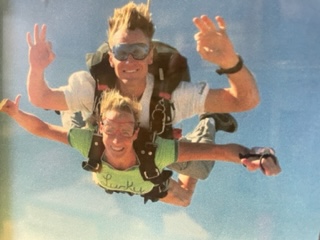
Me and my favorite playmates
As teachers with a seasonal schedule that includes breaks every few months, it’s easy to fall into the trap of “I’ll relax once (X).” But, “X” is always replaced with another “X.” We stretch ourselves tight with overwork during the semester because relief seems just around the corner on the calendar.
But as I’ve experienced, that rubber band of overwork springs back hard. As a result of the snap-back, the break I dreamed of could easily amount to curling up on the couch in a ball of protection, dreading the return to work. Again, not what I’m going for.
Investing time in play throughout the school year (and not just on breaks) is a goal for this serious teacher. I’m always looking for ideas – What do you do for play?
“So often, when we feel lost, adrift in our lives, our first instinct is to look out into the distance to find the nearest shore. But that shore, that solid ground, is within us. The anchor we are searching for is connection, and it is internal.”
Human connection defines the heart of my work in higher education. The GCC Library contains endless opportunities for meaningful connections, both with humans and books. Of course, our library offers more connections to information than just books on the shelf. But for me, a real book in my hands is the ultimate connection with ideas, content, and higher learning. Brene Brown is one of my favorite researchers. Check out her latest book, podcast, or TED Talks. Atlas of the Heart gives us an opportunity to learn a new language of deeper human connection.
Have you ever been asked to do something you were incapable of doing, for the good of the institution and the students?
My first teaching opportunity outside of my graduate assistantship terrified the living daylights out of me. I was hired as the assistant wellness director at a community college in Kansas. A few days into my new role, I was told I would be teaching aerobics as part of my job, so I needed to get certified ASAP!
Cue “fight or flight response,” dilated pupils, rapid heart rate, dry mouth and sudden demand for oxygen. I was no Jane Fonda! I had zero prior practice in any type of dance movement or ability to move to music in a rhythmical fashion, and actually have two left feet!
Much training took place and I passed the certification test. Fast forward to the first day of class. Ten eager students stood in front of me, all decked out in brightly colored 1990’s spandex and high top tennis shoes. There might have even been a few headbands. They were ready to get their sweaty groove on and earn their fitness grade.
The basketball gym looked 100 miles wide and a million miles long. My eyes dilated and the bright lights looked like an alien spaceship landing behind my row of students. I was the alien. It was like an out-of planet experience. My heart was pounding and I have never felt such terror!
I started the music and began with the basic moves, creating a sequence and then repeating. I began to calm down and was encouraged by the smiles of freedom and movement on the students’ faces. I had taken my first big leap in my new career and despite the weeks of sleepless nights, I had done it! I had faced my fear with a pounding heart and was now challenged to take more risks.
Don’t get me wrong. I am not a risk taker. But I have discovered through my 30 years of teaching, that if I want to get to the heart of the matter, I have to take some risks, challenge myself, and feel some fear and pain. I generally come out on the other side with a new vantage point and a new love for doing what I do every day.
What risks are you taking to spark your love of teaching? What choices are you making that are outside of your norm? What conversations do you have with yourself and your colleagues about what could be better? Get to the heart of the matter and see what is possible!